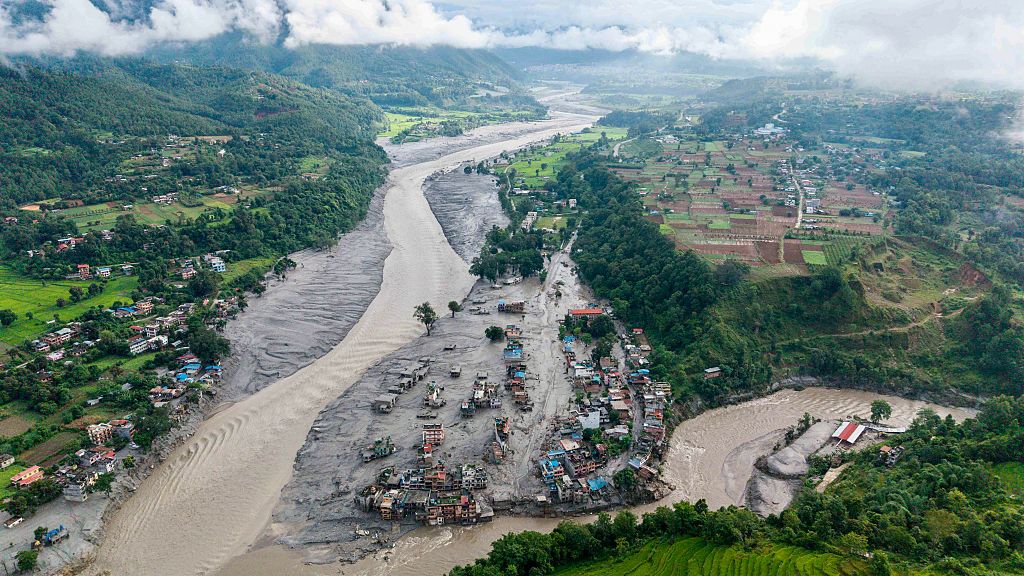
When I first heard the news that the Rasuwa region in Nepal had been seriously flooded, I barely paid attention. Floods are nothing new in Nepal, particularly during the monsoon, which lasts from early June to late September. Every year brings landslides, swollen rivers and washed-out roads. We have sadly learnt to live with them.
But then I opened my social media feed.
What I saw stopped me in my tracks. Walls of water, mud and rock tore through the Himalayan valley, gulping up trucks, buildings, bridges, roads and hydropower stations. People ran for their lives as an entire landscape disappeared beneath the torrent. The scale of the destruction was almost impossible to comprehend.
. Walls of water, mud and rock tore through the Himalayan valley, gulping up trucks, buildings, bridges, roads and hydropower stations
My phone immediately started ringing with media requests, including from this magazine. I sat down at my computer and found myself unable to write a word. I was too shocked. Where would this disaster end? How many people were still trapped? How many would be found alive?
We still do not know the answers. But we do know that Nepal has been battered once again. At the time of writing, 626 bodies have been recovered, and more than 2,400 people remain unaccounted for. The numbers are likely to skyrocket.
My initial indifference made me feel almost ashamed. But I was not alone. My flatmate in Kathmandu sent me a message: ‘I am scared of being desensitised to such news. The floods last year looked big and now, it’s even bigger. I have been hearing news of floods since childhood.’
But what exactly happened at 8.37 a.m. on 26 August?
An initial assessment by geologists and glaciologists suggests that the disaster began with the collapse of a huge section of glacier on the 7,227-metre-high Langtang Lirung. The mass of ice and rock crashed more than 2,000 metres down the mountainside and triggered a massive debris flow that swept into the river system below. Within minutes, what had begun high in the mountains had become a raging torrent of water, ice, rock and mud racing downstream.

The immediate priority is rescue. Nepali soldiers, police and volunteers are working round the clock to evacuate survivors and reach communities cut off by the destruction. Helicopters are desperately needed, but the monsoon rains make flying difficult. Electricity and communications have been knocked out in places as several hydropower stations were washed away. Something as mundane as a power bank has suddenly become a precious commodity.
There is another grim task ahead: recovering the dead. Bodies have been carried downstream in the Trishuli and Bhote Koshi rivers, some reportedly as far as India.
Apart from the residents, there were also many tourists in this remote corner of the Himalayas. But why, given that it is still too early for trekking because of the monsoon? The answer is Mount Kailash. Hundreds of Hindu and Buddhist pilgrims were making their way towards Tibet to visit the holy mountain where a pilgrimage in 2026 is particularly significant: it marks the Fire Horse year, an auspicious combination that occurs only once every sixty years. It was meant to be a year of good fortune. Instead, it has brought devastation.
Amid all this devastation, Nepal deserves credit for its response. The government has taken charge of the rescue operation rather than allowing foreign teams to arrive and potentially complicate coordination, which is a very different approach from the chaos that followed the 2015 earthquake. Nepal has so far declined foreign rescue teams but asked for technical assistance and financial support to be channelled through the Prime Minister’s Disaster Relief Fund. Having seen how the newly elected government has handled the crisis so far, I would have no hesitation in donating through it.
But once the rescuers and TV cameras have gone home, Nepal will have to confront a more uncomfortable question.
Could some of the destruction have been avoided?
Nobody could have stopped this huge mass of ice and rock collapsing from a Himalayan mountain. The event happened extraordinarily quickly. But the flood did not find an empty valley. It found houses, hotels, roads, bridges and hydropower projects increasingly built close to rivers.
Nepal has undergone massive urbanisation in recent decades. Roads have been pushed deeper into mountains, riverbanks built up and settlements expanded into places once left to the river. This makes sense. People need homes, electricity, roads and jobs. But rivers have memories. They may appear harmless for years before reclaiming the space that was once theirs.
There will be a time for rebuilding. But rebuilding exactly where everything stood before would be wrong.
Some homes will have to move. Some hydropower projects will need to be reconsidered. Early-warning systems will have to improve, and urban planning will have to become stricter.
Nepal will recover, as it always has. But it will be a long road, and this time recovery must mean more than rebuilding what the water destroyed. It must mean rethinking where and how we build in the mountains.




Comments