
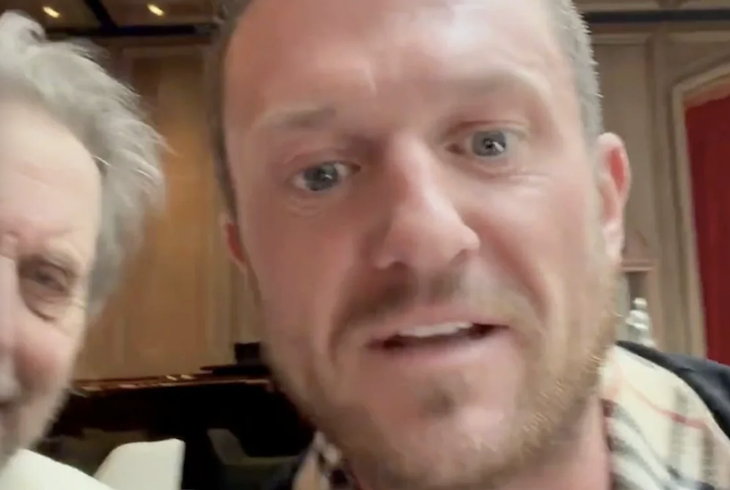
Everyone who is everyone – within a certain political and social fragment – has been in Russia this past week. Conservative American conspiracy theorist Candace Owens; Errol Musk, father of Elon; toxic “manosphere” influencers Andrew and Tristan Tate; and Tommy Robinson, the far-right activist.
Robinson told the Guardian that he had traveled to Moscow “to see how this country got itself so well on to the straight and narrow and see the beauty of a civilized society here.” In the process, he was walking a well-trodden path of westerners heading to Russia to see exactly what they want to see. Once it was socialists like Sidney and Beatrice Webb, who found Stalin’s regime “the very opposite of a dictatorship.” In the 1990s, free-marketeers hailed the plunder of Russia as the apotheosis of liberal capitalism. These days, it is conservatives rhapsodizing about Putin’s Russia being the antidote to degenerate western wokeness.
These days, it is conservatives rhapsodizing about Putin’s Russia being the antidote to degenerate western wokeness
Of course, it is easy to accuse them of being taken in by Kremlin propaganda, and not seeing the “real Russia.” Yes, but only so far. Those advancing this argument tend to suggest that, outside the privileged environs of Moscow and St Petersburg, Russia is some backward hellscape. This is no more accurate than assuming everywhere in the country is as advanced and manicured as Moscow, and often rests on many assumptions and little real knowledge of that “real Russia.”
Just to take one specific example, one of the statistics critics delight in retailing is that a quarter of Russian homes lack indoor toilets. This is inaccurate and misleading. It is a 14-year-old factoid tha counts dachas, the country cottages so many Russians also own. These are indeed often well off the beaten track and without indoor toilets, but these are not people’s first homes. Furthermore, in rural areas in the high north of the country, where underground pipes would freeze solid in winter, villagers may rely on outhouses or dry toilets. Who needs such tedious caveats, though, when you want to present that “real Russia” as a land of misery and want?
To be sure, Murmansk in the far north and Maikop in the south are not Moscow, and there is a clear difference in the level of public services on offer. Then again, West Virginia is not Park Avenue, and Russia’s income inequality as measured by Gini coefficient is only slightly higher than the UK’s.
The point is not whether or not Russia impresses ideologically-predisposed visitors, from Tucker Carlson (who considered himself “radicalized” by the cheapness and quality of the groceries) to Candace Owens (who praised the “clean, beautiful, and family-friendly” streets).
It is, rather, that Russia has become something of a Rorschach Inkblot Test: what you see says more about who you are and what you expect to find.
For those who want to see a neo-fascist imperial Sparta, in which brain-washed “orcs” bay for genocide, they can find the toxic TV shock jocks, the ambitious and unprincipled academics, the unhinged online “z-bloggers” they need to justify their assumptions.
Conversely, those who want to find a clean, socially conservative, Christian refuge from all things woke – like Robinson and Owens – can overlook the large Muslim population, the high levels of divorce (more than double the UK’s), and the relatively liberal values held by so many Russians.
The real Russia is, of course, all of these things at once, and more. It is an authoritarian mobilization state in which citizens, unable safely to challenge the Kremlin directly, still undermine it with subversive humor and simply treat it with weary contempt. It has an economy in stagnation with an inflation rate double the UK’s, yet its national debt is under 20 per cent of GDP, while the UK’s is more than 100 per cent. It’s complex.
The trouble is that this complexity, this nuance, suits nobody. The Kremlin appreciates its own protean ambiguity, allowing itself to appeal at once to right-wingers like Robinson and paleo-leftists, who perversely still regard this neoliberal’s paradise, in which unions are toothless and taxes are low, as some kind of ideological descendant of the USSR. In the Global North, it can talk – at least, before its invasion of white, Christian Ukraine – of a common front against Islam and migration, while in the Global South, it presents itself as the anti-imperialist obstacle to American hegemony.
Meanwhile, the same western leaders who present Russia as some kind of failed state, the late John McCain’s “gas station masquerading as a country”, its economy and armed forces both on the verge of collapse, also present it as some kind of imminent threat to NATO, the most powerful military alliance in history.
Gullible influencers in Moscow, cynical fearmongers in the west: all of them seem to have their own private Russia of the mind.





Comments