
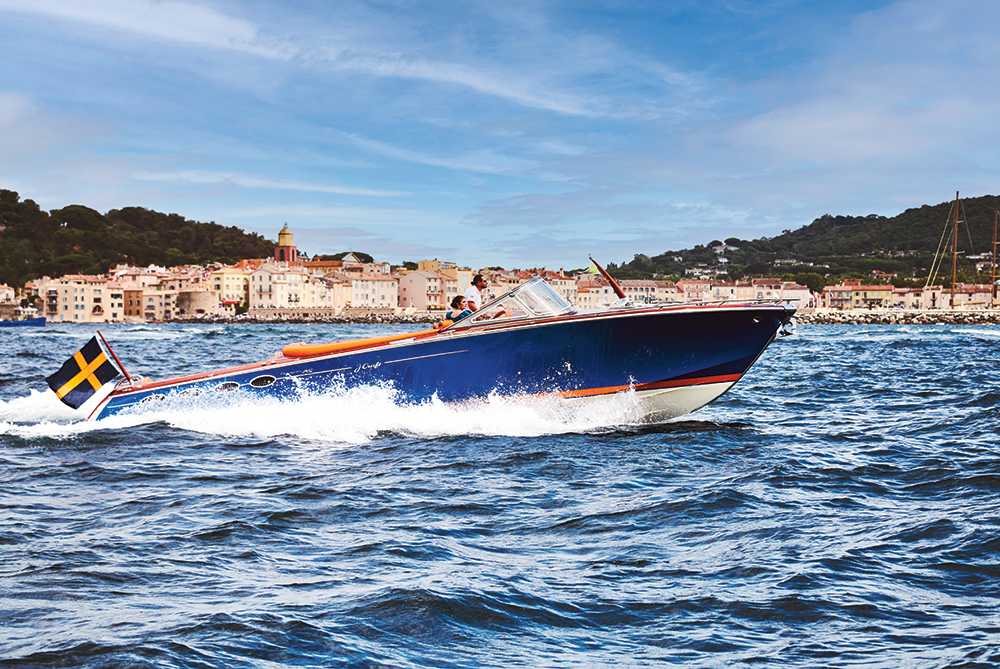
Every J Craft’s retro-style hull conceals ultramodern comforts and a setup fit for a tech-savvy Viking
If you are familiar with the Ship of Theseus paradox, you’ll know that dating back to the Greeks, the famous philosophical question is this: if a boat has all its components replaced, is it at the end still the same boat?
Every J Craft’s retro-style hull conceals ultramodern comforts and a setup fit for a tech-savvy Viking
In Sweden there is a near modern-day version of this taking place every year at the J Craft shipyard on the island of Gotland. It is not so much that the parts of boats are being systematically renewed – although J Craft owners do come for just such an upgrade periodically after several years of use – but that the craftsmen here are hand-building vessels, requiring over 8,000 manual hours each, that look like vintage craft but are packed with state-of-the-art tech.
The difference between a J Craft and other old-school-looking motor cruisers is that these 42-foot creations are designed and made to be seaworthy. Owner Radenko Milakovic, who purchased the firm from its founder, Björn Jansson in 2007, likes to say that these are boats imbued with the Viking spirit, by which he means they are designed to traverse real seas and cope with the sorts of conditions that those ancient Nordic explorers might have encountered as they roved far and wide in their longboats.
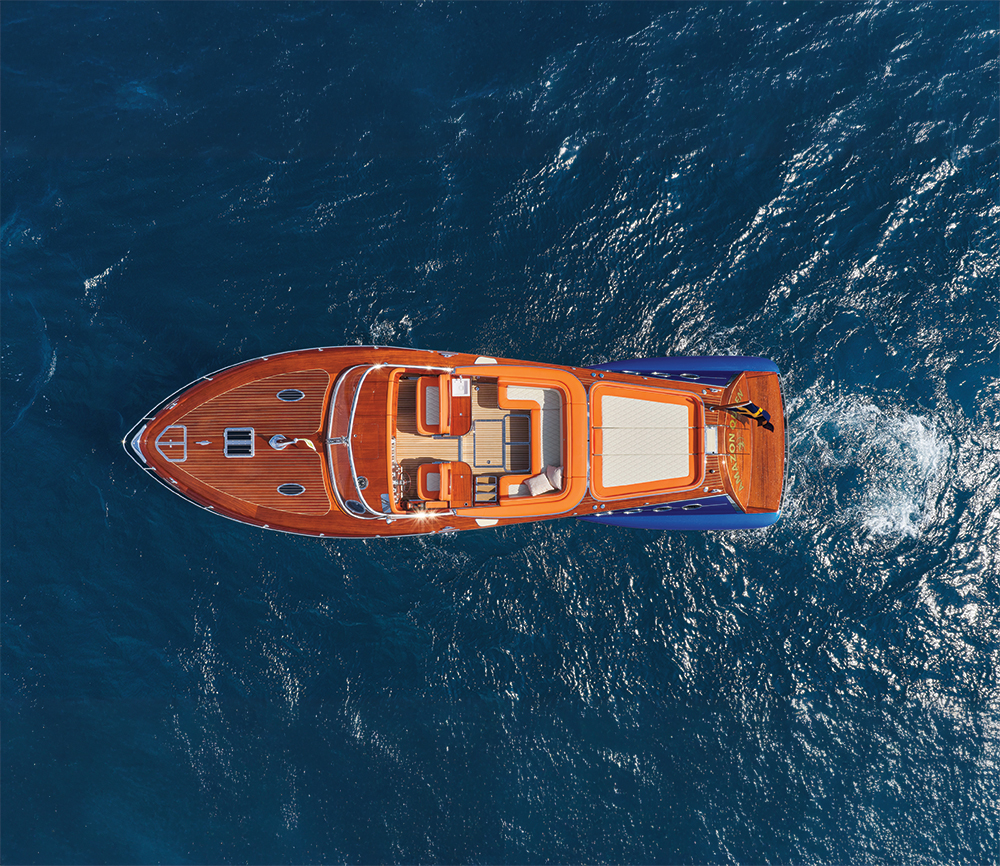
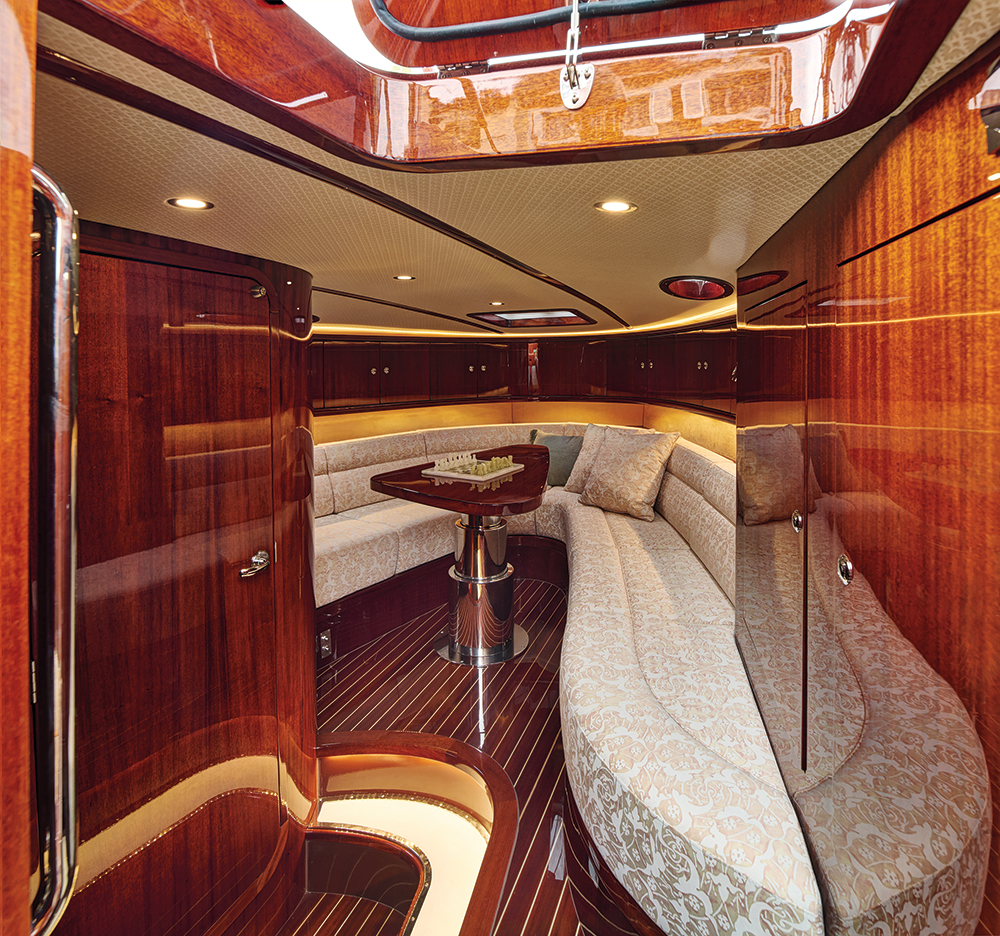
Capable of handling waves up to 14 feet, with a range of nearly 300 nautical miles, and achieving speeds of close to 50 knots (55mph), a J Craft Torpedo counterintuitively appears to be something that lends itself to idle summer days spent on a lake (though it’s well suited to that, too). The mahogany-clad, fully recyclable fiberglass hull and deck and luxurious upholstery (care of the likes of Hermès, Loro Piana, and most recently Venetian textile house Fortuny, which has upholstered a J Craft Torpedo in handmade fabric), rose polished stainless-steel dashboard complete with analog dials, and an original Ferrari 250 GTO wooden Nardi steering wheel all speak of aesthetic luxury. But this vessel is also certified for open sea voyages. Plus, it can sleep four in the cabin under the prow – up to six with the open cockpit closed.
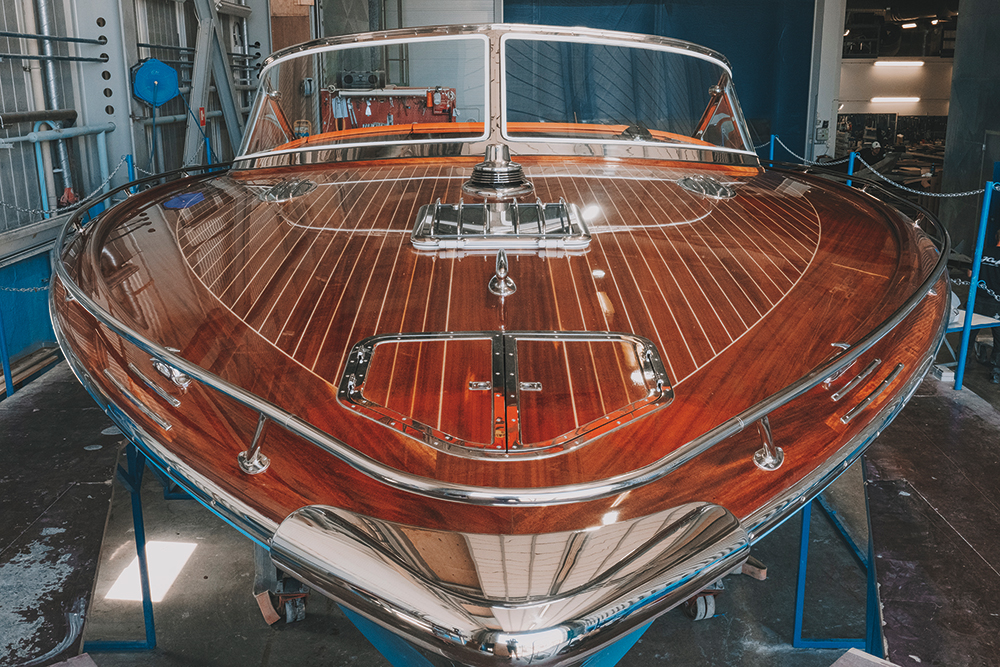
The tech is its superpower. For sure, when at rest the J Craft Torpedo looks like something out of the last century – around the early ’60s if you want to put a date on it. Mahogany decks glow under 20 coats of varnish. The hull’s hourglass curve recalls timeless mid-century Italian and American designs of the Dolce Vita era. Nothing about it signals modernity. There are no visible antennae, no screen walls. It looks analog by design.
However, beneath its classic skin, the Torpedo is a modern, software-driven platform, whose substance and architecture borrows more from modern aviation and naval systems and resilient computing than from leisure marine design.
Let’s, as they say, look at the science. The Torpedo is built around a Garmin-based digital backbone, fully integrated into Volvo Penta’s Glass Cockpit ecosystem. Every major function – propulsion, navigation, radar, AIS, stabilization, satellite-enabled station keeping, energy management, lighting, climate control, communications, entertainment, safety systems, and even a night vision camera – run through this unified and backed-up systems architecture.
But unlike most modern vessels, the Torpedo does not put this stuff on show. Interfaces are hidden. Screens rise from the dashboard when summoned, then disappear again. Displays and cameras are integrated into the hull rather than mounted on it. Critical data can be mirrored across multiple onboard screens, accessed on portable devices, or controlled remotely.
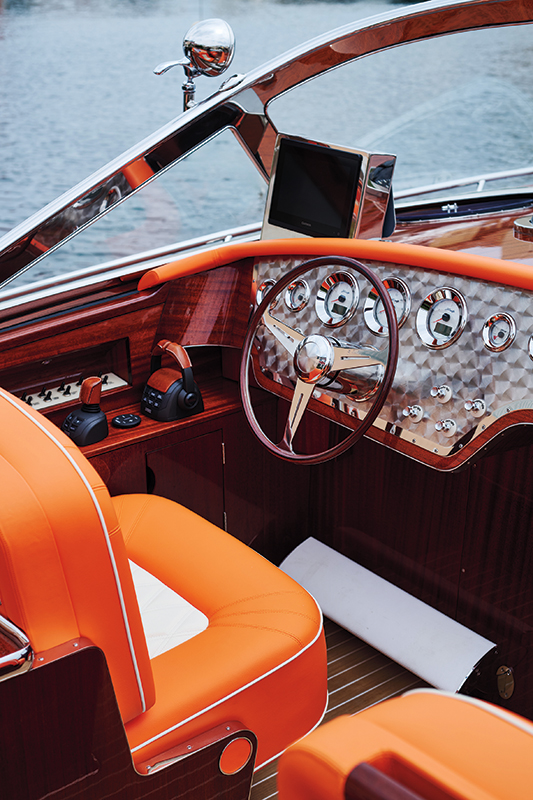
Perhaps the clearest expression of this philosophy is how the Torpedo allows the sailor to interact with it. Like something out of James Bond, using a Garmin Quatix watch, the boat can be steered directly from the wrist; systems can be adjusted and alerts acknowledged.
What’s important here is what all this high-tech stuff delivers: a sailing experience that is effortless and intuitive
Preparation begins before arrival. Routes, charts, and waypoints can be sent to the boat remotely. Systems can be powered up or down, regulated, or monitored while the vessel is unattended. By the time the owner steps aboard, the Torpedo is already awake and ready to go.
What’s important here, though, is what all this high-tech stuff delivers: a sailing experience that’s effortless, intuitive, and deeply relaxing. A J Craft owner stepping on board for the first time in the Hamptons or Palm Beach can be confident of being able to handle the Torpedo easily.
The Torpedo’s satellite-enabled station keeping, navigation system, modular radar, and hull-integrated Starlink antennae mean you’re always situationally aware. Its underwater hull is specially designed to work with Volvo Penta’s IPS propulsion system using pods with forward-facing propellers that turn in the direction of travel, allowing for extraordinary maneuverability and delivering approximately 30 percent better fuel efficiency. The steering wheel is a pleasure to handle, precise and responsive, and there’s a joystick so you can steer gently into your dock sideways. The Zipwake and Seakeeper gyroscopic stabilization systems guarantee smoothness whether anchored or underway.
Alfred Coyle, a former US Air Force F-15 fighter pilot and Torpedo owner, says that steering a J Craft is like flying a jet on the water. He describes how the boat manages forces acting on the body: “Where many modern boats remain flat in turns, throwing passengers sideways, the Torpedo banks, allowing forces to pass through the body rather than against it,” he explains. “So instead of lateral shock, you feel gently centered and pressed downward, even in tight, high-speed turns.”
The combination of this timeless design, handcrafted build, under-the-hood high-tech sophistication and bespoke nature is what makes a J Craft special. It also means that they are rare. These days, only two a year are built, and since the first, commissioned in 1999 for the King of Sweden, just 31 vessels have left the dock at the Gotland shipyard. Owners are therefore unlikely to bump into anyone with a similar ride any time soon, and will enjoy turning heads wherever they may – Viking-like – roam.
A J Craft Torpedo starts at just below $1.8 million; j-craftboats.com






Comments