
The casa grande could be an ancient chalet in the Austrian Tyrol. A steeply gabled roof to slough off the winter snow, dandelion-yellow paintwork, and inside a treasure trove of all an outdoorsman loves.
Antlers jostle for space on every wall. There is a tack room thick with the leathery tang of saddles, a bathroom with 1950s rifle magazines for idle reading, and everywhere photos of family, ancient and modern, often with a trophy – deer, vast mountain goat, or even puma.
But it is the array of polo cups that gives away the location. This is the deep Argentina of the early European pioneers, and Mamuil Malal lodge is the much-cherished home of the Grahn family, fourth-generation Swedish and German immigrants, whose reward for populating this remote corner of Northern Patagonia in the 1860s was an estancia so large it takes the best part of an hour to cross it in a Toyota Hilux.
It was here, at the bar in the floor polish and woodsmoke-smelling living room, that the Sundance Kid allegedly supped his bourbon while on the run from the Pinkerton agents. Today, it is one of several fishing lodges deployed by Fish Patagonia to the ever-growing number of anglers keen to try their luck on Argentina’s astonishing network of rivers that flow down from the Chilean Andes.
The land is veined by a green tracery of willows and poplars, guarding some of the greatest fishing waters in the world
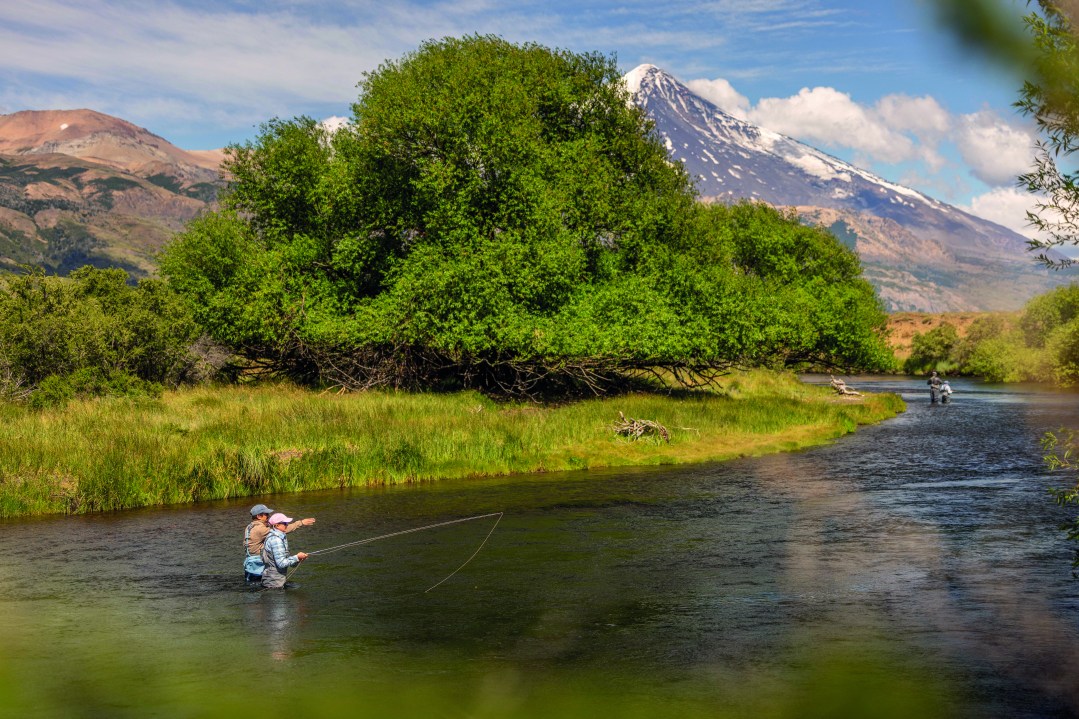
Across a largely desert landscape of vast canyons and arid mesetas, beneath the 3,700-meter Lanín volcano, the land is veined by a green tracery of willows and poplars, guarding some of the greatest fishing waters in the world. The rivers – the Collón Curá, Malleo, and Chimehuin, to name just three – are broad, blue, and crystal-clean, and the trout – brown, brook, rainbow – are canny, spooky, wild, and strong.
These are mostly “float” rivers, fished from a boat expertly rowed and guided by our hosts, the Treichel family. Their cheerful, bantering team delivers the angler to the riverbank, sets up a delicious picnic lunch a few miles downstream, and picks them up exhausted, but hopefully triumphant, on a pebble beach at the end of the day. There is wading, too, but a guide is a must for the newcomer to be taught the ways and locations of the fish.
A brilliant addendum to the Treichels – Peter, Kurt, Erika, and Juergen – is the linchpin organizer, Holly Conyers, a former Oxford law graduate, who stumbled across the town of San Martín de Los Andes as a horse-mad gap-year gaucho, then returned to complete the Gaucho Derby, a 500km endurance riding race. Of course, she won it. Now Peter’s other half, Holly won’t be going back to the London courts.
For our first two days on the Collón Curá, I was more absorbed by the fantastic birdlife than the fish. Black-faced ibises, turkey vultures, and flocks of parrots distracted me from the water, while my largely American fishing gang of six whooped and cursed as they cast to tricky prey, lurking in the shade under the banks. I caught a few – others, far more.
The third day we went to Tromen Lake in the Lanín National Park, a stunning body of water in a steeply wooded Andean mountain valley of quite astonishing drama: definitely the most beautiful lake I have seen in a longish life. On our way, we drove through the world’s only forest of monkey puzzle trees. They are unique to this region, their original home.
For non-fishers, there is plenty else to do. One day at the sumptuous Tipiliuke Lodge, Holly forced me out riding on a 16-hand horse, with Jorge, her taciturn gaucho mentor. Under the bright blue January skies of cowboy country, we ambled across fields alive with cattle, deer, hares, and armadillos.
I should recover soon.
Fish Patagonia offers bespoke fly fishing trips designed around its portfolio of 10 unique local partner lodges located in Northern Patagonia, Argentina. Horse riding can also form part of guests’ itineraries. Prices begin at $1,050 per night, per person. Inquiries to info@fishpatgonia.com; fishpatagonia.com



Comments