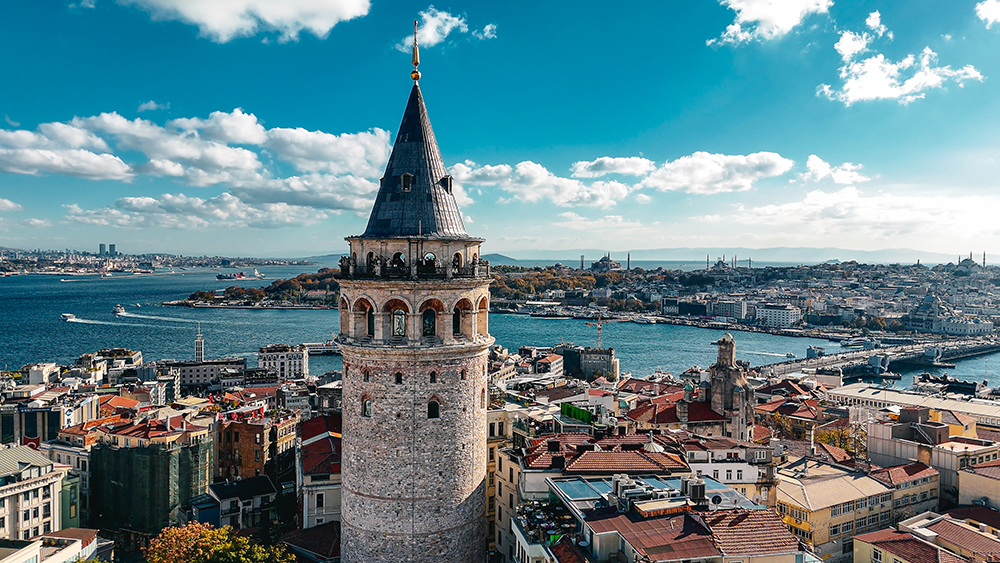

Why do novelists set their stories in cities or landscapes which seem to haunt them? Not the places of their childhood – an obvious choice – or places they’ve researched because those places are intellectually attractive. The places they can’t avoid in their own subconscious. I’m often asked this question because the places I write about are considered exotic. But to me, it’s the reverse. I write about a city long after I’ve lived there and left it, having never had any intention to write about it at all. Such was the case, for me, with Istanbul. I moved there in 2011 after 20 years in New York. It came about by chance. My mother died that year and I came back to Brighton to attend the service. There was a week’s lugubrious interval between service and cremation, during which Newsweek asked me to fly to Madrid to interview Pedro Almodóvar. This seemed like bad taste until my sister argued that, to the contrary, it was exactly what my mother would have wanted. So I went. Almodóvar was charming and subjected me to a day of casual psychoanalysis. “Tell me,” he said, “about your mother.” Then we talked about next steps. Don’t go back to New York, he insisted. “Go somewhere different. Move on.”
When a Turkish friend offered a small flat in the basement of her mother’s house in Etiler in the northern suburbs of Istanbul, I called my landlord in Brooklyn and asked him to throw all my belongings into the street. No money needed. And so I became a migrant Istanbullu for a year and a half, equipped with a single suitcase and a laptop. My new landlord was a painter whose husband was in a coma – and so in a sense we were both in mourning. The little street high on the hill overlooked the village of Arnavutköy and the sea. Every morning at five the amplified call to prayer from the mosque wafted up to my garden of pear trees, a beautiful reminder of death, submission to fate and the duty to carry on living.

Winding roads led down to Bebek on the other side, that seaside enclave of the Istanbul rich, and I soon found a daily rhythm walking down to the Hotel Bebek in the late afternoon to take a sundown cocktail on its deck over swarms of jellyfish in the sea below. Solitude refound. I didn’t know anyone in the city; the phone had gone silent as soon as I left New York. Winter came, great Siberian snowstorms, and via email I began to receive mysterious invitations to dinners and parties, as if a telepathic curiosity about a shadowed loner in a basement in Etiler had leaked out to the wider city.
Sometimes a new city can be like this. You either stay alone for years or else circles of new people suddenly open up, people you had never known about before. In this case, the one person I did know was Tamara, daughter of the Iraqi politician Ahmed Chalabi. I had dined with her father at his mansion in Beirut at an awkward dinner with Christopher Hitchens during which we had learned a great deal about the water table in Iraq and – astonishingly – Hitchens had not uttered a word. Tamara was a different world: young, sophisticated bohemia. Perhaps she was the door that opened Istanbul. Perhaps my landlady had passed on my name: I can’t remember.
During that winter I became close with two characters straight out of Lawrence Durrell’s Justine – Ezgi Esma Kürklü, a beautiful young film actress, and her lover Sebastien de Courtois, one of the great scholars of eastern Christianity. Fourteen years later, as I was writing Children of Wolves, that time came back to me. They were friends of the billionaire Ömer Koç, Turkey’s greatest art collector and reputedly 10 percent of the country’s GDP. Boats were sent to collect us from Karaköy to ferry us to his Ottoman palace to while away nights on his terrace and – bewildered slightly, not knowing the laws of gravity of this society – I began to feel both less and more alien.
I loved walking around the city at night with Sebastien, going to Ali Pasa hamam (designed by Sinan and built by the enslaved Cervantes), eating late at Lokantasi Karakoy, climbing up to the Galata tower, where our friend the legendary musician Julien Weiss had his apartment and where he played with his qanun ensemble for however many hours the Sufic mood lasted. Weiss was one of the most famous players of that instrument in the Arab world – his school in Aleppo destroyed by Assad’s artillery. We used to prowl with him, too, in his long black cloaks. He died in 2015 and so, I suppose, did my relationship with the city. For one always moves on – the places inhabited and loved turned into memory. Or, as the case may be, these little grenade-filled toys called novels.
Lawrence Osborne’s Children of Wolves is out on on August 25.





Comments