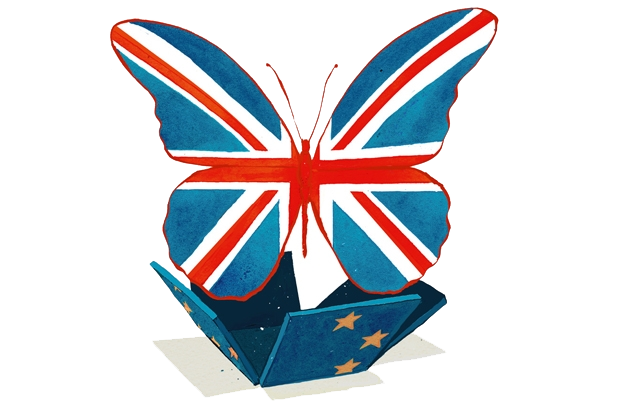


Someone in Brussels has a sense of humour. One of the euro elves let it be known this week that the deal which the UK hoped to sign this summer has stalled over migration rules. Keir Starmer and his minister–negotiator Nick Thomas-Symonds are seeking a deal on food and agricultural products in exchange for one on youth mobility. However, the number of young people coming to the UK, Thomas-Symonds insists, has to be capped. Cue, with exquisite chutzpah, a leak that the EU is instead prepared to offer Britain an ‘emergency brake’ on the arrival of under-30s if the numbers get too much. Sound familiar?
An emergency brake on free movement was exactly what David Cameron asked for in his 2015 negotiations (and even Tony Blair had talked of wanting an emergency brake before that). Of course, Cameron failed to secure this, beyond a few tweaks around access to benefits. This he presented to the nation as a great concession – to the deafening sound of raspberries from the electorate. The deal was so weak that after about three days of touting the products of his renegotiation, Cameron gave up and deployed Project Fear on the likely costs of Brexit instead.
The lesson of the emergency brake is that the EU can evolve its position but often only when it is too late
It was probably unrealistic of Cameron to expect the EU to move on migration. Angela Merkel, the dominant figure of that age, was wedded to the four freedoms of the EU, and put her money where her mouth was by accepting a million migrants into Germany. She is probably the one non-British politician who most contributed to Brexit. And no modern politician’s reputation has fallen faster than hers, precisely because she got migration wrong. Even the EU now takes a more restrictive approach.
But this provokes an interesting thought experiment: what would have happened if Brussels had been more strategic in its negotiations with the UK, rather than fighting tooth and nail on every point? Would a proper emergency brake on migration have made a difference? One current cabinet minister, a Remainer, said: ‘The 2016 outcome could well have been different.’
In that scenario, Cameron would have remained prime minister but the forces of Leave would have been energised, particularly if the result was close, and it is likely there would have been a revolt inside the Conservative party within 18 months. Cameron would have fought to ensure that George Osborne was his successor, but the probable outcome would have been that Boris Johnson emerged victorious. ‘Boris would have been the voice of Britannia railing against the establishment,’ a leading Remainer says.
It is also likely that Ukip, under Nigel Farage, would have surged in the polls. ‘I think we get to populism much more quickly than we did,’ the cabinet minister says.
The big unknown is whether there would have been another referendum, with both Leavers and Remainers split. One Vote Leave luminary said: ‘If Leave had lost the referendum, there were very senior people talking about pushing for a second referendum quite quickly after and blaming the result on Remain cheating. So it’s possible the EU could have done something in that scenario.’
Another believes the deep state would have prevented a re-vote: ‘My own personal opinion from working with some of those cretins would be the establishment would never have allowed it. It was clearly going to be our only chance.’
The most intriguing suggestion is from the leading Remainer: ‘I don’t think Boris Johnson would have called another referendum. He wouldn’t have wanted the economic consequences as prime minister, or the gamble, and he would have preferred to rage against the establishment.’
What everyone I spoke to this week agrees on is that Covid would have presented a challenge of gigantic proportions to the UK-EU relationship. The one great triumph of Johnson’s handling of the pandemic was setting up a separate vaccines taskforce outside the usual machinery of government. Had Britain remained in the EU, it seems certain the Department of Health would have been part of the European vaccine procurement process – indeed Matt Hancock and his officials wished us to join despite Brexit.
The EU tried to block the passage of vaccines to the UK and triggered Article 16 of the Brexit treaty’s Northern Ireland Protocol to that effect – a show of the sort of legal aggression Brussels condemned when on the receiving end of Vote Leave’s constitutional chicanery.
Imagine if the UK had not got the share of vaccines it expected, and if people had died as a result of a Franco-German stitch-up. A Lib Dem former Downing Street aide says: ‘If Remain had won, the temptation for UK politicians to blame the EU for everything around Covid would have been overwhelming. God knows where that would have ended up.’ Given how politically divisive Covid measures were, it is not hard to imagine there would have been a populist revolt from the right agitating for another referendum, which is likely to have ended in a bigger Leave win than the one in 2016. Even if not, Johnson could have negotiated from a position of greater strength in 2021 than Cameron was able to in 2015-16.
The lesson of the emergency brake is that the EU can evolve its position but often only after it is forced to and when it is too late.
Take the current negotiations: Britain’s attempt to buy access to certain sectors of the single market, in exchange for adhering to EU rules on food, chemicals and joining a shared emissions trading scheme. This is the very definition of ‘cherry picking’ – which Michel Barnier, in the talks with Theresa May and Boris Johnson, spent most of 2017-19 deploring.
‘We were always going to be cherry-picking,’ a government source admits. ‘Not joining Schengen was cherry-picking. Not joining the euro was cherry-picking. An SPS agreement [Sanitary and Phytosanitary Agreement] would be a pretty big cherry.’
The problem for Labour now is that Starmer and Rachel Reeves are palpably desperate for a deal with the EU to boost growth, and once again that puts Brussels in the box seats. ‘If the EU don’t need this, they’ll play for time and push for more than we want,’ a Leave campaigner says.
And, it seems, troll the government about migration again.





Comments