
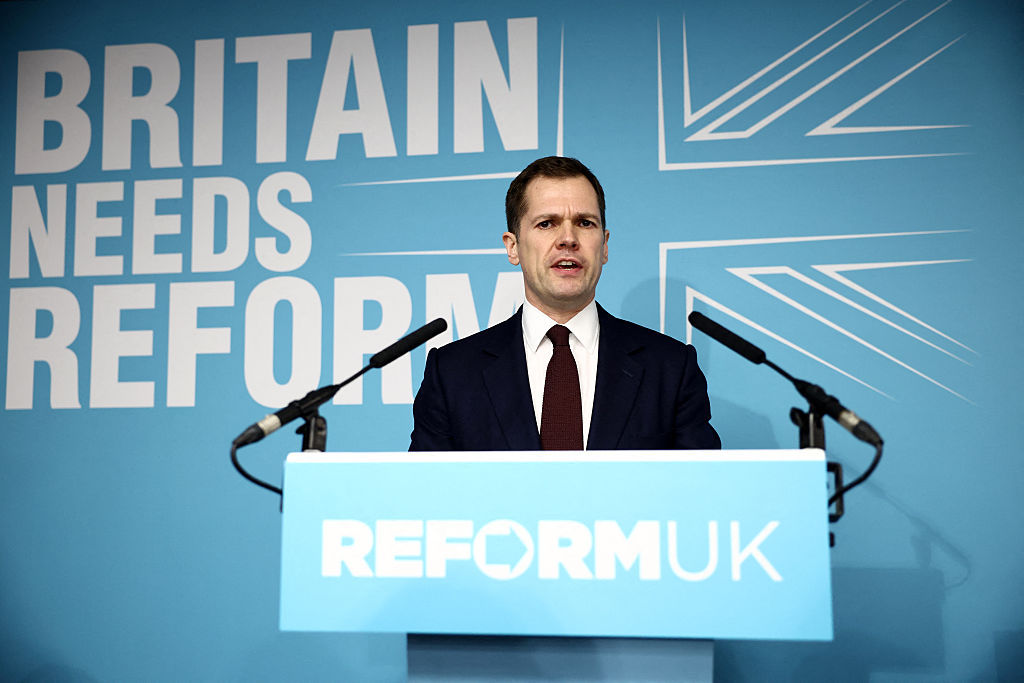
Robert Jenrick arrived late to his own defection. ‘It’s time for the truth,’ he said, before launching into a speech that he would have no doubt preferred to deliver at a more opportune moment.
In Nigel Farage’s opening remarks, which he had to pad out as Jenrick failed to arrive at the lectern, he implied that his new recruit had only been pushed into jumping by the actions of an over-hasty Kemi Badenoch.
He described her sacking of Jenrick as an avoidable own goal, ‘the latest Christmas present I’ve ever had’. In reality, Jenrick could scarcely have been allowed to stay on after senior Reform UK figures had publicly admitted to being in secret discussions with him.
The more important question is, what does it mean for both parties of the Right? As Stephen Pollard wrote today, the move suggests a decisiveness on Kemi Badenoch’s part – Tories can draw a contrast between her resolve and Starmer’s inability to sack his own leadership rivals on manoeuvres.
Moreover, the average British voter doesn’t care much for turncoats, and there is no end of incriminating quotes on Farage’s own volte-face regarding his new colleague. ‘Jenrick is a fraud, I’ve always thought so,’ he said as recently as August last year.
Equally, some will argue that Jenrick, who ranked as the most popular member of the Shadow Cabinet among Tory party members in Conservative Home’s regular polls, is enough of an asset in his own right to outweigh all this. The obvious beneficiary of so much infighting will surely be Keir Starmer, though it wouldn’t be beyond him to squander it.
What does it say about Kemi Badenoch’s grip on her party? A charitable reading, for her, is that it suggests Jenrick had reached the conclusion there was no chance of him leading the Conservative Party.

The ‘sed contra’ to that position is that Jenrick may also have concluded that the Conservative Party was no longer worth leading. Badenoch’s speech referred to Jenrick defecting ‘in the most damaging way possible’ – which suggests he was planning to announce his move following a poor showing in the local elections.
Thanks to the leak, his defection arguably comes both too late and too early. Had he jumped at the high watermark of Badenoch’s unpopularity last summer it might have defenestrated her. Had he gone when he was apparently planning to, he could have dealt graver damage to the Tory brand.
Instead, it happens when the party is looking more unified than it had for some time. Though an accomplished media performer and campaigner, Jenrick’s star hadn’t shone quite as brightly in the firmament, even on the Tory right, as it once did.
Newer parliamentarians like Katie Lam and Nick Timothy – who replaces Jenrick as Shadow Justice Secretary – have proved that other Tory MPs can provide serious opposition by taking an issue and campaigning hard on it, whether on grooming gangs or the Maccabi Tel Aviv scandal, just as Jenrick did on fare-dodging.
Following so soon after Nadhim Zahawi’s defection, the timing is also unfortunate for Reform’s attempts to deny a narrative that they are ‘failed Tories’ rather than the insurgent movement they wish to be viewed as. Then again, it may simply confirm a sense of terminal decline.
Another question is whether Robert Jenrick had been planning to jump with other MPs, and whether others on the right of the party will soon follow – as in 2022, when Jenrick called for Boris Johnson’s resignation in tandem with fellow Midlands Tory MPs Lee Rowley and Neil O’Brien. Had the original plan similarly involved other defectors at a later date?
So far, Jenrick’s parliamentarian allies say that they will stay put, but for how long will that hold true? Crucially, who will this tempt towards Reform who otherwise wouldn’t be tempted? Will right-leaning Tories fear that their party is no longer trustworthy on immigration, and that the ‘wets’ are in control once more?
Kemi Badenoch may have made the best of a bad hand dealt today, and in her statement called for an end to ‘political psychodrama’, but it seems that psychodrama is back whether she likes it or not. Meanwhile, many on the right will simply wish that Reform UK and the Tories could concentrate their energies, defenestration skills and dark arts into bringing down Labour.
Watch the latest of Madeline Grant on Quite right!






Comments