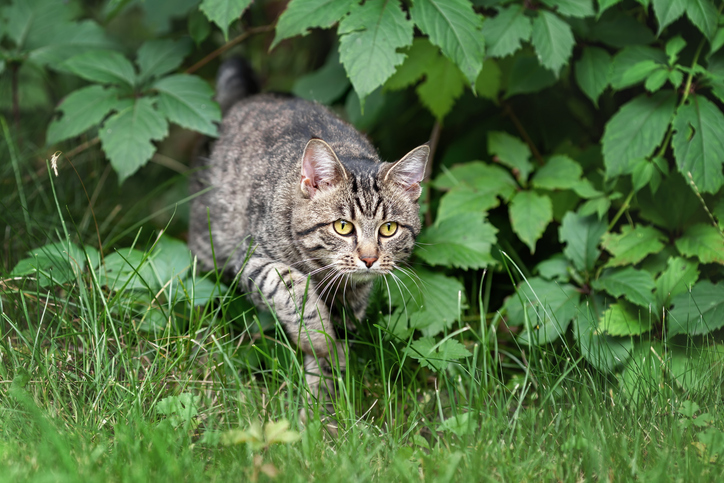
Here we go again. Last February I wrote about the latest wave of ‘catphobia’ – my new word, do use it – prompted by a report (more accurately, an anti-cat rant) published by the Scottish Animal Welfare Commission. The report suggested the ‘compulsory containment of cats in vulnerable areas’ and the banning of cats altogether in some new housing developments. A wave of cat hate followed.
For anyone who hasn’t been brainwashed by the anti-cat mafia that dominates the media and public life, I bring bad news. The majority of this anti-cat screed was easy to swat away as the nonsense it was. As for the Scottish Animal Welfare Commission…well, who cares?
It’s as if the anti-cat mafia has decided it’s time to explode its nuclear weapon
But, my fellow cat lovers, we now have a very different and altogether higher-calibre adversary to contend with. I can barely bring myself to report that tonight on BBC1 the latest piece of anti-cat propaganda is to be delivered by…Sir David Attenborough. And it’s not just any old new series of his; it’s one celebrating his 100th birthday. It’s as if the anti-cat mafia has decided it’s time to explode its nuclear weapon. How are we supposed to take on Sir David Attenborough celebrating his centenary?
In the documentary Secret Garden, he argues that the 9.5 million pet cats in Britain kill 55 million birds every year. He suggests – assuming that this is, by definition, a bad thing – that cats wear a bell on their collars as this ‘reduces pet cats’ hunting success by a third’. As it happens, I don’t think it’s an outrageous suggestion; my cat, Louie, wears a bell on his collar, mainly so I can hear where he is.
But that’s not all. In a recent interview, the series’s producer, Bill Markham, lets rip at cats on the bizarre ground that they are too well looked after. Having so many pet cats is, he says, ‘unfair on the prey’, because ‘they’re being fed every day. There’s no limit on their population. So the normal relationship between predators and prey falls apart.’
I’m struggling to understand the logic. Like most cats, Louie does occasionally bring back a dead bird for me. But it’s very occasional – perhaps once or twice a year. That’s because he doesn’t need to kill to eat. He’s just doing what cats do once in every while for fun. But if I didn’t feed him every day, he would do what cats do because he had to – and kill many more birds. If you’re trying to reduce the number of dead birds, how is making cats more reliant on killing them a good idea?
Markham also says people should keep cats indoors during the avian breeding season in April and May. It’s not too outrageous a suggestion, although if you’ve ever had to contend with a stir-crazy cat for whatever reason – recuperating after an operation, for example – then you’ll know it’s not that straightforward.
My real issue with the series isn’t the specific suggestions put forward. It’s the tone and the approach that we see all the time – that cats are somehow a problem that has to be dealt with. Usually they’re contrasted with dogs – ‘man’s best friend’ in that idiotic phrase, as if they’re loyal and bright while cats are self-centred.
Anyone who owns a cat (or rather is owned by a cat) will know what rubbish that is. I’ve no interest in being slobbered over by a dog that runs affectionately at anyone. But when I’ve earned a cat’s trust and affection, as with Louie, that’s something I’ll take with me to my grave.
I hesitate to take issue with Sir David Attenborough, but it’s depressing how yet again cats are being portrayed as a problem. Wouldn’t it be wonderful if we just celebrated the joy, the comfort and the calm that cats can bring?




Comments