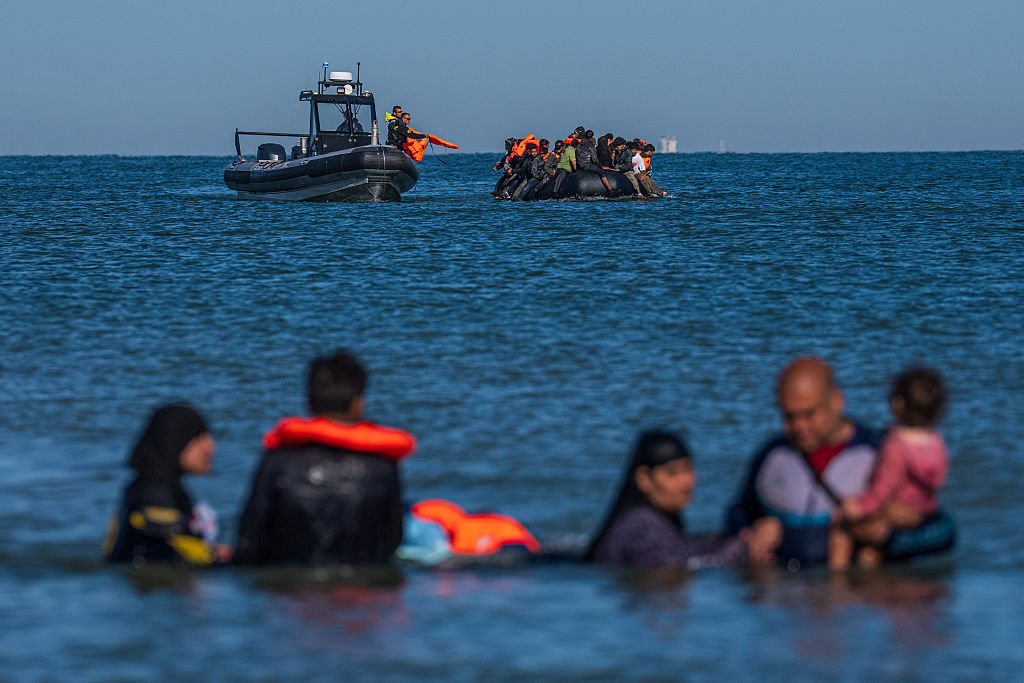
This April, we agreed another deal with France to stop migrants coming across the Channel. The Home Office has explained it is ‘bearing down’ on small boat crossings, and that this latest £662 million deal would ensure ‘enforcement action on beaches and put people smugglers behind bars.’ Over the last Bank Holiday weekend, almost a thousand migrants were recorded as coming across the English Channel. This is regrettable, but there is no alternative. Small boat crossings began at scale in 2018. Since then, the total number of recorded arrivals comes to about 200,000. We have to accept that they are now a fact of life.
In the interests of fairness – the figures could easily be inflammatory – we also don’t record data about what proportion of crimes, or violent crimes, in this country are committed by small boat migrants
There is an immediate human cost to these arrivals. Since 2018, the Migration Observatory estimates that 162 people have died in the Channel. The Migration Observatory maintains it is neutral, but its suspicious interest in migration suggests an agenda. We should treat its figures with caution. Our government has no such bias, and its neutrality is demonstrated by the fact that it produces none at all.
In the interests of fairness – the figures could easily be inflammatory – we also don’t record data about what proportion of crimes, or violent crimes, in this country are committed by small boat migrants. Deng Majek from Sudan arrived by small boat and murdered Rhiannon Whyte, who worked at his asylum hotel, with a screwdriver. Haybe Nur from Somalia killed a man in a Derby bank with a knife. Ahmad Mulakhil from Afghanistan was convicted of raping a 12-year-old girl in Nuneaton; Sadeq Nikzad, also from Afghanistan, of raping a 15-year-old girl in Falkirk. These are anecdotes, and there are many others, but the plural of anecdote is not data. We have to look at the bigger picture which, thankfully, government statistics don’t make available.

Dominic Cummings has suggested that the solution is violence. He discussed the use of the UK military to kill some of those attempting to organise crossings, after leaving the ECHR, and declared his confidence that it would bring small boat crossings to a swift end.
The notion that we might deliberately murder people in order to stop the small boat crossings is abhorrent. Our military might stage armed interdiction: warnings, warning shots, finally violence until the boat changed course. Such an approach is not merely against the law, but unthinkable.
Shooting people on a crowded boat is not easy, and it is likely there would be unintended casualties as well as deliberate murder, yet if the boats were stopped then the total number saved from drowning would likely be several times the number we killed, or greater by an order of magnitude, in the first year alone.
But we would then have become killers, and that is not a price worth paying. One could argue we prefer the harms of inaction to the guilt of action, even when the human costs are smaller. But morality is not a question of trying to minimise harms and deaths overall, but making sure we do the right thing. Killing people is not the right thing, even if it saves lives. We cannot make it the job of the military to use lethal force or guard our borders.
Human lives cannot be treated statistically, as though the actions that result in the fewest deaths were automatically better, even if they were monstrous. Even in the face of horror, violence is not the answer. Mahatma Gandhi, in an open letter to the British people on July 3 1940, gave a memorable example. ‘I want you to fight Nazism without arms… Let them take possession of your beautiful island, with your many beautiful buildings. You will give all these, but neither your souls, nor your minds,’ he wrote. ‘If these gentlemen choose to occupy your homes, you will vacate them. If they do not give you free passage out, you will allow yourself, man, woman and child, to be slaughtered, but you will refuse to owe allegiance to them.’
Gandhi is a moral leader, Cummings is not. We cannot stop the small boats. All that is reasonable, therefore, is to continue striking landmark deals with France. Small boat arrivals are a fact of life. It is not for us to decide who comes to our country. Australia’s experience suggests strict offshore processing and an absolute ‘no settlement’ policy for such arrivals would bring them to an end without violence, but that is more unthinkable than murder.






Comments