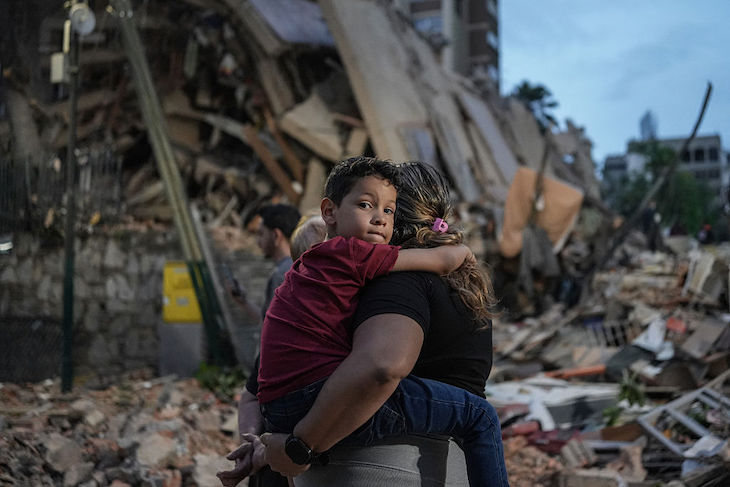
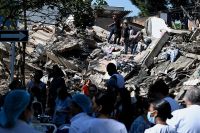
Venezuela thought its luck was changing. Then the earthquakes stuck. For a country that’s economy has long been in tatters, parts of Venezuela are now in ruins. The huge 7.2 of and 7.5 magnitude quakes have devastated pockets of Venezuela, with parts of the capital, Caracas, and the northern coast dotted with mounds of rubble.
Rodriguez could also use this tragedy to argue an election is not what the country needs
It’s a cruel twist of fate the South American nation that was finally beginning to pull itself out of dismal abyss it had found itself in. Many Venezuelans, little by little, were allowing them to be more optimistic this year.
Nicolás Maduro was out of the picture following his capture in January. Hundreds of political prisoners had been released. Political exiles had begun to return home. And there was even optimism that the economy would soon grow with US investment. The future was looking much brighter than it once had. But the double earthquakes that hit Venezuela on Wednesday have changed that.
When phones starting letting out a piercing alert and flash warnings popped up, there was a brief pause, confusion and then panic. In Caracas and the heavily impacted state of Guaira, residents talk of believing they were living their last moments, of walls imploding and seeing their own terrified expressions reflected in that of those around them.
Venezuelans are still struggling to take in the mammoth damage the twin earthquakes have caused to parts of the country. Yet community members have been organizing themselves, alongside authorities, to search for survivors – and the dead. They have also set up a website to register those who are missing. So far, more than 30,000 names are on it, and it’s increasing.
Unfortunately, so too is the death toll, which is creeping towards 600. It’s unknown just how much that will increase. The US Geological Survey said it could reach tens of thousands – a figure too uncomfortable, and yet too hypothetical, to begin to process.
Power and internet are largely functioning again. People are sharing messages and images of those who they haven’t heard from. They’re still hoping lack of contact is just a lack of internet, battery or electricity.
Plazas that were once used for public gatherings, concerts and where children played are now used to sleep in – many can’t go home. Schools have been suspended and set up as makeshift help centers. Recovery efforts are set to take months.
While the country waits on promised international assistance to arrive, those assisting in recovery efforts say they don’t have enough supplies.
The economic and humanitarian crisis that has rocked Venezuela over the last decade has ravished public services. Hospitals are poorly equipped, medical staff badly paid, and many have left the country as part of the migrant wave that has seen almost eight million citizens flee. Despite apparent free healthcare, Venezuelans have long had to take their own supplies – medical gloves for doctors and nurses, antiseptics, their own food – and often even their own bedsheets.
Economic mismanagement, corruption, hyperinflation, as well as international sanctions, threw Venezuelans into the throes of precarity. The minimum public sector wage has long been equivalent to under $1, and that’s per month.
Venezuela thought its luck was changing. Then the earthquakes stuck. For a country that’s economy has long been in tatters, parts of Venezuela are now in ruins
Venezuela will be relying heavily on international aid and supplies for this recovery. The Trump administration has said it will offer $150 million in humanitarian aid. A swathe of other countries from Mexico and Panama, to Qatar and Spain and many more are releasing money, rescue personnel and equipment.
This crisis will be a big test for interim president Delcy Rodríguez. While politics has so far largely been left out in the immediate aftermath of the tragedy gripping Venezuela as the search for bodies and momentous rescue takes priority, that will soon shift.
Despite being loathed by many opposition supporters, Rodriguez is a politician known for efficiency and organizational prowess. But this will be one of her biggest challenges, as accusations of years of neglect of infrastructure, maintenance and whether building regulations were thoroughly checked will roll in.
The chavista government is also known for its lack of transparency but with the eyes of the world on Venezuela, particularly those of the US, Rodriguez can’t afford opaqueness.
Demands for the president to give the go ahead to internet providers to unblock X mounted up in the hours after the quakes – and it was, although some still can’t access it. The site is often used by those who can access it via VPN to obtain information, as well as news that isn’t from the state media companies.
The social media platform, along with dozens of other sites, were blocked in the country both before and after the contested 2024 election, in which Maduro claimed he’d won – despite evidence very much to the contrary.
The strategy of controlling the information flow was one of many repressive tools the chavista government had been deploying. Citizens have also been subject to arbitrary detentions for speaking out against the government, heavy crackdown on protests – and even stop searches checking people’s phones.
When Maduro was captured, at least for the majority of Venezuelans, after feelings of joy, relief, fear had finally settled into a kind of cautious optimism. However, frustrations had been growing for an election date. Maria Corína Machado, the largely popular opposition leader, is viewed by many as the person they want to run the country and close the door on nearly three decades of chavísmo.
But with Washington influencing enormous control over the South American country’s oil industry, and even the wider country itself, there are some niggling worries among Venezuelans that perhaps Washington prefers the status quo rather disrupt their business deals with an election.
US-Venezuela relations have been warming. Just under half a year ago, cooperative relations between the two countries were largely non-existent. Although after the ousting of Maduro there was arguably little choice to accept US influence for the chavista remnants left behind.
Rodriguez could also use this tragedy to argue an election is not what the country needs. Yet this earthquake, and Delcy’s handling of it, could only heighten calls for a new government.
For now however, the focus for all of Venezuela will be on finding those still missing and providing support to those who have lost everything – including loved ones.


Comments