
Vladimir Putin has not changed his war aims a jot since 2022 and remains determined on fighting on. Donald Trump has no new plan for peace other than bringing the Ukraine war to an end on Putin’s terms. And Kyiv is running out of money and men to defend itself, just as surely as it has already run out of Patriot interceptors to defend its skies against the Kremlin’s barrages.
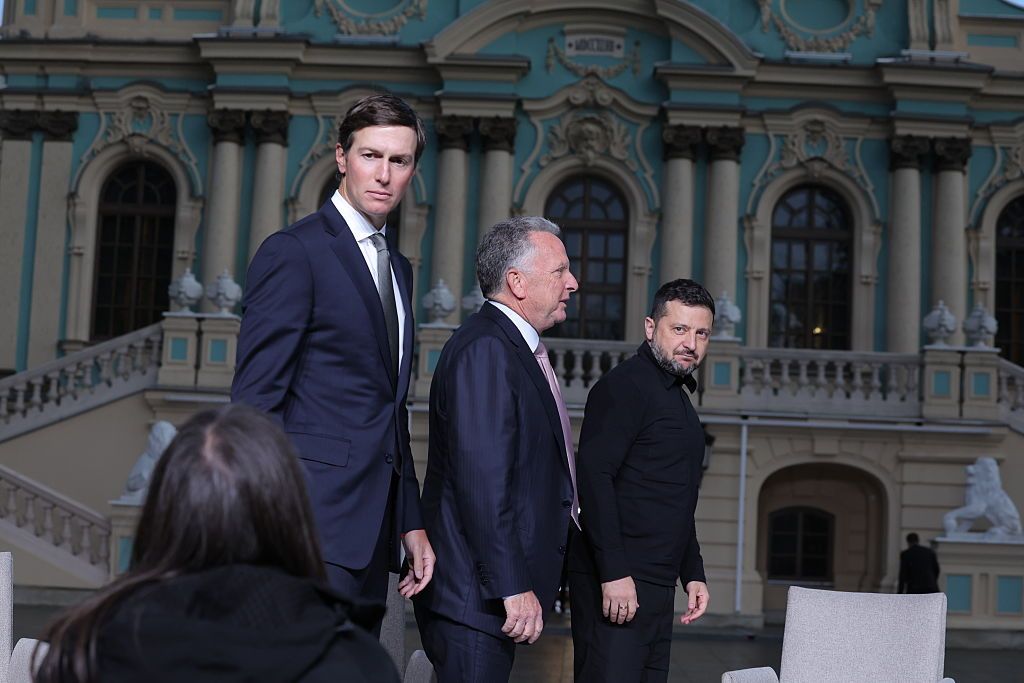
Those are the three depressing takeaways from the latest round of shuttle diplomacy in Moscow and Kyiv by Trump’s son-in-law Jared Kushner and special envoy Steve Witkoff.
On the eve of their departure, Trump said his boys would be presenting “a new plan” for Ukraine. It quickly became clear that no such initiative existed. Instead, a grinning Putin simply cycled through his old talking points about liberating all of Donbas and insisting that Ukraine still needed to be “demilitarized” and “denazified.”
Trump’s people continue to focus on the commercial upside of ending the war
Objectively, talking is better than not talking – especially in a war that has become a grinding battle of attrition on the ground, and where both sides have switched their strategic efforts to a long-range battle where they vie to destroy each other’s cities and vital infrastructure. Jared Kushner was mocked by some pro-Kyiv commentators for his upbeat insistence that Trump is seeking to end the war using his business background. “War is negative sum. Everyone loses from war,” Kushner told a press conference in Kyiv. “Business and peace is positive sum.” Kushner also spoke of Putin’s “aspirations” for his country that could also be achieved once the war is concluded. Yuri Ushakov, Putin’s Politburo-faced foreign policy advisor, confirmed that “economic issues and potential major, mutually beneficial Russian-American projects were discussed in considerable detail.”
In short, Trump’s people continue to focus on the commercial upside of ending the war. Volodymyr Zelensky, by contrast, called the battle for Donbas “a war for survival.”
In one sense, Trump is profoundly wrong in his belief that dangling business deals will somehow influence the Kremlin’s decision-making. If Putin cared about the Russian economy, he would not have launched his full-scale invasion in the first place. For Putin, the conflict is not about preserving prosperity but about defending Russia against an existential threat.
At the same time, Zelensky is equally deluded about Ukraine’s chances of defeating Russia – or even, tragically, about stopping the Kremlin’s slow but relentless advances. More importantly, as the Kremlin continues its ruthless campaign to render Ukraine’s cities unliveable, destroy the country’s economy and rob it of its future, Kyiv’s ability to defend itself is in serious doubt.
Part of Ukraine’s unfolding nightmare is tactical. Every one of Russia’s long-range attack systems has become more devastating. A new generation of jet-powered Geran attack drones, much faster and more accurate than their old Iranian Shahed models, are being deployed in mass. Russia is developing at least two new, low-cost cruise missile systems and stepping up production of air- and ground-launched ballistic missiles. “This is a war of cities and infrastructure. No one will win it,” Serhii Beskrestnov, Zelensky’s advisor on defense technologies and a leading figure in Kyiv’s defense establishment, told the Guardian this weekend. “Attack has become stronger than defense.” Beskrestnov predicts that Ukraine will not be able to obtain enough missiles to fully protect Ukraine’s cities from devastation this winter.
Western leaders’ pledges at the beginning of the war to give Ukraine “whatever it takes” for “as long as it takes” were fundamentally misleading
But a larger part of Ukraine’s slowly unfolding defeat is strategic. Western sanctions have basically failed – not least because of the West’s self-preserving insistence on keeping oil prices down under the Biden administration and, since the Iran war, because of Europe’s hunger for Russian liquefied natural gas. Rather than being crushed by sanctions or wrecked by Ukrainian long-range strikes, Russia’s defense industrial capacity is stepping up. Yes, that comes as a crippling cost to the economy, with a record 45 percent of Russian government revenues now going into war production. And indeed, Ukrainian strikes have caused a fuel crisis and knocked out 20 percent of the warehousing of Wildberries, Russia’s answer to Amazon. But that’s a price that Putin is willing to pay – as he has just reaffirmed in the most emphatic possible terms to Kushner and Witkoff.
Perhaps the most important strategic crisis for Ukraine is a triple failure on the part of its European allies. First, the UK and Europe have talked up sanctions while in practice sending far more money to Moscow in payment for oil and gas than they have given Kyiv in military aid. Second, fear of escalation and prioritizing their own defense over Kyiv’s has prevented Europeans from sending offensive missiles (such as Germany’s Taurus) for use against Russian targets or from sharing their supplies of precious Patriot missile defense batteries. But the third and most serious failure is a refusal to countenance seriously engaging the Kremlin in peace talks, and a stubbornly fixed idea that encouraging Ukraine to fight and fight forever will somehow magically lead to victory.
In short, western leaders’ repeated pledges at the beginning of the war to give Ukraine “whatever it takes” for “as long as it takes” (Joe Biden in June and November 2022), were fundamentally misleading. Indeed, these open-ended but non-specific promises – which became a mantra repeated by all British prime ministers since Boris Johnson and were recently reaffirmed by Andrew Burnham in Kyiv – ended up achieving the worst of all worlds. The already-paranoid Kremlin was convinced that it was fighting the “collective West” – while that self-same West continued to buy the Kremlin’s oil and gas and transport it in their ships.
The crunch point – where those promises will finally crash hard into reality – will come soon in the form of an imminent fiscal crisis in Kyiv. Ukraine’s Prime Minister Serhii Koretsky recently announced that Kyiv has already spent most of its 2026 defense funds and faces a looming €26 billion ($30 billion) budget black hole – despite a recent €90 billion ($104 billion) loan from the EU. That loan, secured after months of Brussels horse-trading, represented the high-water mark of what the EU is realistically capable of raising. As Ukraine heads into the hardest and most punishing winter of the war, it is about to run out of not only Patriot missiles and men for the front lines, but money to fight on.
At the same time, Zelensky faces a perfect political storm at home. A year of relentless corruption scandals in Kyiv – the latest featuring the arrest of a deputy prosecutor general on charges of protecting online scam centers – has seriously eroded trust in Zelensky’s administration. A dozen senior members of his team are now in jail, under investigation or have fled abroad. A shoot-out in a Kyiv street between rival factions of Ukraine’s SBU and HUR domestic and military intelligence services have left many Ukrainians wondering if their country is sliding back to 1990s-style gangsterism. Last week, an investigation by the New York Times found that Ukraine’s military procurement system has suffered from serious fraud, waste and mismanagement during the war. Secret audits show that in 2024 alone, about $1.2 billion was lost through overpayments and corrupt contracts. Unsurprisingly, August polls by SOCIS show that a majority of Ukrainians consider corruption a more serious threat to their state than Russia – and that nearly 57 percent of Ukrainians blame Zelensky for the prevalence of corruption, nearly double the number in a similar poll from April 2025. The same poll also also projects that three different rivals would beat him in a second-round election, each by a landslide margin of around 2-to-1.
What can save Ukraine from political and military collapse? There are signs that Europe’s political taboo on taking to Putin is cracking. Alice Weidel of Germany’s AfD, newly victorious in elections in Saxony, has called for “an open channel to Russia in order to reach an understanding and achieve a peaceful solution.” According to Iuliia Mendel, Zelensky’s press secretary from 2019 to 2021, “new forces are rising, and they are getting stronger” which represent “our only chance for peaceful Europe… More weapons will not save us. They never have.”
To date, every successive peace offer has been worse for Kyiv than the last. It seems that Putin’s clear intention is to give Ukraine’s cities a brutal final kicking before finally settling the war on his own terms, perhaps next year. The Trump administration has long given up on the idea of backing a full Ukrainian victory, and it will be for historians to decide whether that decision to pull American aid and arms became a self-fulfilling prophecy. Europe, for its part, continues talking the talk. But it has no concrete plan to help, or save, Ukraine from the Kremlin’s fury – much less to crush the Russian economy or break Putin’s will.




Comments