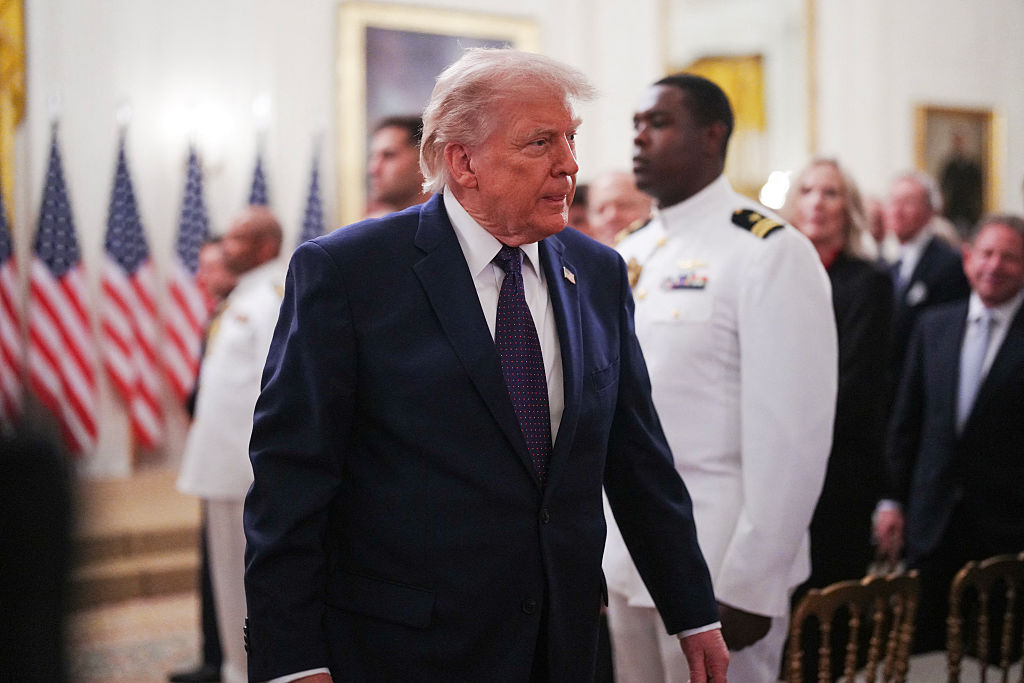
“I love inflation,” said Donald Trump earlier this month, when asked about the latest increase in the Consumer Prices Index to an annualized 4.2 percent. But the power of the President’s positive thinking cannot overwhelm the enormous threat that rising prices pose to his legacy. The new figure is more than an inconvenience or a technicality. It could bring about a sharp change in the political order. Rising costs will likely prove to be Trump’s undoing and present the Democrats with a free hit for November’s midterms and beyond.
There was one reason above all others why Trump returned to the White House in 2024: high inflation during the Biden years. His 2016 slogan, “Make America Great Again,” morphed into “Make America Affordable Again.” His campaign focused mercilessly on this issue. While migration and culture wars – both popularly credited with increasing Trump’s appeal – affect relatively few people directly, the price of filling up your tank or putting food on the table impacts everyone, every week.
The key to Trump’s remarkable victory was shown in an exit poll for CBS News, which found that three-quarters of respondents reported suffering from moderate or severe hardship thanks to inflation in the previous 12 months.
Trump’s second presidency was founded on public fear of inflation. It will likely die on it, too
The devastating thing for Trump is not just that inflation, which was 2.4 percent as recently as February, is now higher than it was on election day in 2024, but that the sharp rise in prices over the past few months can be so clearly traced to his policies.
Most of the increase in CPI over the past three months can be put down to a 40 percent rise in gasoline prices, a direct result of Trump’s war in Iran and the closure of the Strait of Hormuz. America’s aggressive policy of energy self-sufficiency, pursued by presidents of both parties for the past quarter century and now expressed through Trump’s unapologetic slogan “Drill, Baby, Drill,” has certainly helped to protect the country from the worst effects of a global energy crunch.
The current conflict in the Middle East will not have such dire consequences as the Yom Kippur War of 1973 and its fallout; the US was then a hefty net importer of oil and gas. Nevertheless, you cannot take out a fifth of global oil and gas production – the proportion that used to flow freely through the Strait of Hormuz – without having a serious impact on the US economy.
By bombing Iran, Trump had already broken one of his electoral promises: not to get involved in overseas wars. But that action has crushed his biggest electoral promise of all – to bear down on the cost of living.
It is not just the Iran War that is driving up prices, either. Even before the bombing began on February 28, CPI was sitting stubbornly above 2 percent, the target which the Federal Reserve tries to bear in mind when setting interest rates. A significant part of that was down to Trump’s tariff agenda.
Whatever Americans were liberated from on “Liberation Day” in April last year, it wasn’t inflation. Tariffs feed into inflation directly and indirectly: by pushing up the cost of both imported and US-made goods (the latter of which rely on foreign-sourced raw materials and components).
At the turn of the year, America appeared to be weathering the negative consequences of Trump’s protectionism. Even the Wall Street Journal, the leading free-market newspaper, had to admit that tariffs had not caused the collapse that its editorial board had predicted. Thanks to the AI investment boom and Trump’s focus on American manufacturing, the domestic economy appeared to be going from strength to strength. But that growth was fragile, and now the ongoing crisis in Iran is hampering American prosperity.
On page 10, Francis Pike makes a spirited defense of Trump’s foreign policy from a geopolitical perspective. He argues that, from Venezuela to Iran, Trump has scuppered China’s strategic advantages. That makes sense in the long term. But Trump has little more than four months until the midterms. Even if he can somehow end the imbroglio in the Middle East and bring inflation under control, he is likely to feel the political pain of it for the rest of his time in the Oval Office.
It is true that CPI is nowhere near where it was in 1980, when Ronald Reagan first won the White House. It hit 14.8 percent in the spring of that year, and helped to condemn Jimmy Carter’s presidency. Yet recent surges of inflation follow three decades in which it seemed that the beast had been tamed.
Moreover, wage growth is not keeping pace with rising costs. Real average hourly earnings fell by 0.1 percent in May, according to the Bureau of Labor Statistics, which means a fall in living standards.
The current CPI rate is modest too, compared with the surge during Joe Biden’s presidency. But at least Biden had an excuse: the world was recovering from a pandemic which had severely constrained output and disrupted global trade. Trump has no excuse. The current surge can be laid very firmly at his door. His second presidency was founded on public fear of inflation. It will likely die on it, too.

Comments