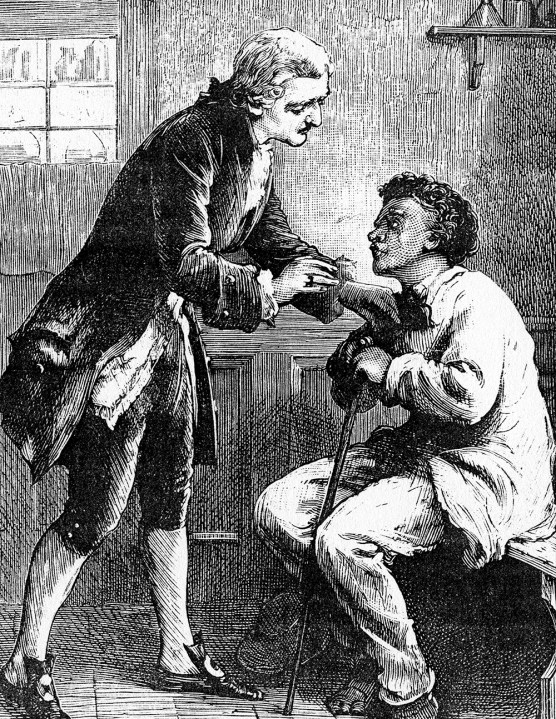
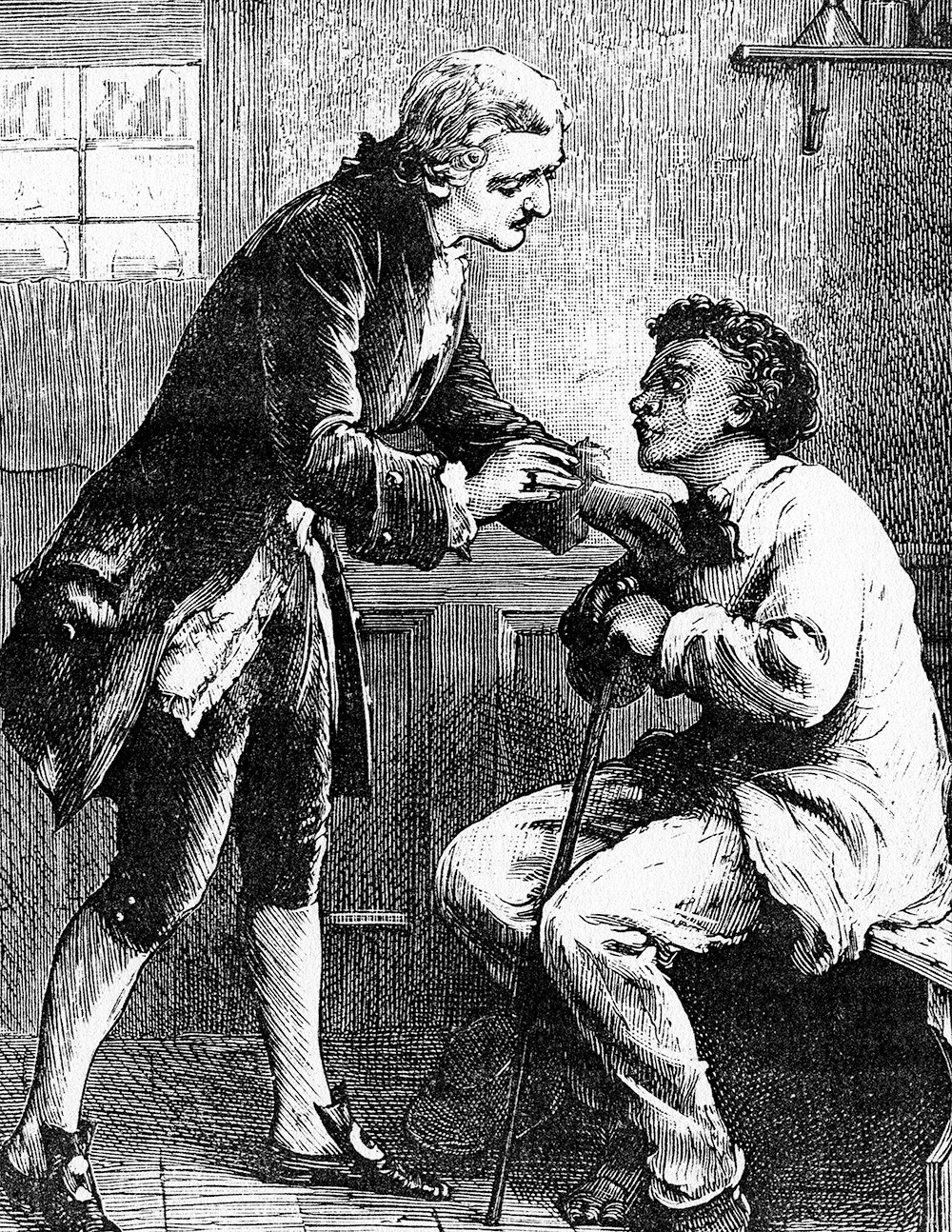
One day during the summer of 1765 a young black man, an enslaved person called Jonathan Strong, stumbled into a doctor’s surgery on Mincing Lane, off Fenchurch Street in the City of London. He was seriously injured, having been badly beaten about the face by his ‘owner’, and there were fears he might lose his sight. The doctor, William Sharp, though respected enough in his profession to be called upon to treat members of the royal family, was also known to be willing to tend those who had no means of paying. Sure enough, Sharp cared for the injured man, and he and his younger brother Granville arranged for Strong to be admitted to St Bartholomew’s Hospital, where he remained for more than four months. When he was strong enough to be discharged, the brothers found him lodgings, gave him some money and secured him a job.
Granville Sharp was then 30 years old, a clerk in the Ordnance, responsible for supplies to the army and navy. This may have been his first encounter with an enslaved person. He seems to have given no thought to the subject of slavery before this. At the time, most people in Britain accepted the phenomenon as a fact of life, perhaps regrettable but necessary. But for Sharp, meeting Jonathan Strong was a call to arms: the spectacle of cruelty and injustice towards a fellow human being demanded a response. He would dedicate the remaining 46 years of his life to campaigning against slavery, bringing court cases and paying for shorthand writers to make transcripts, writing letters to influential people, corresponding with abolitionists overseas, signing petitions and attending meetings, expending more than he could easily afford on the cause. Black men in distress who approached Sharp for help were treated with kindness and courtesy. It was Sharp’s support of the escaped slave James Somerset that led to Lord Mansfield’s landmark judgment in 1772, to the effect that no slave owner could enforce his property rights in England. But Sharp’s efforts to establish an ideal community of freed slaves in Sierra Leone was less successful. Many of the settlers died; some were enslaved by the local ruler; and ‘Granville Town’ was burned to the ground.
Sharp’s opposition to slavery was based on his strongly held Christian belief that all men were brethren
Sharp lived long enough to see the Slave Trade Act passed in 1807. This was a fundamental change. Though slavery was ubiquitous, and indeed most of the slaves taken to the Americas had originally been enslaved by their fellow Africans, the Atlantic slave trade was especially cruel. In 1781 the horrible case of the slave ship Zong, from which more than 130 Africans were ‘cast alive into the sea’, outraged public opinion. Together with the black campaigner Olaudah Equiano, Sharp was appalled that the matter had been treated in the courts as a dispute about a contract between shipowners and insurers, with no suggestion that a crime had been committed. The campaign against the slave trade gathered momentum and between 1787 and 1792 an astonishing 1.7 million Britons (perhaps a sixth of the entire population) signed a petition opposing the trade. While leadership of the campaign passed from Sharp to younger men, both Thomas Clarkson and William Wilberforce acknowledged Sharp as ‘the father of the cause in England’.

Sharp’s opposition to slavery was based on his strongly held Christian belief that all men were ‘brethren… by descent from one common father’. It followed that a black man born in Great Britain or in the British dominions would enjoy the same rights as any white man. It should be said that by no means all Christians took the same view. The Society for the Propagation of the Bible in Foreign Parts, an unofficial arm of the Anglican hierarchy, vigorously defended the rights of slave owners and indeed possessed its own plantation. When slavery was eventually abolished in 1833, the Society received compensation of £8,558 for its loss of 410 people held in slavery there.
Sharp was a member of a tightly knit family of high-minded brothers and sisters who spent much of their time together and corresponded when they were apart. They became known as a clan, the subject of a portrait by Zoffany in 1781 and of a group biography by Hester Grant, The Good Sharps (2020). They were particularly celebrated for making river excursions, during which they put on concerts. Their eminent guests included Lord North, David Garrick and the King and Queen themselves.
This is the first biography of Granville Sharp to be published in almost a century. It is deeply researched, as one would expect of Michael Bundock, the author of a highly regarded biography of Johnson’s black servant and eventual heir, Francis Barber (2015). Bundock writes clearly, with a modest humanity appropriate to his subject. He concludes his book with a list of 11 individuals, all of whom Sharp had personally rescued from slavery:
Sharp’s critics dismissed him as an eccentric utopian, well-meaning but unworldly, whose many campaigns and schemes could not survive contact with reality. But which of them – and which of us – can compile a similar list?





Comments