How will our time be remembered? The age of anger? The age of grievance? The age of victimhood, or of revenge? Perhaps all these things, but it will also be remembered as something else: the Golden Age of the long-form interview.
Universities may be dumbing down, people reading less, we’ve stopped writing letters or having dinner parties
In the 1990s, when I was young, many of us yearned for such discussions, but usually got, on our four TV-channels, mere 15-minute slivers of the great and good. Only a revival of John Freeman’s Face to Face (presented this time by Jeremy Isaacs) seemed to buck the trend, while the buzz around Melvyn Bragg’s long final interview with Dennis Potter before his death – one of the most powerful episodes in TV history – showed our hunger for such things. Listening to an engaging person speak unfiltered and at length about their childhood, their work and the state-of-the-world could be the greatest TV imaginable. It recalled Potter’s own words about the medium: ‘Turn on, tune in, grow…’
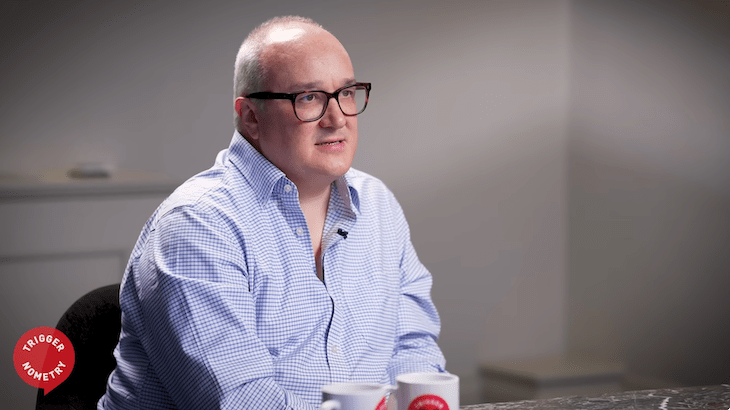
Now, with the rise of YouTube, the long-form interview is everywhere. On Triggernometry, probably the most reliable home-grown podcast, hosts Konstantin Kisin and Francis Foster – not so much the Ant and Dec as the Ant and Bee of their craft – have been interviewing tirelessly since 2018. Their show has featured an apparently never-ending list of Christian nationalists, comedians, anti-woke dissidents, trans-activists, gender critical campaigners and so on. Meanwhile, Spectator readers needing a fix of Rod Liddle should make a beeline for their long interview with him, where he displays an almost puppyish eagerness to entertain. ‘My point’, he says, ‘has always been to say what I think people believe but are too scared to say for reasons of either direct political correctness or indirect political correctness… and also to make people laugh. Most of my job is to amuse. For that I usually get called a racist and a homophobe, because I have made jokes about black people before, and indeed gay people. But I like to think of myself, in a very real sense, as an equal opportunities cunt, as someone who will offend everybody, including the people I come from, up in the north-east of England, and people who live in Brighton. Especially, maybe, people who live in Brighton…’

Another stand-out is Triggernometry’s interview with Dominic Sandbrook, in which the historian speaks with polite dismay about modern, ‘intensely moralistic’ attitudes to studying the past, ‘almost as though people were indignant and affronted and surprised that something so terrible could have happened in history…. Of course, people behave selfishly, sadistically, because that’s in us… We can be horrified by the slave trade and think slavery is wrong and all sorts of things, but you’ve got to grant people in the past their own agency, their own space, their own difference… and respect their difference.’
People today, he adds, ‘have lost sight of the beast in themselves… Knowledge of the beast is so important.’
The interview – 80 mins long – should be required viewing in schools, and would perfectly fit the two 40-minute history classes Sandbrook tells us many schoolkids are down to receiving per week.
One worthy rival to Triggernometry is Andrew Gold’s Heretics, whose Unique Selling Point is its well-mannered, unassuming host. Gold’s courtesy, together with a refusal to budge from his softly stated principles, seems to act as a goad to some guests, who reveal themselves, often fatally, in the ensuing conflict. Exchanges with ex-sportswoman/broadcaster Eni Aluko about DEI (Diversity, Equity, and Inclusion) and a recent podcast with Vanessa Feltz grew especially heated; while his chilling interview with Steve Laws saw the English ethnic nationalist telling Gold, Watford-born and Jewish, that he would have him deported from the country as racially impure.
With the woeful evaporation from our screens of arts programmes like The South Bank Show, it might be expected podcasts would step up to do the job. It’s telling, though, that in our time even artists get drawn into discussing mostly politics. A couple of podcasts that bridge the gap – among the very best of the last ten years – are James Delingpole’s discussions with old school friend and painter of country houses, the late Jonathan Myles-Lea, who in 2021 died tragically from cancer, at the age of 52.
In a pair of talks that seem to range over everything, we hear about Myles-Lea’s charmed route into painting, his youthful visits to Soho, and his friendship with Francis Bacon, who tells him sternly to leave his cushy job at Channel 4 and focus on art full-time: ‘You are a real artist. Unless you’re a painter, you’ll never be happy.’
Myles-Lea talks about Beauty, an abiding theme of his and ‘a value like truth or goodness… something which provokes awe in people who love the truth but also a sense of disgust in people who don’t.’
By the second interview, he is dying, but still wonderfully free from self-pity. He discusses, movingly, his conversion to Catholicism, and tells us that since getting kidney cancer in 2016, ‘I’ve never been happier. I’ve had the best five years of my life,’ adding:
‘Being given a terminal diagnosis, you can choose to do two things. One is to give up…The other is to imbue every single day with a certain magic and a focus….When I wake up I can be excited, for instance, by the way the light is falling on the wall…The appearance of the buds on the trees is not just pretty, it’s sensational – it’s blooming within your heart.’
At such moments this podcast comes close to being a thing of beauty itself. But whether listening to the sublime or the politically ridiculous, our insatiable desire for this parade of intimate strangers passing leisurely through our lives is cause for hope. Universities may be dumbing down, people reading less, we’ve stopped writing letters or having dinner parties. Yet as our intellects decline and our isolation grows, our ability to find, handle, even relish the long-form interview is – though we take it now for granted – one reason that the 2020s, benighted as they are, aren’t an entirely bad time to be alive.





Comments