Normandy

How the Bayeux Tapestry broke the internet

From our UK edition

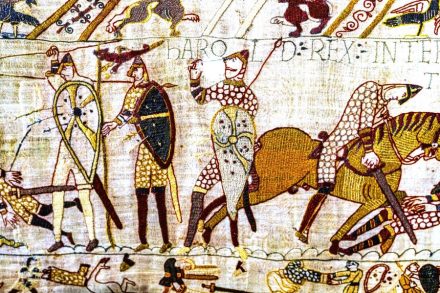
Move over Kim Kardashian, with your cover shots for Paper magazine. Same for you, Taylor Swift, with tickets for your Eras tour. For there’s a new phenomenon breaking the internet – with sales appearing to rival the speed of Glastonbury – and it’s not so much viral as venerable.  When I made a note in my diary for 10 a.m. on 1 July to get tickets for the Bayeux Tapestry display at the British Museum, little did I imagine just how difficult it might be. Prompted by my younger daughter’s project on the Norman Conquest, and its commission by Bishop Odo, William the Conqueror’s half-brother, I promised her we’d go and see it in the autumn when it came to London – its first trip to these shores since it was taken to France late in the 11th century.

‘I think I’ve found a real paradise’: David Hockney interviewed

From our UK edition

David Hockney has died, aged 88. During lockdown in 2020, Martin Gayford, the author of ‘Conversations With Hockney’, spoke to him for the magazine. Spring has not been cancelled. Neither have the arts ceased to function. David Hockney’s marvellous exhibition at the National Portrait Gallery may be sadly shut, but the artist himself is firing on all cylinders. ‘I was just drawing on this thing I’m talking to you on,’ he announced when I spoke to him via FaceTime the other day. He was sitting in the sunshine outside his half-timbered farmhouse in Normandy. ‘We’re very busy here,’ Hockney explained, ‘because all the blossom is just coming out, and there’s a lot more to come. The big cherry tree looks glorious right now.

What did Britain really gain from the daring 1942 Bruneval raid?

From our UK edition

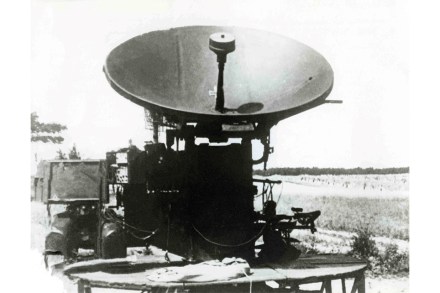
These days we use radar to help us park our cars, but during the early years of the second world war it was white hot technology and a closely guarded military secret. First used to detect aircraft in 1935, within a few years it had helped win the Battle of Britain and sink the Bismarck. It was so secret that work on it was forbidden even to physicists of genius who had fled the Nazis. (In the event, this freed up two such émigrés, Rudolf Peierls and Otto Frisch, to prove the viability of the atom bomb and thus kick-start what became the Manhattan Project.) Intelligence about what the enemy was up to with radar had a price above rubies.

Letters from Spectator readers, July 2024

The cunning of the Democrats’ lawfare On the right flank the aristocrats of the conservative intelligentsia dominated by the likes of Max Boot, David Frum, David French, Bill Kristol and George Will would rather compromise than soil their false pride; the haughty intellectual snobs are thus perfect targets for Alinsky’s “Make the enemy live up to its own book of rules” — aristocratic intellectual elites that would rather die than support a judicial and policy juggernaut with bad table manners. As Victor Davis Hanson observed, Marquess of Queensberry Republicans would rather lose nobly than win ugly. — Adler Pfingsten Will Cherelle Parker become the next ‘America’s mayor’ in Philadelphia?

letters

Joe Biden’s D-Day performance is evidence of his mental unfitness

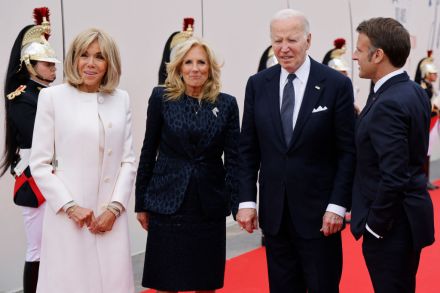
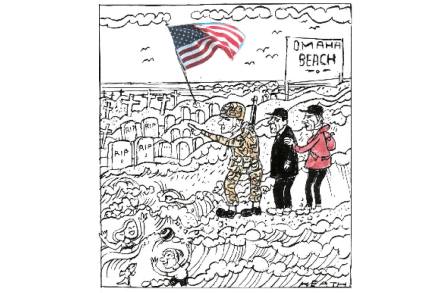
President Joe Biden spoke in Normandy on the eightieth anniversary of D-Day Thursday — and only slightly made a fool of himself. As he entered the event, it looked as if he entirely missed where he was supposed to sit, but played it off with a nice salute to a veteran. In the middle of a rousing speech, he talked about how many Russians died in Ukraine... for mysterious reasons. He did a bit of a squat in an invisible chair as the speaker Lloyd J. Austin III was introduced. The debacle ended with Dr. Jill Biden leading Joe away as the president of France, Emmanuel Macron, nimbly ran to greet D-Day veterans. And we can’t forget Biden’s subtle double fist pump after the jets flew over the ceremony.

d-day

This Memorial Day, reflect on your freedom

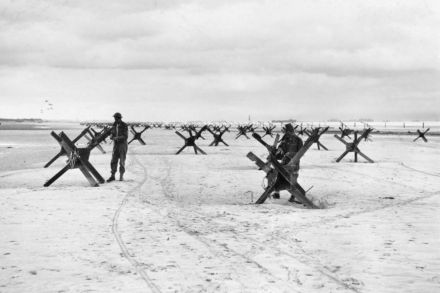
Last summer, I spent some time in and about Port-en-Bessin-Huppain in Normandy. The little fishing village and its surrounding towns on the English Channel (“La Manche,” “the sleeve” en français) is delightfully picturesque in that rugged, elemental way that proceeds from the collision of tempestuous sea and commanding headland. Expansive fields of corn and other crops ripened fast, orderly in their serried, midsummer ranks. Orange-red poppies punctuated the grassy, flower-strewn verge and complicated the landscape, heavy with age and history. Poppies are for remembrance — and there’s a lot to remember in these parts.

d-day memorial day

On D-Day at eighty

Traveling to Normandy fourteen years ago, we encountered a rare guide. He was a middle-aged Frenchman native to the neighborhood. I do not recall how long he had been at it, but he had learned something important about the guide business that was evident the day he shepherded us, and another American woman and her teenaged daughter, about the places made famous before any of us were born. He knew when to show, when to tell and when to relate something from his own experience that would enlighten ours. He took things in a certain order, which was not the order I would have guessed. First we stopped at the German cemetery at La Cambe, where 21,200 of the some-80,000 German soldiers who died in Normandy are interred. I remember few other visitors.

Normandy

The Hundred Years War ends in England’s agonising defeat – but triumph for Jonathan Sumption

From our UK edition

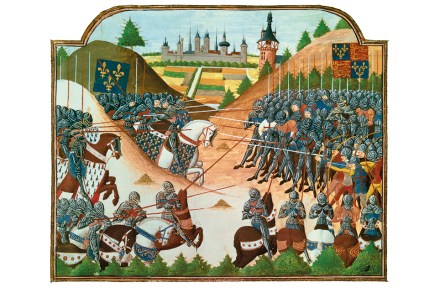
On 5 February 1328 the last Capetian king of France was laid to rest in the royal mausoleum of Saint-Denis. It is now 33 years, and more than 3,000 pages since Jonathan Sumption’s first readers followed Charles IV on his last journey, as his funeral procession wound its slow way from Notre-Dame across the Grand Pont and out through the streets of Paris into the open countryside to the north of Europe’s most populous and richest city. The death of Charles IV led to a crisis of succession that for the next four generations would embroil France and England in a war of unimaginable savagery.

All about my mother: Édouard Louis’s latest family saga

From our UK edition

Shunned by his father and his peers because of his homosexuality, Édouard Louis (born Eddy Bellegueule in 1992) left his village in rural Normandy and moved to Paris, becoming the first member of his family to attend university. By his mid-twenties he had published three well-received autobiographical novels: about working-class machismo (The End of Eddy), his experience of sexual assault (A History of Violence) and the condition of the French welfare state (Who Killed My Father). In his latest book he turns the spotlight on his mother, revisiting ‘the succession of accidents that made up her life’. Monique Bellegueule had ambitions to train as a chef, but was derailed by teenage pregnancies and terrible relationships.