
What in Heaven’s name should we do about the benefit bill? And what on earth can be done about it? Both those questions were recently addressed by Kemi Badenoch’s thoughtful Wilberforce lecture on ‘The influence of Christianity on Conservative thinking.’
In the lecture, Badenoch asserted that ‘work is good for the soul as well as the economy’; affirmed ‘the Christian recognition that we all have duties to ourselves, our families, and communities’; recognised that ‘the state matters – no decent society abandons those with severe needs’ and quoted St Paul’s epistle to Timothy that: ‘Anyone that does not provide for his own household … is worse than an unbeliever.’
Hard-working people on modest incomes are incensed that their taxes are used to discourage others from working. They want help focused on the genuinely disabled
But, she added: ‘If one in four now self-report as disabled, we have to be honest: welfare must be reformed so help reaches those with serious conditions, while we support others to recover and return to work.’
A bevy of Bishops promptly criticised her, without apparently reading her lecture.Former Archbishop Williams said: ‘Badenoch seems to assume that poverty is a lifestyle choice’. The Roman Catholic Bishop Moth asserted that: ‘care for the poor [is] an essential expression of our faith’ as if Kemi had denied rather than reaffirmed just that.
It is unfair to criticise off-the-cuff comments by Bishops reacting to snippets of Kemi’s speech shared by mischievous journalists. Politicians likewise give knee-jerk responses to phrases from sermons they have not read. I joined the cabinet after the ‘Faith in the City’ report was published by the Archbishop of Canterbury’s Commission on Urban Priority Areas,provoking similar foolish exchanges. Fortunately, the new Archbishop of Canterbury, George Carey, agreed that if the government and Church of England were invited by the media to comment on each other’s remarks, we would always read the full text of whatever we were discussing. A similar concordat between the Bishops and Tory benches would be welcome.
What clerical comments on social security demonstrate is a lack of coherent Christian thinking about how personal morality relates to the welfare state. As Kemi said in a later podcast: ‘In early Christian times there was no welfare state… The Christian tradition is about communities and families and charity, not about compulsory taxation in order to pay for welfare.’ That is true. Christ’s parables emphasise personal responsibility to our neighbour. The Good Samaritan cared for the injured man at his own cost. He did not pluck money from the wallets of those who had walked by on the other side.
Now the welfare state provides a safety net – and more – what is our Christian duty? Is it to vote for the most generous and unconditional level of provision on offer – mostly paid for by those better off than ourselves?
Surely Kemi is right: we should focus finite resources on the genuinely needy while requiring those who can work to do so – because ‘work is good for the soul as well as the economy’.
While bishops have disputed the morality of welfare reform, Labour ministers have concluded it is politically impossible. The government was forced to abandon its plans to restrict Personal Independence Payments and the Chancellor extended, rather than curbed, benefits at the last budget.
The current upsurge in disability benefit claims is neither unprecedented nor insoluble. When I became Social Security Secretary, the number of people claiming invalidity benefit had nearly trebled over a decade. Rowan Williams is right that few people choose poverty. But on losing their jobs – usually through no fault of their own – they discovered that they could top up unemployment pay with invalidity benefit just with a GP’s note. Having convinced others, and themselves, that they could not work it was hard to convince employers that they could. They became trapped on benefits.
I decided to replace ‘GP’s notes’ by an objective medical test by medical practitioners employed by the department. I feared this would be politically explosive. Many articulate, middle-class people were on this benefit. So I wrote to the Prime Minister warning him to be braced for a backlash.
The letter was accidentally sent to the Press Association. I feared it would kill the proposal and end my career. The media erupted. I did a dozen interviews with the interviewers mercilessly reading out my words about the likely hostile reaction.
But each interview got easier. The public began to call in describing how this benefit was abused by fit and healthy neighbours – even people training for the Olympic team. Benefit recipients sheepishly admitted that it had prolonged their period out of work. The overwhelming reaction was: ‘Why hasn’t government tackled this sooner?’
The public is far better informed than the media class about how the benefit system works – or doesn’t. Hard-working people on modest incomes are incensed that their taxes are used to discourage others from working. They want help focused on the genuinely disabled.
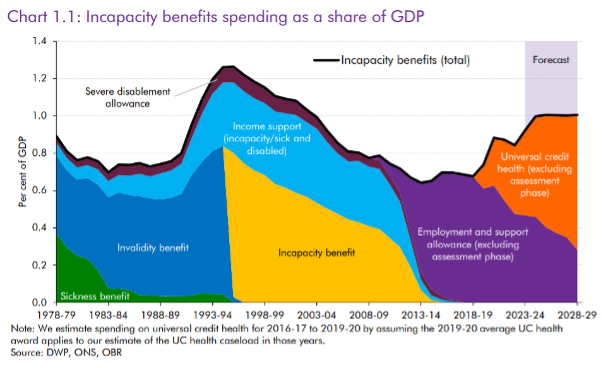
My reforms worked. An OBR analysis shows spending peaked in 1995 when applicants for the new incapacity benefit faced an objective medical test. It fell steadily as a share of national income for the next 20 years. Blair kept the reforms and, once the test was established as fair and objective, extended it to existing recipients whom I had initially exempted.
Welfare reform never ends. Behaviour of claimants and benefit staff evolves. During Covid the system apparently reverted to accepting PIP applications without face-to-face examination. People have come to treat anxiety and depression as reasons for not working rather than problems likely to be alleviated by a job.
A government which refocuses benefits on the needy by requiring the fit to work will (I pray) be blessed in Heaven and certainly rewarded by voters on earth.



Comments