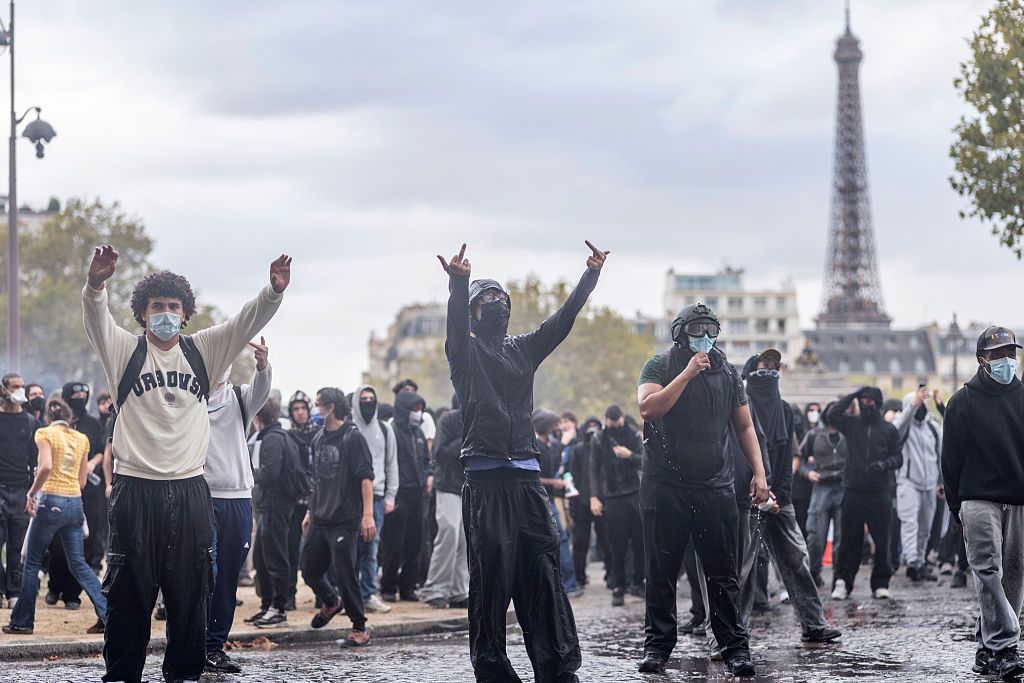
France has had its share of riots in recent years but the scenes of urban warfare that erupted on Saturday were unprecedented. The Socialist mayor of Paris, Emmanuel Gregoire, said entire streets ‘have been devasted’. His shocked deputy, Lamia El Aaraje, said the capital suffered ‘a level of violence that I believe we had never seen before’.
In Limoges, the city hall was burned to the ground and those in Lille and Marseille were badly damaged. A tourist office in the heart of Lyon was razed and in Agen the branch office of Marine Le Pen’s National Rally was ransacked.
As Sébastien Lecornu said, the violence was perpetrated by two groups: far-left extremists and what he termed ‘criminals’.
In Nice, Toulouse, Rennes and Bordeaux police fought running battles with thugs. Journalists were targeted in Brest and in Paris masked protestors besieged a conservative television station.
But it was Paris that bore the brunt of the anarchy on a day that left 150 police officers and gendarmes injured, some of them seriously. Cars were set alight, as were newspaper kiosks and restaurants. Nearly 900 people were arrested. Police attempted to disperse the rioters with water cannon and tear gas but as night fell there was widespread looting. Supermarkets, sports stores and fashion boutiques were stripped of their goods.
The Prime Minister, Sébastien Lecornu, issued a statement in the evening in which he told the nation that they ‘can be proud of their police officers and gendarmes’. He also named those responsible for the mayhem: ‘Far-left groups have organised acts of violence in several towns and cities across France; criminals have joined in to loot and destroy.’
Marine Le Pen went further, pointing a finger at Jean-Luc Mélenchon, the leader of the far-left La France Insoumise. ‘Legitimate social demands have once again been held hostage by the far left and the speeches of Jean-Luc Mélenchon’s MPs, who… seek to plunge the country into chaos,’ she said.
Those social demands were a merger of the school protest movement, which began last month, and the return of the yellow vests.
The latter had weeks ago earmarked Saturday October 17 as a day of peaceful protest at the cost of living crisis. Then schoolchildren began demonstrating about the state of the education and the two movements converged in what some had billed as a ‘Jeune/Jaune’ (Young/Yellow) protest.
It brought more than half a million people out onto the streets across France on Saturday; men, women and children peacefully expressing their dismay at their deteriorating social conditions. But their message was drowned out by the police sirens, fireworks and breaking glass as thousands of thugs ran riot.
J.D. Vance, the American vice-president, blamed the violence on mass immigration: ‘Western liberals imported the third world into France and other countries in the name of diversity and compassion,’ he posted on X on Sunday morning. ‘They were told it would lead to this and they didn’t listen. I pray that France, a beautiful country of amazing people, will stop this madness before more of its landmarks burn.’ It is not as straightforward as that. As Sébastien Lecornu said, the violence was perpetrated by two groups: far-left extremists and what he termed ‘criminals’.
Far-left extremists are usually white, like those arrested earlier this year after the death of a nationalist student in Lyon. The people seen on television forcing their way into the city halls of Marseille and Lille were mainly white. On the other hand, the ‘criminals’ filmed looting in Paris, Marseille and Bordeaux appeared to be of immigrant background.
A few of the violent demonstrators wore yellow vests, but these are not the yellow vests of 2018, when the movement first began. Those protestors – who came mainly from the provinces – were middle-aged men and women struggling to make ends meets; they were apolitical and just wanted someone in Paris to listen.
Those who went berserk in France on Saturday aren’t interested in dialogue. They are young and wear Keffiyehs and wave the Palestinian flag. What they want is a ‘New France’. This term was first coined by Jean-Luc Mélenchon in a speech in 2018, and which he has since developed. Addressing a crowd in Seine-Saint-Denis, the most immigrant-heavy department in France, Mélenchon announced: ‘I’m not afraid, and I’m not ashamed to say it: what you see here is the New France’. Ironically, he delivered the speech the day after the first Yellow Vest protest.
Mélenchon has been on the rise ever since and the polls are predicting that he and Le Pen will face each other in the second round of the presidential election in April. Le Pen is the favourite to win, but one fears how her victory will be received in some quarters.
The anarchy yesterday may just be the hors-d’oeuvres to what will explode in the spring.



Comments