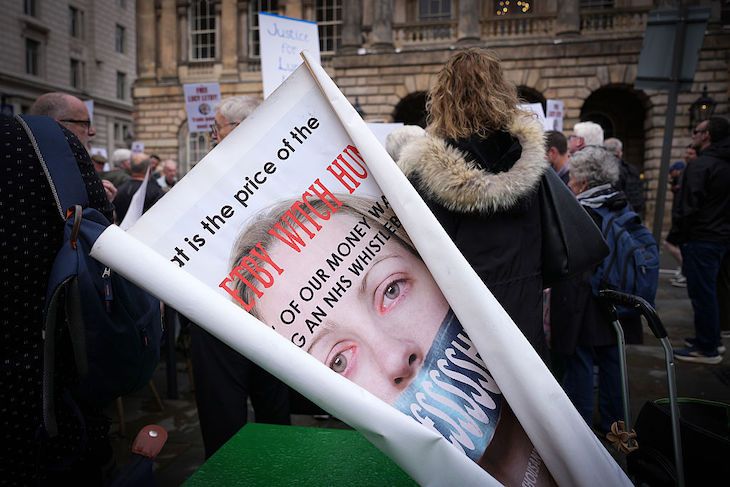
Lady Thirlwall prefaced the launch of her report yesterday with the same message that she launched her public inquiry with two years ago. This was not about the guilt or innocence of Lucy Letby, she said. That matter has been decided in two trials and two appeals. The Thirlwall Inquiry is about how Letby was allowed to get away with it.
Despite this caveat, I would bet that most people’s motivation for reading her surprisingly gripping report is to seek out evidence of Letby’s guilt or innocence. There are plenty of nuggets of fresh information, but little for Letby’s band of supporters to cling onto. The three volumes of the Thirlwall Report are not the case for prosecution. They are not even half of the case for the prosecution. But if the report achieves nothing else, it must surely convince any fair-minded reader that there was a spate of unexpected, sudden deaths and collapses in the Countess of Chester Hospital under Letby’s watch between June 2015 and June 2016 that cannot be explained by infection or bacteria or under-staffing. There is a wealth of evidence showing that these incidents were considered alarming at the time by doctors and nurses alike. They were not retrospectively badged as suspicious in some bizarre attempt to frame an innocent nurse.
It is a tried and tested method of murder in hospitals, previously employed by Victorino Chua, Beverley Allitt and Colin Norris
Since the aim of the report is to learn lessons for the NHS, Thirlwall’s story starts and ends in the hospital. The Letbyist’s bête noire Dewi Evans, the paediatrician who found forensic evidence of foul play, never gets a mention since he was not involved until the year after the last murder. Instead, we have an account of mounting unease among medics at a neonatal unit who are seeing things that they have never seen before and which they cannot explain. This is not a story about the “how” but the “who”. And since the “how” was explained in court and the “who” is serving fifteen whole life sentences in HMP Bronzefield, the only question is why she wasn’t caught sooner.
Hindsight is a wonderful thing, but since no one saw Letby doing anything untoward and her modus operandi was still a mystery when she was taken off the ward in July 2016, one must be realistic about this. Even if she had been arrested in June 2015, when she had already killed three babies and attacked another, it is far from certain that she would have been convicted. Sending a few misleading text messages and being in the wrong place at the wrong time is not enough to convince a jury of guilt. Yes, there was some medical evidence too, but it didn’t point directly to Letby.

But, as Lady Thirlwall argues, Letby could plausibly have been stopped in early August. The biggest missed opportunity was the failure to recognise clear evidence of insulin poisoning in a routine insulin test. High levels of insulin combined with low levels of C-peptide are considered in science and law to be unambiguous proof of the administration of exogenous insulin. Baby F, who was suffering from severe hypoglycemia, had a very high insulin reading and levels of C-peptide so low that they could not even be measured. The Senior Clinical Scientist at the laboratory that ran the tests phoned the hospital to alert staff to this, but the doctor at the Countess considered the possibility of deliberate insulin poisoning to be “so fantastical and unlikely” that she did not bother mentioning it to anybody. As Lady Thirlwall says, the results “should have led immediately to a call to the police”. Had it done so, Baby F could have been Letby’s last victim. Instead, the last child on the indictment was Baby Q. The victims are listed in alphabetical order.
Astonishingly, this happened twice. In April 2016, another neonate – Baby L – had extremely high levels of insulin and very low levels of C-peptide. The laboratory again called the hospital and spoke to the duty biochemist who called the neonatal ward but, unable to speak to anybody, settled for updating the infant’s medical records with the test results. They went unnoticed by the doctor who was caring for Baby L at the time. (Known as “Dr A” in the original trial and as “Dr U” in the Thirlwall Inquiry, his identity was revealed as Dr Mark Deakin after his death in July. He was described as Letby’s “boyfriend” by the prosecution, although there is no reason to believe he was her accomplice.)
Unaware of the insulin evidence, all the doctors had to go on was the coincidence of Letby’s presence. The death of Baby I in October 2015 raised their suspicions to new heights and they began to think the unthinkable. There had now been five highly unusual deaths in five months in a hospital which normally saw two or three deaths a year, typically of infants born with congenital abnormalities.
Since the start of the year, there had been seven deaths on the neonatal unit and Letby had been on shift for all of them. Only two involved congenital abnormalities. A shift chart showing Letby’s invariable presence at the scene of the possible crimes was drawn up but when it was e-mailed to the Head of Risk and Patient Safety by Dr Brearey as the Appendix to a ‘Thematic Review of Neonatal Mortality’ it went unseen. The recipient defended herself at the Thirwall Inquiry by explaining that she received more than 100 emails a day and didn’t scroll all the way down to the bottom of the document. She complained that “if Dr Brearey felt that he needed me to do something, he should have stipulated that very clearly in the email”, a response that Lady Thirlwall described as “unacceptable”.
The tipping point was reached in June 2016 when Letby was cot-side as two healthy triplets suddenly died within a day of each other. “He’s not leaving here alive, is he?”, she said while Baby P was being resuscitated, a comment that shocked the doctor she was talking to. Incredibly, even after this, several nurse managers resisted attempts to remove Letby from the unit – not to have her arrested or sacked, but to merely have her suspended from duty while an investigation could be undertaken. It is these managers who bear the brunt of Lady Thirlwall’s scorn while the doctors are largely treated sympathetically. “Acknowledgement of their errors and failings was characteristic of the consultant paediatricians”, she writes. “The doctors’ reflective and self-critical approach is in marked contrast to that of the managers to whom they turned for assistance.”
The campaign to free Letby is a clown show
Of course, if Letby’s many convictions are overturned on appeal, this whole narrative will have to be flipped on its head. The managers will become heroes who stuck up for a persecuted nurse while the doctors will become villains who engaged in a deranged witch hunt against a vulnerable young woman. But that is unlikely to happen for two reasons. Firstly, because she did it, and secondly because the campaign to free Letby is a clown show.
On Monday, two of the supposedly world-leading experts who have been recruited to come up with alternative interpretations of the evidence announced that they will no longer be working with the defence team. Helen Shannon, a chemical engineer, and Geoff Chase, a professor of bioengineering, became part of Letby’s appeal after claiming that very low C-Peptide readings are not unusual in neonates. They take issue with another group of academics on the defence team who claim that the insulin and C-Peptide readings in the Letby case should have been ignored because the test is not reliable. Shannon and Chase say that the other group’s claims are not only “demonstrably inaccurate” but are “inconsistent with the available evidence, science and established physiology”.
Letby’s lawyer, Mark McDonald, told Newsnight that he “fundamentally disagrees” with Shannon and Chase despite them being on a panel of experts who he described as “the best in the world” until this week. Neither theory stands much chance of persuading the Court of Appeal, but the fact that Shannon and Chase chose the day before the Thirlwall Report was released to make their headline-grabbing announcement suggests that all is not well on Team Letby.
For her part, Lady Thirlwall dismisses “suggestions from different quarters outside the Inquiry that the testing carried out was in some way defective”. Many of her recommendations, such as mandatory webcams above every hospital cot, are unlikely to pass the cost-benefit test, but while public inquiries tend to result in backward-looking and expensive regulation, her recommendation that any test that shows elevated insulin and low C-peptide levels should be “immediately acted upon” seems sensible. It is a tried and tested method of murder in hospitals, previously employed by Victorino Chua, Beverley Allitt and Colin Norris. If there is one lesson from the Countess of Chester tragedy it is that this red flag should never be overlooked.





Comments