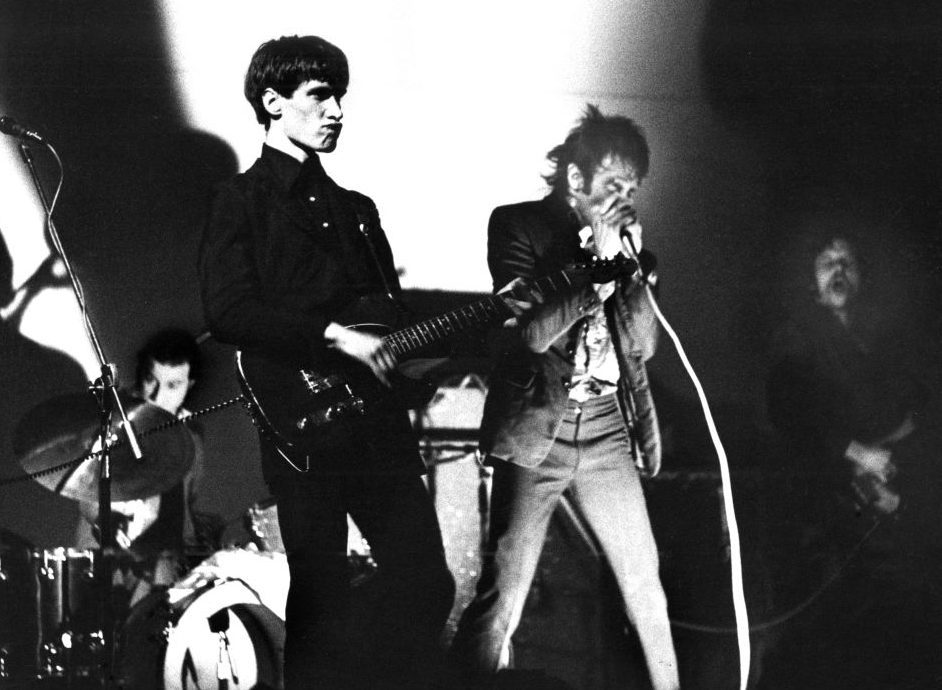
At the recent West End run of the play about Wilko Johnson, the guitarist and co-founder of 70s rockers Dr Feelgood, one exchange always got a big laugh. It was part of an argument between Lee Brilleaux, the band’s singer, and Wilko himself.
Lee: We were more popular after you left. We had our biggest hits after we kicked you out of the band. I mean, do you know how many Dr Feelgood tribute bands there are now in Spain?
Wilko: I dunno. And I don’t care.
Lee: Twenty-seven.
It is a peculiar phenomenon, this: there may be plenty of 70s bands still going strong, but most are way more successful than Dr Feelgood in terms of what used to be called record sales. Spotify, for example, currently lists approximately 30 million monthly listeners for the Rolling Stones. That’s roughly 174 times more than Dr Feelgood’s 171,000.
Dr Feelgood were only properly big for about ten minutes
Dr Feelgood were only properly big for about ten minutes. It was exactly 50 years ago this month, at the tail end of the glorious summer of 1976, that their live album Stupidity hit number one. It is still the only live album in rock history to go straight to the top of the charts. The band’s fans included Elton John, John Lydon, Paul Weller, Joe Strummer and, it is said, a young Diana Spencer.
But that date is key. 1976 was the age of the monoculture. There were just three TV channels and only one national radio station, Radio 1, that played pop and rock. We were all – I’m only slightly exaggerating – watching and listening to the same thing. The UK population in 1976 was just over 56 million. Roughly 28 per cent of that figure – nearly 16 million – were aged between 12 and 30, the ages when we are most receptive to new music.
Let’s assume – not unreasonably, I think, given Dr Feelgood were briefly so very popular – that a quarter of those new music listeners were fans of, or receptive to, the band. That means there were 4 million Feelgood fans in the UK alone in 1976. Most of those fans will still be alive today. And many will have passed their listening habits on to their kids. Hence the wide-ranging and enduring appeal.
These numbers partly explain why the eyes of so many men (and it is mainly men) ‘d’un certain age’ light up when the band is mentioned. They also reveal why the play about Wilko Johnson was an unexpected success. It is about to tour the UK, having smashed records at the Queen’s Theatre Hornchurch, sold out London’s Southwark Playhouse and completed a successful five-week run in the West End. (Declaration of interest: I wrote it. But every word belongs to, and was inspired by, Wilko.)
It helped that the play had a fantastic, stranger-than-fiction story to tell: in 2012, Wilko was diagnosed with incurable pancreatic cancer and given a year to live. Overnight, he became more famous than ever, thanks to his cheerful acceptance of his fate. Twelve months later, doctors realised they’d made a mistake. Wilko, who by that stage had become a nicer person (or, in his words, ‘less of a C**t’), lived for another 10 years. It’s basically A Christmas Carol, but with guitars and cancer.
But compare the extraordinary name recognition for Wilko (who also, improbably, starred as a mute executioner in Game of Thrones) and Dr Feelgood with the awareness of the mega-hit ‘Rein Me In’, by Sam Fender and Olivia Dean, which recently broke the record for the most weeks ever spent at number one. My research is far from scientific. But at a recent dinner party of 12, only three had heard of it. And Times Radio recently spent five minutes discussing why so few people had actually heard of the song. As The Proclaimers might have sung: ‘Top of the Pops nae more! Radio One nae more! Music industry nae more!’
There’s more to Dr Feelgood’s long half-life than statistics. 1976 was a terrible year for music. Glam rock had burned out, prog was boring everyone stupid and the charts were full of novelty songs or soul-sapping vapidity. Dr Feelgood, with their startling, manic R&B, went off like a bomb in a Buddhist retreat. It was thrillingly punk-ish, even if punk hadn’t officially been invented yet.
Live, the band were incendiary. Lee and Wilko, the focal points, were crazy, thrilling and threatening. You didn’t know if they were going to play for you or beat you up. And they were funny. In a demented kind of way. Rik Mayall said he learned as much about comedy from Wilko as anyone: ‘…that absolute seizure of the audience… The power and the terror. It was incredible.’
The band changed the course of popular music. Within a year of Stupidity topping the album charts, punk went nuclear. You’d be hard-pressed to find any punk, alive or dead, who hasn’t acknowledged the band’s huge influence. As Johnson himself said: ‘People say we influenced punk. No we didn’t. WE F***ING INVENTED IT.’
It won’t surprise you to learn that the ‘original’ Dr Feelgood are a) still touring successfully, and that b) despite the band being the official, authorised version, they have no original members remaining. Like so many pop brand names, the band have become like a KFC franchise: visible, lucrative and recognisable, provided you know how the industry works.
This is nothing new, of course. For years, Herman’s Hermits toured with no Herman and just the one Hermit. Today, bands like Lynyrd Skynyrd, Foreigner and Yes (no!) continue to perform, but with no original members. And it probably doesn’t matter. Because nostalgia is bigger than ever. Us boomers have money to spend, and provided the new holders of the title can cut it musically, that’s okay by quite a few of us.
Whether you think one of the 27 Feelgood tribute bands in Spain can cut it, however, is a moot point. But they’re entertaining if nothing else. But if you want the real thing, please try some of the most exciting live rock and roll ever committed to celluloid, filmed, on a bare stage, with no pyrotechnics, on Southend, the band’s home turf.
Will there be 27 tribute acts to Sam Fender in Spain in 50 years? I doubt it. I have seen the future of rock and roll: and it’s in the past.
Wilko: Love and Death and Rock ’n’ Roll is touring the UK from Monday, September 7.





Comments