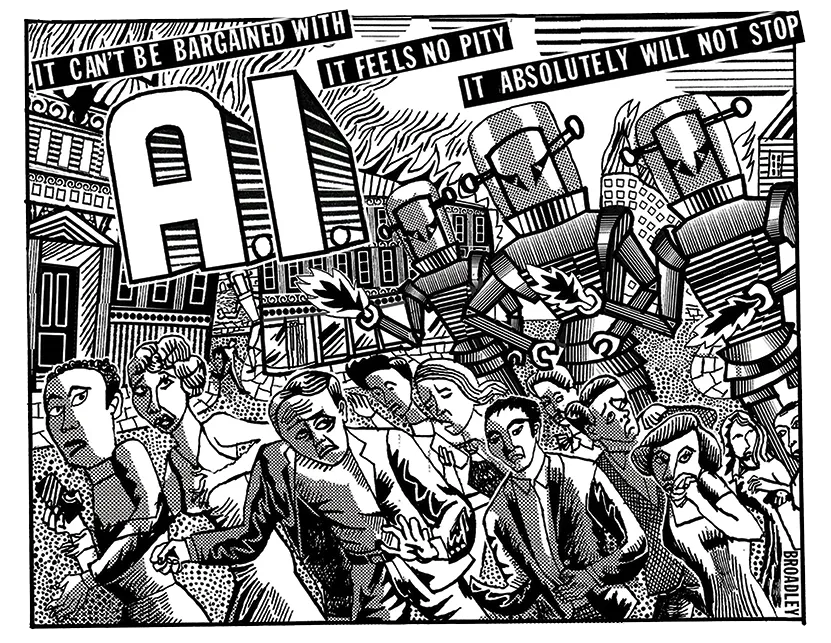
In the final scene of Casablanca, Humphrey Bogart explains to Ingrid Bergman why she’ll regret staying with him – ‘maybe not today, maybe not tomorrow, but soon and for the rest of your life’. The same can be said of when we’ll feel the impact of AI on the workforce. A tsunami is coming that will hit the entire political economy of Britain and the world. And a real danger is that that shock will cause a leftwards lurch and massive state intervention.
We are therefore facing one of the biggest economic shocks the nation has ever seen
The CEOs of Microsoft and Anthropic have already predicted that within 18 months AI will essentially be able to do any white-collar job and do it better than most humans. Their timelines may well be exaggerated but within five years AI will be able to do a huge variety of white-collar jobs. With advances in robotics, many blue-collar jobs could also be at risk within ten to 15 years, at a very conservative estimate. The effect on coding has already sent a chill through the Silicon Valley labour market already.
The British economy is particularly vulnerable to the labour replacing effects of AI – successive governments have made a bet on the service sector as the main driver of economic growth fuelled by a never-ending supply of fresh graduates from a mix of universities which vary between the world class and the questionable. Meanwhile, net zero policies have ratcheted up the cost of energy, while regulation has restricted access to the data required for the foundational large language models, essentially strangling the UK’s ability to be a leader in the technology at birth. It is highly likely that we about to enter an era of mass unemployment, with redundancies starting at the bottom of the service sector and creeping relentlessly upwards and outwards.

We are therefore facing one of the biggest economic shocks the nation has ever seen. The assumption that new jobs will be created to replace the old remains questionable, AI can do almost all tasks humans can do faster and better, without rest. Even if new jobs do emerge, it will be after two decades or more of massive economic and societal dislocation.
The last time the UK experienced anything like this was the industrial revolution, no one alive today has experienced anything close. Unlike that revolution, Britain is entering this from a position of economic weakness and as a taker not a maker – a vassal of the AI superpowers US and China. Most importantly, the impact of the industrial revolution was smoothed by the export of surplus population to the colonies and very gradual expansion of the franchise. We are entering this revolution with a stagnant economy, ever increasing population and universal suffrage. In many ways these conditions mirror those of the industrial proletariat that inspired Karl Marx to pen the Communist Manifesto. As AI companies concentrate capital and market hold, both at the state level and the company level, there is a real danger that the middle classes, which cushioned this nation against socialism in the 19th and early 20th century, find themselves with no alternative but to turn to the state for support.
The left is ready to respond with its usual raft of tools – higher taxation, greater regulation, enhanced government intervention in the economy. To these can be added the new utopia of universal basic income, a cradle to grave support. The authoritarianism of the Labour government’s response to technology is already clear in the expansion of the Online Safety Act, as it moves to restrict free speech platforms under the thin guise of child protection. Whether the moves happen under the Labour party, or an ideological flexible government from the nominal right, the shift to state authoritarianism is already beginning. AI adoption will super charge it.
Meanwhile the traditional right is looking backwards by focusing on undoing the Blairite legacy, from unpicking remaining EU legislation and the ECHR, to restoring the primacy of common law, to restricting or reversing mass migration. All worthy, and necessary causes, but as the world changes there is a danger this is moving deck chairs on the titanic.
There can be no return to the world of the pre-1997 era. To preserve the values which we hold dear – liberty, personal responsibility, entrepreneurialism and community – we must develop a coherent view on the national response to AI. Or, once again, we will be fighting a losing battle on the left’s turf. This must include a clear view of the political economy of the next 20, 50 and 100 years. The formulation of this vision and the road maps which support it must be set out now. While there are many dangers, there is also opportunity, not least the prospect of decoupling growth from mass migration.
Otherwise, to mirror Bogart in Casablanca, ‘We’ll always have Paris’ – a nightmarish mix of civil unrest, creeping integration into the EU and an encroaching state governed by a polo neck wearing class of bien pensant technocrats to whom our values are anathema. We must avoid this future nightmare at all costs, or we will regret it for the rest of our lives.




Comments