The fall of Olly Robbins and the renewed focus on what the Prime Minister actually knew about Peter Mandelson’s appointment returns acute attention to the one man who genuinely holds Keir Starmer’s fate in his hands.
There are important questions about the double standards at play here, and their possible causes
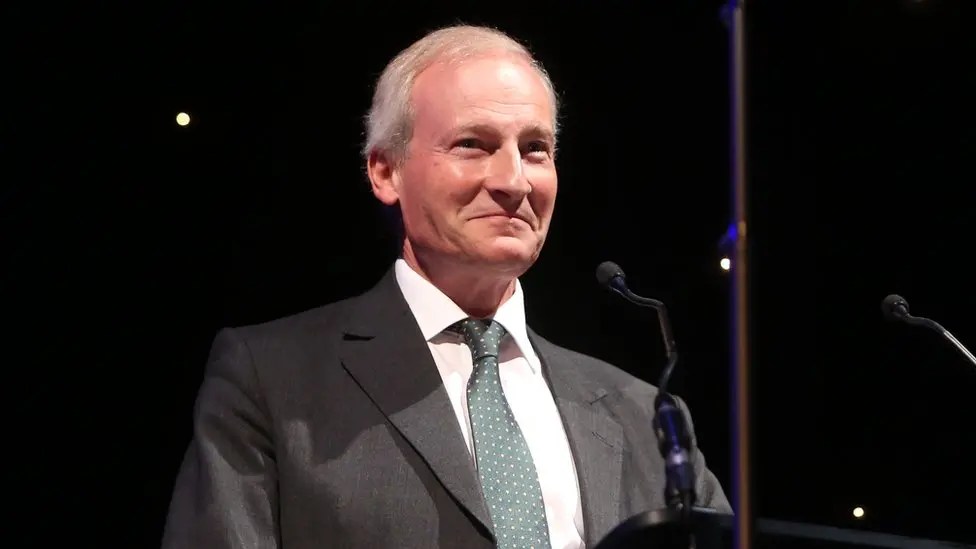
Sir Laurie Magnus is the Prime Minister’s ‘independent adviser on ministerial standards’, and he has the power to initiate an investigation into every aspect of the PM’s own conduct.
He is a banker by background, but this does not quite do him justice. He is a silken but steely courtier with commercial experience and integrity: a rare bird in Whitehall.
Educated at Eton and Christ Church, he is a baronet – the third in his family (the first having been a Tory MP before and after the first world war, and both an education reformer and a rabbi).
Appointed by Rishi Sunak in 2022, he survived the change in government, unlike the many advisers and directors of government departmental boards and quangos appointed under the ancien régime.
He has previously rejected calls to scrutinise the Prime Minister’s own conduct in the appointment process for Peter Mandelson to the Washington embassy. Dismissing the need for any investigation, he declared: ‘I consider that the documentation that has been made public indicates that the relevant process for a political appointee was followed.’
Yet it is now reported that the propriety and ethics (PET) team at the Cabinet Office – who work closely with Sir Laurie, as he himself has admitted in parliamentary evidence – had proactively suggested that closer examination was needed.
This is particularly strange, given that the opposition had asked Magnus to look into a ‘possible breach of the Ministerial Code’ by the Prime Minister, not merely for him to affirm the process was followed.
This narrow focus contrasts revealingly with his rather different approach in the case of Josh Simons’s resignation as Cabinet Office minister (from the department which contains PET) only a few weeks ago.
Then, he concluded that there had been no breach of the ministerial code but still advised Sir Keir Starmer that ‘you will wish to consider in the light of this distraction and potential reputation damage, whether he continues to hold your confidence as a member of your Government.’
While this liberal approach may have seemed somewhat ultra vires, it had no doubt been encouraged by current members of the government. In opposition they called for an expanded role for the adviser, especially when it came to pursuing Boris Johnson.
Still, while to many it was not an appropriate observation for an independent adviser to make when writing to the (elected) head of the government, it now raises important questions about the double standards at play here, and their possible causes.
Why cleave to a minimalist ‘process’ question in the case of the Prime Minister’s own conduct, having adopted a maximalist approach when enquiring about his ministers?
Why give a clean bill of health to such process, when you know your own support team had wanted to investigate Mandelson’s appointment more rigorously?
Why shy away from opining on the Prime Minster’s own conduct, when your predecessors Sir Alex Allan and Lord Geidt were seemingly champing at the bit to opine on Boris Johnson, and to see their advice acted upon?
This very confused picture would suggest either that he is making it up as he goes along, or perhaps that he is unwilling to overstep the mark when it comes to investigating the Prime Minister himself (or perhaps, not quite yet, so soon after an election). But in matters of standards, and ethics, what is sauce for the goose must be sauce for the gander.
In truth, such inconsistency can be justified neither by his own specific terms of reference nor by any balanced appreciation of the nature of our constitutional arrangements.
We have reached a fork in the road: will the grim march of public sector HR be taken to its logical conclusion, to include an elected Prime Minister? Or should it be rolled back?
Any constitutional conservative may instinctively prefer the latter, reasoning that we have parliament, the press and the court of public opinion, periodically expressed at the ballot box: these, surely, should be the proper safeguards against poor behaviour.
Alas, it may be too late for that: we must already reckon with a plethora of related bodies (the dreaded ‘stakeholders’): the Committee on Standards in Public Life, the Parliamentary Commissioner for Standards, the Advisory Committee on Business Appointments, and yes, the Cabinet Office propriety and ethics team.
Usually, in such cases, the march of the bureaucrats sweeps all before it, and a weakening PM will in time succumb to his prerogatives being whittled away, albeit postdated until after he himself has left office, naturally.
As it stands, Sir Laurie may now investigate alleged breaches of the Ministerial Code, not only if the Prime Minister asks him to, but (since 2022) with his ‘consent’. So: has the PM prevented Sir Laurie from fully investigating his own conduct in relation to Peter Mandelson?
Has Sir Laurie himself actually asked to do so, whether prompted by Kemi Badenoch, or privately, on his own account?
And if he has, but was refused, or had his proposed scope curtailed, would he ever declare this publicly? Intriguingly, his next annual report is due to be published at the end of May, so we await an answer.
All told, in a role that is dependent on retaining the PM’s confidence (on pain of dismissal, however camouflaged), this is an unsatisfactory, even untenable, situation, whether one takes a minimalist or a maximalist view with regard to prime ministerial powers.
How could an elected PM retain any adviser who recommended that his own conduct breached ministerial standards? From this unresolved constitutional conundrum all else flows.
Can we trust Starmer’s ignorance? Tim Shipman discusses on the latest Coffee House Shots podcast:


Comments