
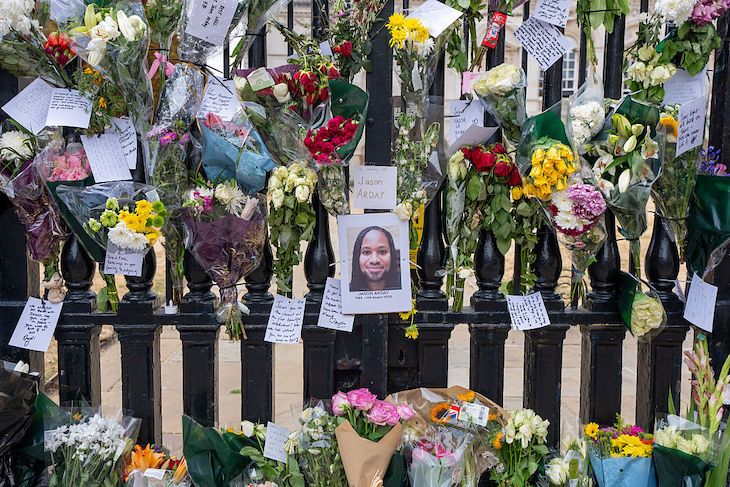
It’s been six weeks since the Jason Arday scandal came to its tragic conclusion, when the disgraced Cambridge professor was found dead at a flat in south London, after credible accusations of plagiarism, academic fraud and extensive fabrications about his personal life and achievements brought his career crashing down.
Arday was on a pedestal from which he was always, inevitably, going to be knocked off
Arday’s death triggered a moment of ‘anti-racist’ hysteria the likes of which we hadn’t seen since 2020 and Black Lives Matter. At a vigil in Trafalgar Square, Lord Woolley, the principal of Homerton College, Cambridge, called Arday the victim of a ‘lynching’ – a shameful, racially charged accusation that glossed over the extensive claims against Arday, demonising journalists and whistleblowing academics purely for exposing his falsehoods.
At that point, it became clear this story was being rewritten and the great and good were determined to dodge awkward truths, preferring to construct a lurid fantasy in which Arday was British academia’s Emmett Till. The pilfered PhD thesis, the apparently falsified quotes in his academic papers, the tall tales of running ultra-marathons, raising millions of pounds, or appearing on television shows aired before his birth – none of this is now allowed to intrude upon the agreed narrative.
Thus, Cambridge, which was dragged kicking and screaming into taking the allegations seriously, has been (partially) let off the hook. It has watered down its investigation into the Arday affair before it has even really begun. It will now focus on whether Cambridge offered him sufficient support amid the storm. This is much more limited than what was originally promised, a day before Arday’s body was found, when Cambridge vice-chancellor Deborah Prentice said there would be a ‘thorough and transparent’ investigation into his 2022 appointment by the Faculty of Education.
This doesn’t bode well for Cambridge’s now-battered reputation. Of course it should be held to account for how it supported a colleague at his lowest ebb. But as an ancient institution, nominally committed to the pursuit of truth and academic excellence, it also owes the world an answer as to why it ever hired him to begin with – a man whose wafer-thin record was obvious even before the plagiarised passages began to surface. Was Cambridge desperate for a more ‘diverse’ faculty? Was the university dazzled by Arday’s fantastical backstory? Did it sacrifice standards on the altar of identity politics?
Those who think ‘standards’ are the last refuge of the racist are only betraying their own bigotry of low expectations, not to mention their ignorance of this case. As the New York Times has reported, when Arday was appointed as a professor of sociology of education, he was chosen over ‘three more senior scholars, including two women of colour’. Perhaps it was his origin story – he claimed he was illiterate until the age of 18. Perhaps it was his ‘scholarship’, infused with the fashionable bunk of critical race theory. Either way, it appears Cambridge chose Arday at the expense of more accomplished ethnic-minority academics.
Even so, if Cambridge prefers to self-flagellate over how Jason Arday, who clearly wasn’t well, was treated by the university, it might well ask: was it ever particularly kind to elevate a man way beyond his talents, and to indulge a man who had become a prisoner of his own fantasies? Arday was on a pedestal from which he was always, inevitably, going to be knocked off – as soon as someone began poking around his wild claims and questionable CV. The blame lies squarely with Cambridge for putting him there in the first place.




Comments