
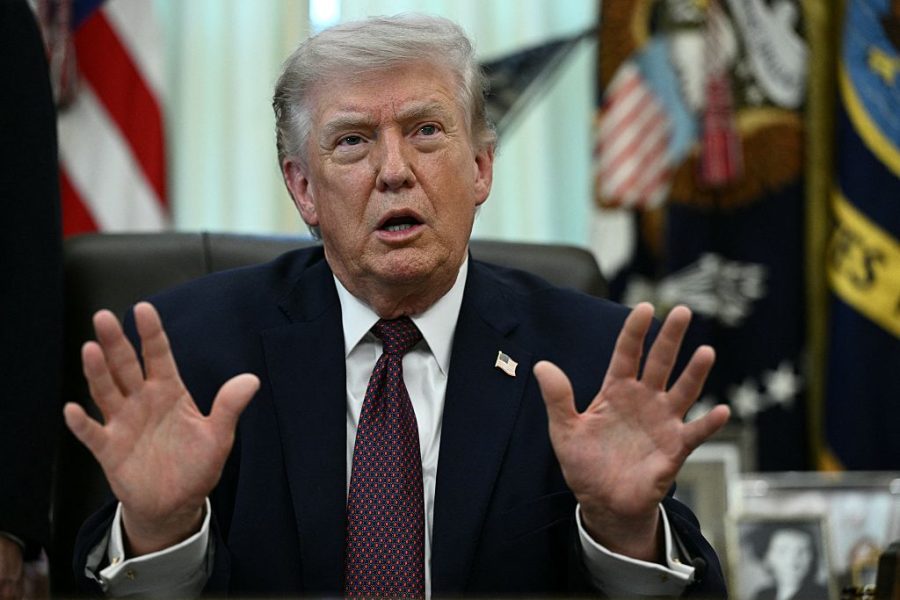
Donald Trump has never liked the North Atlantic Treaty Organization (Nato). Disagreements have been managed before and problems deferred, but his recent rage at Nato over what he sees as a lack of support for his war against Iran is now threatening to bring the issue to a head.
When he was still a candidate for the Republican party’s presidential nomination in March 2016, Trump made his feelings clear to The Washington Post:
Nato is costing us a fortune, and yes, we’re protecting Europe with Nato, but we’re spending a lot of money.
His objections were and are typically Trumpian: he sees other countries taking advantage of the United States, American goodwill and generosity being exploited and insufficient fealty being paid to him. It is undoubtedly true that other member states for decades underspent on defence in the knowledge that America’s military dominance would be a backstop. It is also true that the US provided the overwhelming majority of the alliance’s total defence expenditure (though that has fallen from 72 per cent in 2017 to 59 per cent last year).
Nato is not an all-purpose alliance
It is also clearly the case that President Trump’s notion of Nato is hazy at best. In May 2017, he made the charge that several member states ‘owe massive amounts of money from past years’. He spoke as if the alliance had a central fund into which members paid, whereas in fact there is only a relatively small direct budget for central operating costs like permanent headquarters, command systems and shared logistics, including joint airfields and communications networks. This will only cost €5.3 billion (£4.6 billion) this year, whereas the vast majority of spending is on national armed forces, last year totalling $1.4 trillion (£1 trillion).
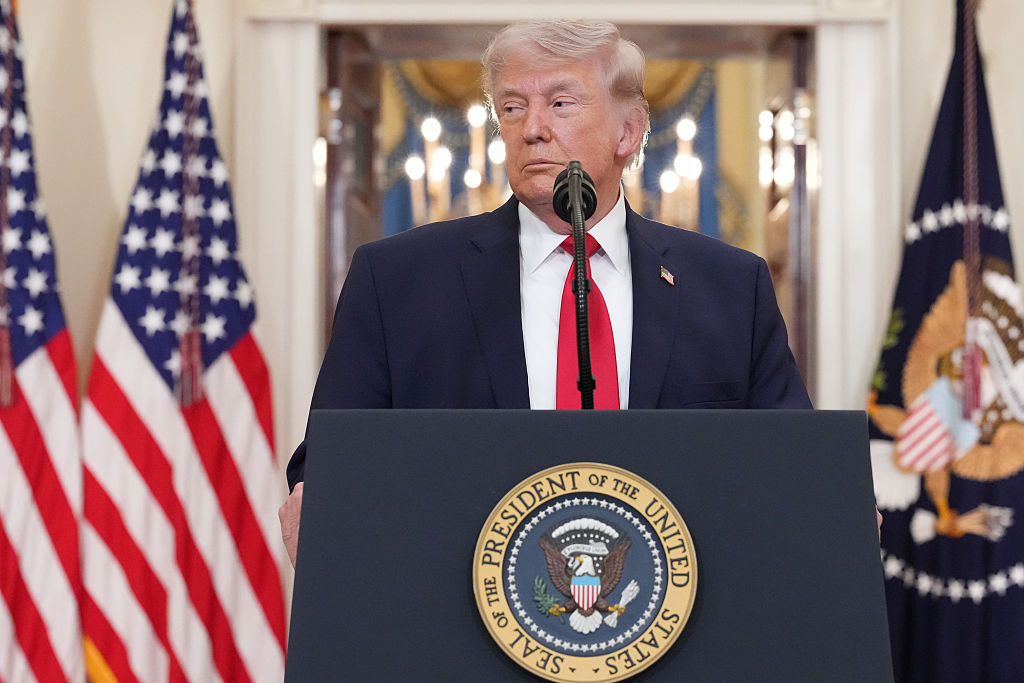
At the same time, Trump also said that Nato should be doing more to control immigration. Again, anything but a daring imaginative reading of the North Atlantic Treaty, the agreement which founded Nato in April 1949, sets out the organisation’s tasks: ‘the further development of peaceful and friendly international relations’, ‘maintain[ing] and develop[ing] their individual and collective capacity to resist armed attack’ and the:
Exercise of the right of individual or collective self-defence… taking forthwith, individually and in concert with the other parties, such action as it deems necessary, including the use of armed force, to restore and maintain the security of the North Atlantic area.
Nato is not an all-purpose alliance, which is why its member states are often part of other multilateral organisations like the European Union, the Commonwealth, the Council of Europe and the AUKUS defence partnership. Yet this is an area which has attracted President Trump’s ire recently: after the United States and Israel began their military campaign against Iran on 28 February –what America calls ‘Operation Epic Fury’ and Israel has dubbed ‘Operation Roaring Lion’ – he expected Nato member states to assist America as a matter of course.
On his Truth Social platform on 17 March, the President’s anger was palpable:
The United States has been informed by most of our Nato ‘Allies’ that they don’t want to get involved with our Military Operation against the Terrorist Regime of Iran… despite the fact that almost every Country strongly agreed with what we are doing, and that Iran cannot, in any way, shape, or form, be allowed to have a Nuclear Weapon. I am not surprised by their action, however, because I always considered Nato, where we spend Hundreds of Billions of Dollars per year… to be a one-way street – We will protect them but they will do nothing for us.
Military action against Iran was not an agreed Nato mission and member states were not informed in advance – neither was there any suggestion that it met the criteria of Article 5 to suggest the United States was under attack. So Nato had no obligation to assist nor jurisdiction to act. Legal and procedural niceties are, of course, irrelevant to President Trump. He has now said explicitly that American withdrawal from the alliance is ‘beyond reconsideration. I was never swayed by Nato. I always knew they were a paper tiger’.
Whether this is a determination of new policy or a passing fit of pique is not clear. There is, nevertheless, a minor hurdle: section 1250A of the National Defense Authorization Act for Fiscal Year 2024 states:
The President shall not suspend, terminate, denounce, or withdraw the United States from the North Atlantic Treaty… except by and with the advice and consent of the Senate, provided that two-thirds of the Senators present concur, or pursuant to an Act of Congress.
While this prevents unilateral formal withdrawal from the alliance, the President could radically downgrade America’s commitment with very similar consequences. Nevertheless, it is another safeguard.
The provision was inserted by bipartisan agreement between Democratic Senator Tim Kaine of Virginia and Florida Republican Senator Marco Rubio – now Secretary of State and National Security Advisor. If the President is determined to stand aside from Nato, and it falls to Rubio to manage the policy, it may act as a kind of morality play.
Swearing fealty to a lord as unpredictable and impulsive as Donald Trump can leave you badly exposed with your own words and actions. To stand by the President is not to stand by an ideology or political sensibility: it is to contract out your own judgement and philosophy. Are the glittering prizes worth it? In this case, that is a question for Secretary Rubio and his father confessor at the Church of the Little Flower in Coral Gables. But there is always a price.


Comments