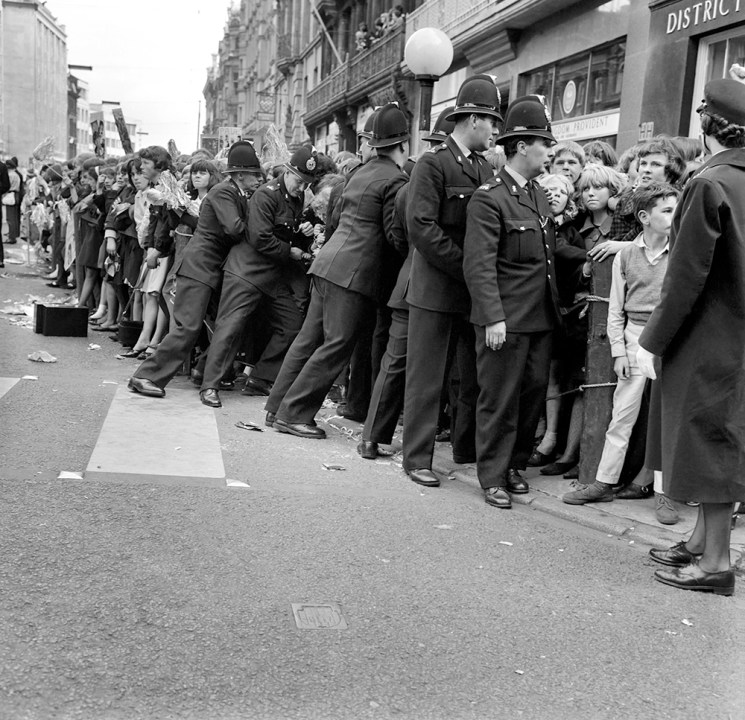

It would be easy to dismiss A Hard Day’s Night, the Beatles film made in 1964, as a throwaway period piece. The plot hurls the Fab Four into a meta narrative: they’re playing themselves while a director – a seething Victor Spinetti – panics as the boys are delayed on their way to a televised variety performance by mishaps, distractions and stampeding fans. The film was thrown together to fit the group’s breakneck schedule – scripted over a few weeks in January by Alun Owen, shot by Richard Lester by May and out in cinemas in July.
In her absorbing, concise book, Samira Ahmed sees the film not as a cursory promo but as a watershed moment in British culture – “a kind of cinematic big bang.” She sets out how its mix of social realism, let’s-do-the-show-right-here musicality, cinéma vérité and golden-age slapstick led to new possibilities in entertainment: ambitious rock-band films and promotional music videos as an art form.
Ahmed is a Beatles megafan. But you don’t have to be an obsessive to grasp the film’s significance
British pop cinema existed before A Hard Day’s Night, but it was mostly simplistic stuff. Summer Holiday, the gratingly chaste 1963 Cliff Richard vehicle, had nothing like the same wit, ironic detachment or wider effect. The Beatles had already turned down at least five film offers, holding out for a better, more ambitious project – as they always did. George Harrison recalled:
They wanted us to just be the group in the back or just pass through a film, just sing a couple of songs. But we didn’t want that because we’ve never enjoyed that sort of film. So we waited until we had a reasonable offer.
Ahmed, well known as a presenter of Front Row, BBC Radio 4’s flagship arts program, is a Beatles megafan. But you don’t have to be an obsessive to grasp the film’s significance through her scene-by-scene analysis and contextual notes. This is not a film theory text written in academic language. It’s a book about Beatlemania. Ahmed is in the tradition of cultural commentators such as the late Tony Wilson in that she brings rigor to her subject regardless of whether it is high artor pop culture.
There are irresistible details about the film’s cast and crew. Lester was a 32-year-old Jewish-American director, a semi-outsider in Britain with an anti-deferential streak. He cut his teeth working for Associated-Rediffusion, the upstart commercial TV channel in London, and begged United Artists to let him direct the Beatles. He and Owen sketched out the plot while observing the group holed up for days in a Parisian hotel room. It would earn Owen an Oscar nomination for Best Original Screenplay.
Much of the filming was improvised and Lester deliberately left in mistakes. Harrison really did fall over in the opening scene, in which the group are chased by “a cartoon cloud of girls,” as Ahmed puts it, down a platform at Marylebone station; Ringo Starr really did help him up. Even the title emerged on the fly, an off-the-cuff witticism from Starr. John Lennon and Paul McCartney turned it into a song overnight.
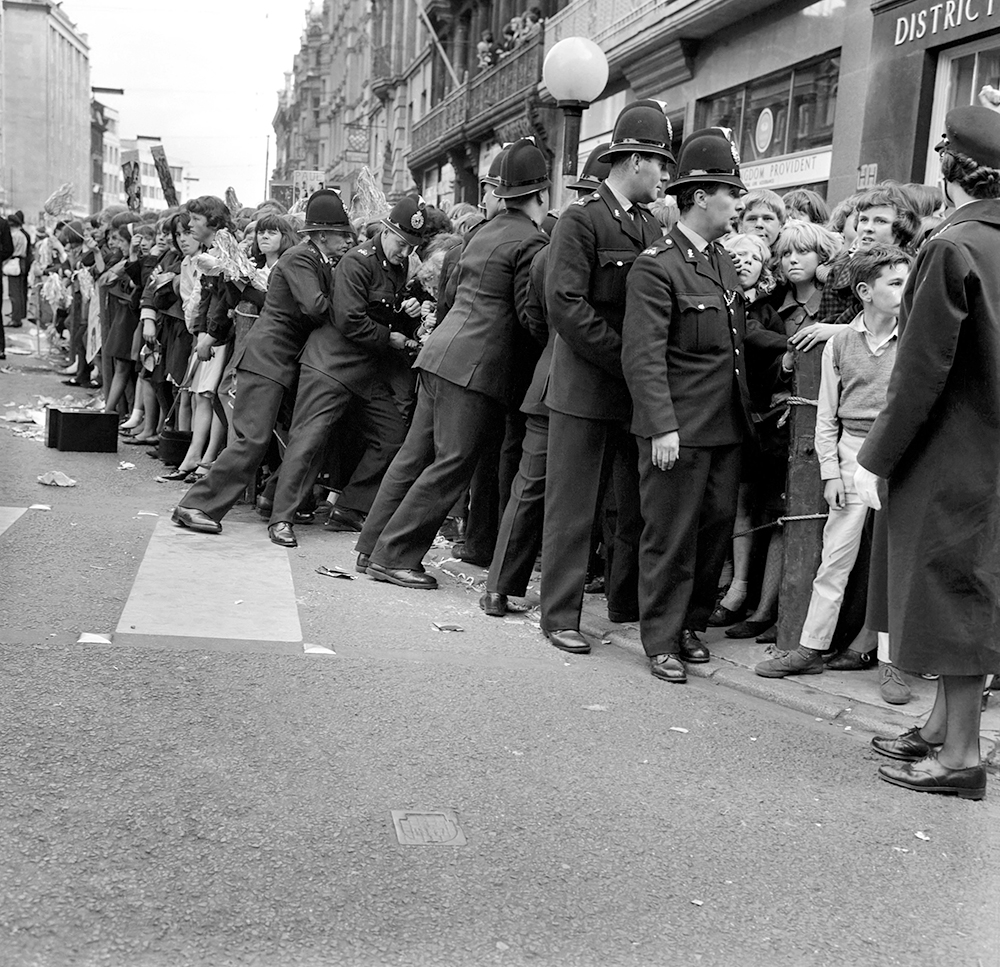
There were real-life dramas. Crowds appeared everywhere the Beatles filmed; an assistant lost most of the first day’s shoot when he, too, fell over running from fans, dropping film cans everywhere. Lennon’s absent father, the feckless Alfred, turned up unannounced during filming. He had not seen his son since he was five. “Tell him to fuck off,” said Lennon.
Ahmed draws on fresh interviews with a few people involved, whose reminiscences illuminate the strangeness of Beatlemania. David Janson, who played a truanting schoolboy, recalls how, after the Beatles finished a press conference, “adults descended like flies to snatch as souvenirs anything the four had touched.” It was not only teenage girls who were transfixed.
But it’s Ahmed’s perspective that is fresh. Beatles histories are typically written by men. Her book includes a chapter on the women in A Hard Day’s Night, but equally interesting are her observations on the Beatles from her perspective as a child of Commonwealth immigrants growing up in the 1970s. The group were vital to her understanding of Britain and her place in it. “The gang to end all gangs” made her feel welcome. I would like to have read much more on this.
In 1966, Maureen Cleave, the journalist closest to the Beatles, suggested that they had become as fixed in the British psyche as the Queen and Big Ben. But, as Ahmed points out, it took an immigrant to make the Britain of 1964 – a monochrome world of telephone booths, slam-door trains and variety performances – look like the most exciting place in the world.






Comments