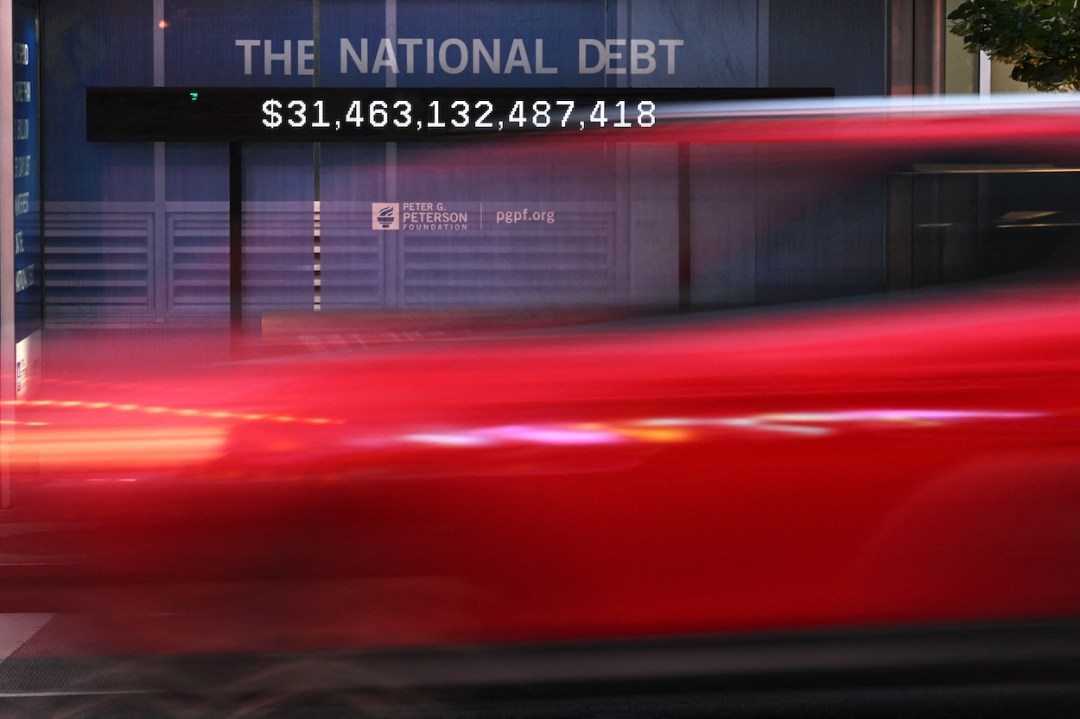
The 5 percent barrier has long since been left behind. This week, the yield on 30 year American government bonds hit 5.6 percent, its highest level since way back in 2002, while the cost of ten-year borrowing rose to its highest level in 20 years. However hard the Treasury Secretary Scott Bessent tries to control it, the interest rate the American government has to pay to finance its vast deficit keeps on rising relentlessly. As it climbs towards 6 percent and perhaps even higher, surely we must soon see a change in the political debate. Three decades of financial complacency will be swept aside – and the politics of deficit reduction will be back.
The United States is in a better position than most developed economies
We can forget about Artificial Intelligence, or the rise of the space economy. The only story that really matters on Wall Street right now is the rising cost of debt. Yields on US borrowing have risen relentlessly all year, with the yield on the 10-year note up from 4.1 percent in January to 5.2 percent now. That matters. When you owe $40 trillion, and are adding another few trillion every year, then the amount you have to pay for money makes a big difference.
Just as importantly, the yield on US Treasury bonds is the benchmark against which every other asset in the world is measured. When the yield goes up, so does the amount demanded to lend to every other government, corporation or individual. As the price rises, so does the cost of government debt, most painfully in Japan and Europe, on corporate bonds, and on mortgages or credit card borrowing. Indeed, it was no great surprise that American mortgage rates punched through 7 percent this week as well, or last week that heavily indebted France was downgraded yet again. Expensive American money spills out everywhere.

It is not hard to understand why yields have started rising again. The maturing of the Chinese industrial miracle means the glut of global savings is no longer as big as it was. The AI boom with its expensive data centers, along with the rising cost of replacing fossil fuels with greener alternatives, means that capital is scarce once again. And the extraordinarily easy monetary policy deployed by central banks after the 2008 banking crisis has been unwound. Take your pick. Whatever the reason, the outcome is already clear. There isn’t any free money any more.
The real question, however, is surely this: when will politics catch up with what is happening in the financial markets? After all, if you re-wind 20 or 30 years, the deficit used to be central to the political conversation. “The time has come for your public servants to bring spending down into line with tax revenues,” said President Reagan, in an address to the nation in April 1985. “Without deficit reduction, we can’t have sustained economic growth,” argued President Clinton, outlining his economic plans in August 1993. In perhaps the most over-used political quotation of all time, the political strategist James Carville said he wanted to be reincarnated as “the bond market,” for the simple reason that you could “intimidate everyone.” True, like fidelity, balancing the books was more often an aspiration rather than a realistic goal. But it was a standard cliche of the campaigning stump speech. And of course, President Clinton actually meant it, becoming the last occupant of the White House to actually deliver a surplus, with the federal books in the black to the tune of $128 billion back in 2001.
In the quarter-century since then, it has been completely forgotten. Barack Obama never talked about the deficit, neither did President Biden, and through both his first and second terms President Trump has hardly ever mentioned it. Perhaps they didn’t need to. With central banks reducing the cost of money to close to zero in the wake of the 2008 financial crisis, and printing plenty of the stuff whenever it was needed, it was so cheap to borrow that there was no real need to worry about it.
That soaring yield on bonds means that is about to change. With annual debt payments of more than $1 trillion a year, the cost of servicing the US national debt will start to cut deeply into other government programmes; corporations, especially in highly leveraged sectors such as private equity, will start laying off workers or even closing down; and with mortgage rates soaring, it will become more and more expensive to buy a home. In short, the deficit will matter again.
The really big space in American politics over the next few years will be for a rational discussion about how to balance the books again. It doesn’t need to be impossible. The United States is in a better position than most developed economies. France, and perhaps Britain as well, may already be trapped in a doom loop, where the rising cost of servicing the national debt means taxes have to keep rising, crushing growth, and making the deficit even larger.
Once you are trapped in that kind of cycle, it is very difficult to ever escape. America is not there yet. It has two big points in its favor. To start with, growth is still robust (indeed one explanation for spiraling yields is that the economy is overheating). With 3 percent-plus annual growth, the deficit can be stabilized. Next, the US is still relatively lightly taxed, with the federal government only taking 17 percent of GDP, meaning there is plenty of space to increase taxes slightly if necessary. But it will still be hard work. Even so, sooner or later, the United States will have to get its deficit and the national debt under control. That is the only thing that will calm the bond markets. In the past, that has been a winning issue for both the Republicans and the Democrats. It could be again very soon – the only real issue is who wants to grapple with this growing financial crisis.






Comments