
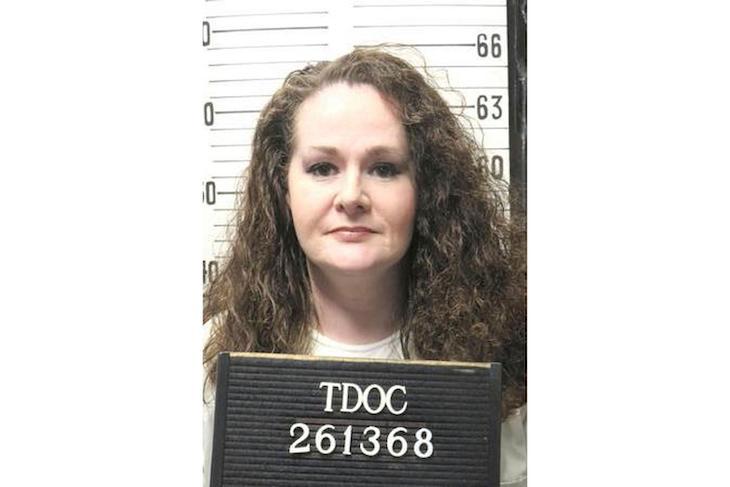
Coincidentally with the sad passing of Esther Rantzen, who spent her last couple of years campaigning for assisted suicide in the UK, there’s just been an interesting case of an assisted dying going wrong. The state of Tennessee kills prisoners sentenced to death by means of an injection of pentobarbital, the same substance used by the Dignitas clinic in Switzerland (only not usually by injection) where Dame Esther had considered going after she was diagnosed with stage four lung cancer.
Pike has been executed once; that, even supporters of the death penalty must agree, is enough
Unfortunately, or fortunately, depending on your point of view, a prisoner sentenced to death, Christa Pike, survived a double injection of pentobarbital and is now in hospital being resuscitated. First, the state tries to kill you, then it saves your life; how confusing.
Before the botched execution overnight, she challenged her sentence on the basis that the judge hadn’t taken her childhood sexual abuse into consideration, but in the event, the Supreme Court allowed the execution to go ahead. So it did.
Pike is 50. When she was 18 she and her then-boyfriend, Tadaryl Shipp, beat, tortured and killed 19-year-old Colleen Slemmer, whom they had met at a job training camp for troubled teenagers. The killing was gruesome enough but there was uproar when it was found that an inverted pentagram had been incised onto Colleen’s body, giving the murder a satanic aspect. Pike was sentenced to death in 1996 and the victim’s mother, May Martinez, was among those who wanted the execution to happen. Speaking to NBC News after the botched execution, she said: “It was a mess.”
I’ll say. Pike’s legal team reported that: “Ms Pike has lost consciousness and still has a heartbeat and is audibly snoring.” A doctor told the BBC that she probably “never achieved a sufficient blood level of pentobarbital to cause apnoea and cardiovascular failure during the attempted execution,” meaning that the dose wasn’t strong enough or potent enough to cause her to stop breathing and her heart to stop beating. That after the choreography of execution had been gone through; the curtains drawn twice around the bed.

It all goes to show that killing people is tricky; there is no perfect method. Pentobarbita, a form of which is used at Dignitas, is not instant or infallible. I used to think that my own preferred method, if I were executed, would be the guillotine: nice, clean, hygienic and designed by its creators to ensure a painless death. But after reading Albert Camus’ polemic on the Guillotine, which included accounts of severed heads trying to talk during the French Revolution, it seemed to be a lot more problematic than it looked, though still better than the botched axe execution that killed Mary Queen of Scots.
The subject of doing people in has been very much in the news on account of the UK’s assisted suicide bill which died its own death a few weeks ago. Before the first debate I spoke to (Baroness) Ilora Finlay, a palliative care expert who has visited other jurisdictions which allow assisted suicide, and she was quite clear that it didn’t always go to plan. The length of time people took to die varied after taking an overdose of barbiturates, or whatever variant was prescribed; most within an hour, but some over the course of many hours. In some procedures there would be a preliminary injection to prevent convulsions followed by a lethal dose; the bad outcome would be if the preliminary dose prevented you speaking but was insufficient to prevent you feeling what happened subsequently. This was borne out in the first House of Commons debate when a Conservative MP who was formerly a vet recalled chillingly that when he put animals down, the procedure didn’t always go to plan.
But there is always room for improvement. Recently an exciting pioneer of death, the Australian Philip Nitschke, developed something called a Kairos Kollar, a device which kills you by gradually restricting blood flow in the carotid artery. It is still in the process of development; perhaps the doctor might try it on himself.
So what should happen to Christa Pike? I had always assumed that under English common law a man could not be hanged twice, a variant on the double jeopardy principle, but I may be quite wrong about that. Certainly sometimes hanging failed. The nearest case to Pike’s may be that of Anne Greene who was hanged for infanticide in 1650 in Oxford.
As sometimes happened during a hanging at the time, several of her friends pulled on her body to hasten her death and a soldier struck her four or five times with the butt of his musket from the same kindly motive. Greene was presumed dead half an hour later, so she was cut down and given to physicians at Oxford for dissection – being a convict, that was allowed. Picture their surprise when, on opening the coffin, they found the body had a faint pulse. They and their colleagues rallied round and using a variety of means I shan’t go into – including a tobacco enema – they revived her. She wasn’t hanged again but lived for another 15 years, got married and had three children. Her survival was, by common consent, regarded as God’s way of indicating she should get off.
And so, I think, with Pike. With all due regard for the sensitivities of her wretched victim’s mother, it would be cruel to put her through death by injection twice. She has been executed once; that, even supporters of the death penalty must agree, is enough. Perhaps, since it is now 30 years since her conviction, it is time to free her. The person who should really be grateful for Pike’s survival is the male prisoner who is still awaiting execution in Tennessee; the governor has suspended all further executions pending inquiries.






Comments