


I am somewhat allergic to food nomenclature: zero-waste, plant-based, seasonal, small plates, “live cultures,” foraged, farm-to-fork. It’s not that these are inherently off-putting concepts, but I associate them with “foodie” fads, gimmicks and big egos.
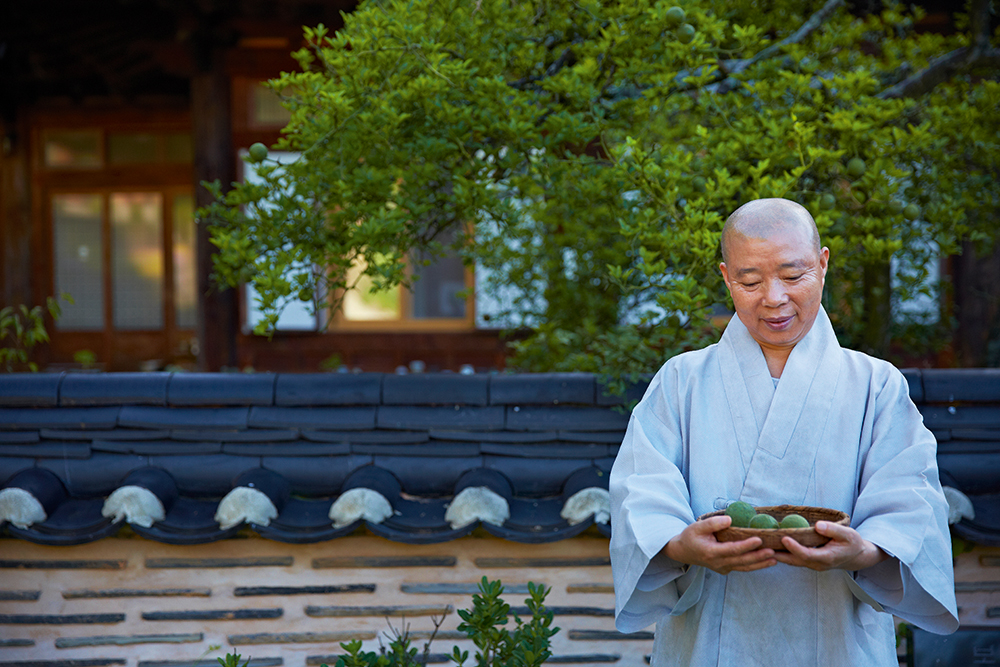
All of those trendy labels could apply to the food cooked by the “philosopher chef,” a Buddhist nun called Venerable Jeong Kwan, plus you could throw in a dash of mindfulness and eastern spirituality for good measure. Yet Kwan, who is venerated by Le Bernardin’s Eric Ripert and Noma’s René Redzepi, and has featured in an episode of Chef’s Table, is the furthest thing from an ego-chef. She has no restaurant, no recipes, cooks for only two other nuns and begins her meals by reflecting on her lowliness: “Where has this food come from? I am ashamed to be eating it. I will take it as medicine to get rid of greed in my mind and to keep my physical being in order to achieve enlightenment.”
Our need for food translates into the metaphor of our need for the divine,for nirvana: a spiritual hunger
I spoke to Kwan, who is usually based in South Korea, in a small, quiet classroom of Le Cordon Bleu in London before a class she was teaching on “Plant-Based Culinary Arts.” As her cooking adheres to the Buddhist principle of nonviolence, it includes no meat, dairy or eggs, nor does she use the “five pungent plants” – onions, garlic, chives, scallions and leeks – which are said to whet the appetite and stimulate lust (when cooked) and anger (when raw).
So food is a temptation to gluttony, a way of flexing money or taste, an aphrodisiac, fuel for rage. Then what business does a nun have in a Cordon Bleu kitchen when she could be living on locusts and honey, or waiting for manna to fall from heaven?
Cooking is part of what Kwan, speaking through a translator, called “practice”: disciplined mindfulness, a spiritual effort to abandon earthly desire and escape the wheel of life and death. “I take my ingredients as an extension of practice,” she said, which involves the mind as well as the body. “You start noticing the cycles of nature” – cooking with what is in season in her garden or with what she has preserved for winter, watching a seed give way to a stem, leaves, flowers and fruit before returning to the earth – “and in that way, you also search for yourself.”

A process of coming to terms with the transience of all things, including your own life… that’s one way to describe cooking. It’s not, however, completely surprising that a nun would have a somewhat lofty attitude towards food. Every major religion has its culinary rituals – its symbolic dishes, its prayers, chants, songs, offerings, fasts – which hint that man does not live by bread alone. Our need for food translates into the metaphor of our need for the divine, for nirvana: a spiritual hunger.
Kwan wore a knitted cap over her shaved head and sat cross-legged on a chair, speaking with lively gestures from her small but obviously deft hands. “When I see ingredients,” she said, “I intuitively know what needs to be done, how to season them, shape them, cook them.”
She learned to cook by watching her mother, but her method goes beyond mere mechanical skill: “I follow the connection (in-yeon, the karmic connection built over past lives) with an ingredient or with the people I am feeding. The connection arises naturally. It’s not something you can force.”
In a past life, she said, she must have been a cook. In this life, she was about to teach a class to some journalists and food influencers who were waiting in the kitchen next door. If Kwan’s cooking is an intuition, a skill accumulated over various reincarnations, how can it be explained to a squad of the unenlightened? The boring answer is that we were given step-by-step recipes and premeasured ingredients to re-create her famous soy-braised shiitake mushrooms. The rest, I guess, came down to in-yeon mixed with equal parts of time, technique and luck.
I felt both calmed and unsettled in Kwan’s company. To tell the truth, I’ve had an irrational fear of reincarnation since childhood. I am scared of the thought of dying and waking up as somebody or something new, with no recollection of my past life, and having to do it all over again. Where Kwan is at peace with her impermanence, I am deeply and fearfully attached to my one life. The idea of being part of a cycle of nature and rebirth, with a course in between for the maggots, absolutely spoils my appetite.
Kwan had to confront life’s impermanence early on. When she was 17, her mother died suddenly. “I was filled with grief and resentment,” she told me, but it was the beginning of her life of practice. She decided to run away from home, without telling anyone, and joined a community of monks at Baekyangsa Temple, where she still lives. “I thought: ‘If I were to marry and have children, would it be right for my son or daughter to carry sadness like mine in their heart?’ I didn’t want to pass on that suffering.” In time, though, that suffering yielded to acceptance, then gratitude. Kwan thanks her mother for giving her the opportunity to enter the temple, and her mother’s wisdom is still alive in the kitchen.
Near her hermitage, Kwan tends to a small garden beside a stream and ginkgo trees. “I till the soil, fertilize it, plant seeds, and what grows is mostly vegetables: lettuce, napa cabbage, eggplant, zucchini, cucumber.” To cook anything requires months of patience, especially when you consider the time it takes her to ferment traditional Korean ingredients: kimchi, gochujang chili paste, persimmon vinegar, syrups from fruits packed in sugar and left for months to macerate, “liquid gold” soy sauce aged for 15, 20, 30 years. Some of her soy sauces will outlive her – but that, she would say, is the point.
This article was originally published in The Spectator’s February 2, 2026 World edition.



Comments