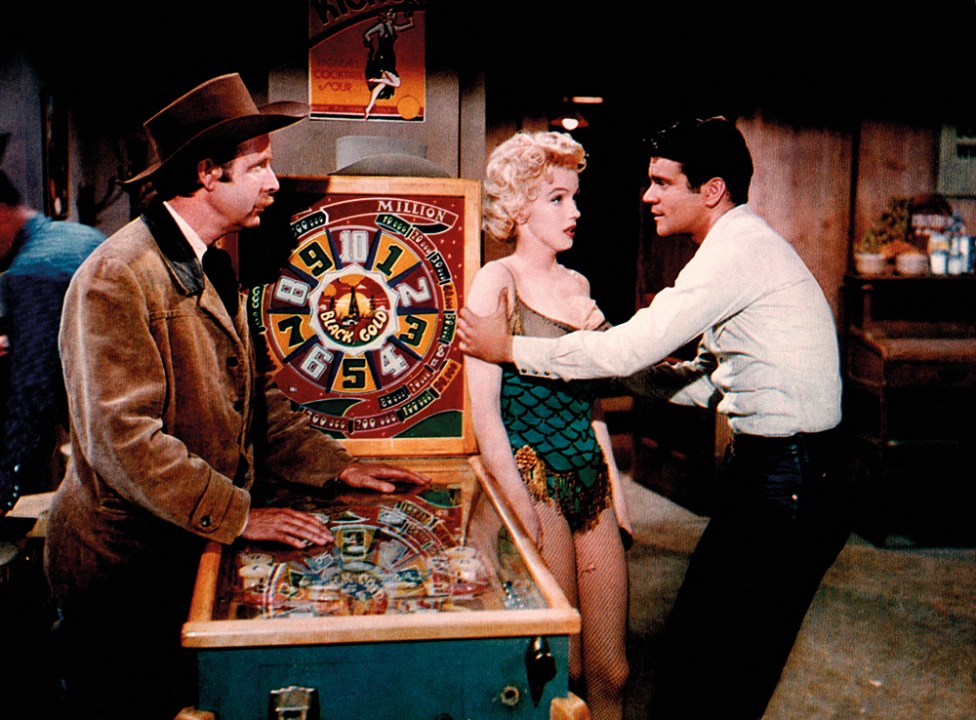
‘Pinball games, with their flashing lights and unforgettable names, are the one thread that runs together my otherwise fragmentary life.’ So writes Andreas Bernard in the last sentence of this touchingly Proustian memoir. He hymns a life spent flipping small steel balls up and down machines which, despite their clamorous lights, bleeps and honks, amounted to glorified beer coasters and ashtrays, usually in dank corners next to the toilets of some German bar, Italian resort arcade or glum rest stop on California’s Pacific highway.
The subtitle is misleading: the book is Bernard’s biography, not the pinball machine’s. He begins his tale as a pre-pubescent, sneaking into Munich bars with his chum Stefan to play these captivating games. As a student in Berlin, he finds solace in solitary pinball after lectures. His enthusiasm survives the truth that hardly any girls played, with the notable exception of Emily. Their globetrotting romance in search of the perfect machine and the highest score chimes with many a youthful dalliance – say, Keanu Reeves questing under the homoerotic aegis of Patrick Swayze for the perfect wave in Point Break.
As a student in Berlin, he finds solace in solitary pinball after lectures
For digital natives, no doubt, there’s something unrelatable about Bernard’s preoccupation with what he calls ‘a relic from the second half of the 20th century’. You have to push two buttons to activate flippers and heft your hips against the bloody thing to win free games? How could that compare with such graphically beguiling video games as Horizon Zero Dawn, still less with the globally connected phenomenon of multiplayer online games?
But in truth most of us hold together our fragmentary lives with something – be they Bob Dylan albums, hairstyles or coffee spoons – whose charm and power is scarcely explicable to those who have never fallen in love. Bernard’s genius is to communicate something of his life’s grand obsession, while recognising how pinball machines are emblematic of an industrial culture that was slain by digital in the 1980s. Though pinball is sanctified in the Who’s rock opera Tommy, in European art movies (Godard, Fassbinder and Wenders – whose 1966 short film supplies Bernard’s title) and in a 1980 Haruki Marukami novel, the machines are deader than disco.
Trevor Horn wasn’t quite right when he claimed that ‘video killed the radio star’; but it is true that games such as Space Invaders (1978), Asteroids (1979) and Pac-Man (1980) replaced screenless games made of steel and glass around the same time as Buggles’s 1979 hit. That said, the most complex iteration of pinball, Star Trek (featuring a wide body playfield with multiple ramps, targets and cellar holes), was only released by Williams Amusements in 1993. Later technological developments, whereby video games became things one played at home or on a smartphone, killed the arcade itself. The year 1982 was when pinball as mass entertainment died: Bally Manufacturing, for instance, shipped 86,000 units in 1978 and in 1983 produced only 4,706 machines.
The response of pinball machine manufacturers to the rise of video games was predictably inept. Like the ageing Gustav von Aschenbach, gaudily made up to seduce some unattainable adolescent on the Lido, the manufacturers got rid of old-school mechanical features in favour of digital ones and themed their new tables after videogame rivals. The pinball game named Mr and Mrs Pac-Man was the nadir in this respect.
For Bernard, these developments destroyed the charm: the pinball machines of his youth made sounds produced by xylophone-like keys under the playfield rather than synthesised ones. Never again would he and Stefan watch entranced as some repair man oiled the springs so that a favourite machine could be as good as new.
German sociologists have ponderously demonstrated that pinball machines typified how the lines between work and leisure under late capitalism became blurred, pointing out that factory hands were echoing similar mechanical gestures in pinball games as those they deployed in car assembly line – or indeed Chicago pinball machine factories, which in 1979 produced nearly 1,000 machines every workday. In fact pinball might be seen as the last hurrah of Fordism.
Happily, Bernard doesn’t labour this point but makes a more interesting one – that pinball machines were doomed because they could not be data-compressed. A machine that depended on gravity and physical exertion could not be played on an iPhone. Large, expensive machines could not be digitised. Nor, writes Bernard in a tantalising aside, could smoking, which was as much a fixture of the pubs and bars of his youth as the machines themselves. He argues that cigarettes’ unhealthiness was less a knockdown argument for their being banned from public places than the fact that, like pinball machines, they cannot be miniaturised. ‘If it were possible to smoke with an iPhone,’ he suggests, ‘smoking would probably still be permitted everywhere.’ Perhaps.
Bernard also memorialises a very European love affair with America, one that now seems increasingly improbable. He recalls how in 1979 Chicago-based Bally produced a game themed around the Harlem Globetrotters. It flopped in America, most likely because the team was black. As a result, 15,000 games were exported, mainly to France and Germany, where basketball had never been a popular sport. In such ways, Europeans were dreaming in American, but in an American more inclusive than the one that white America would tolerate. Indeed, for all the Chicago-built pinball machines themed around Kiss, Rush, Metallica and Dolly Parton, not one celebrated a black musician.
Long after his break up with Emily, whenever Bernard chanced upon a town where the couple had romanced over the flippers (Rimini was where they played Whirlwind and Corraljeo where they played Star Trek), he would visit a faded arcade and insert a coin into his favourite game. Though by now a pinball wizard, he would fluff it. Why?
Because my feelings for Emily, which I thought I’d shaken off long ago, would come back in full force. The ball would become blurry before my teary eyes, I’d let it fall out of play like a novice, and I’d walk out into the street in the middle of a game.
Pinball, that’s to say, was never the only thing holding together Bernard’s otherwise fragmentary life. Not really.






Comments