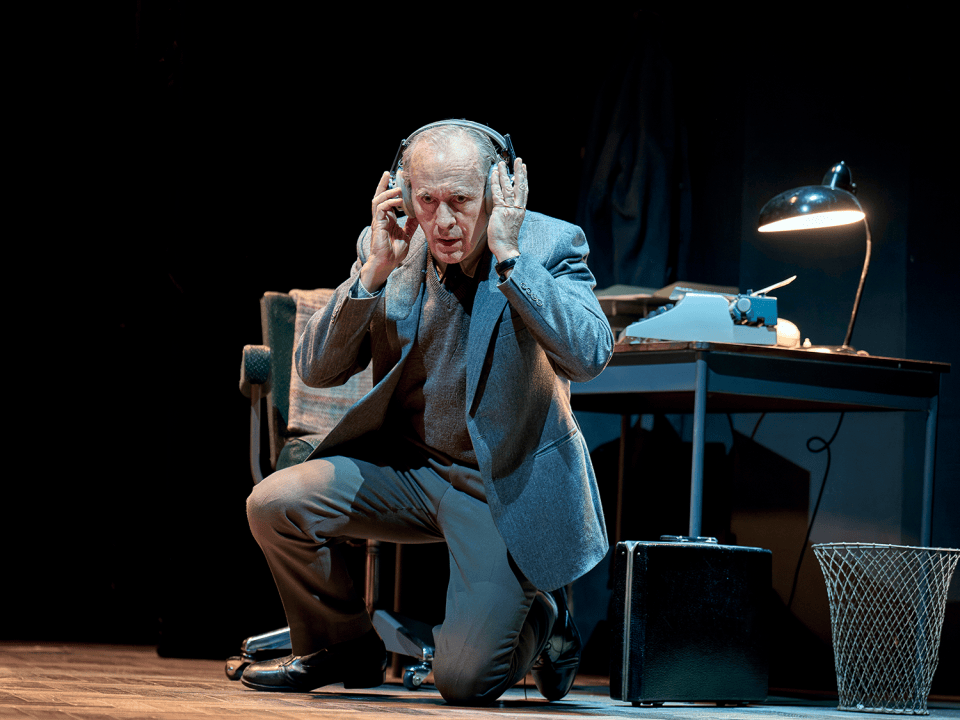


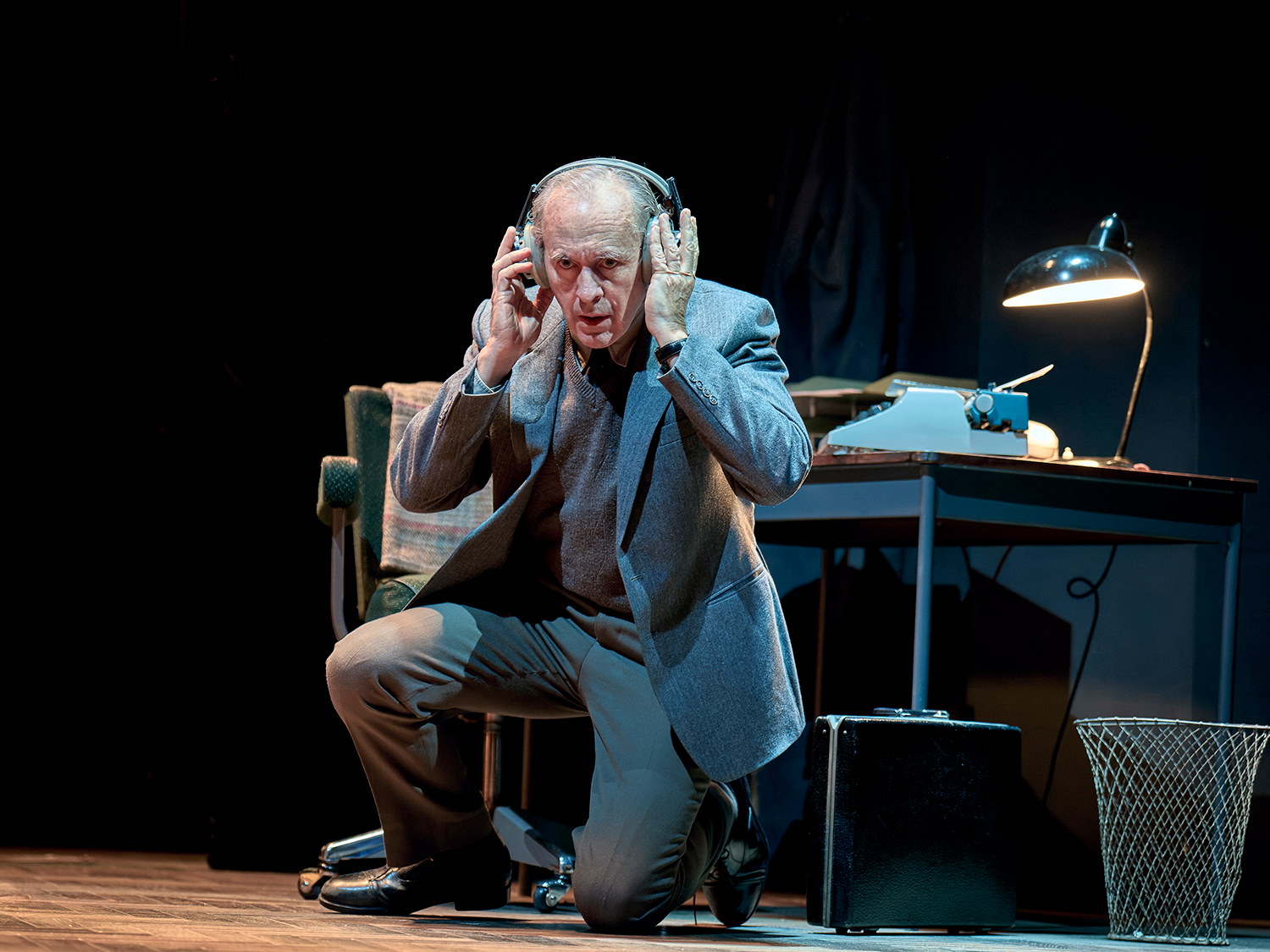
The Lives of Others is a peculiar play about obsession and voyeurism based on a 2006 movie set in east Berlin during the Cold War. A Stasi snoop eavesdrops on a pair of glamorous thesps whose love affair is imperilled by disloyalty to the state and to each other.
Keira Knightley plays Christa, a hysterical and insecure actress, who dates a state-approved dramatist, Georg, in order to advance her career. Christa also seduces Hempf, the minister of culture, for the same reason. But why entertain two lovers who offer the same benefit?

Christa’s flat is bugged by a team of trenchcoated weirdos who get their kicks by listening to ‘vigorous active intimacy’ in her bedroom. The emotional mood of the piece is ugly and cheerless. And the shifty, hard-faced characters are hard to warm to. Georg is a tiresomely bland sort of chap whose best friend, Jerska, has been blacklisted for holding the wrong opinions. Jerska denounces theatre audiences as ‘overdressed and under-informed’. And he has a stab at an aphorism. ‘A director without a play is like a miller without corn.’
But Jerska vanishes early and the narrative drifts from one incident to another. A typewriter hidden inside a cream cake is used to write an article attacking the east German government. A red sock belonging to Hempf is left in Christa’s flat and discovered by Georg. The Stasi snoop, Gerd, speaks to Christa in a café but the conversation leads nowhere. Stephen Dillane (Gerd) seems a little elderly for the beautiful Christa whose character serves as a mere trophy for the men to fight over. Knightley easily conveys Christa’s chilly, fretful and selfish nature but she’s unlikely to look back on the role with much fondness. Andrew Woodall does well playing Hempf, a miserable self-serving rapist, who wins the prize as the nastiest character in this parade of monsters.
Hildegard Bechtler orchestrates her designs astutely. The stage includes a huge revolving cube, containing a bathroom and a bedroom, half-concealed by translucent fabric. The semi-opacity imparts a sense of mysterious grandeur to the banal actions that occur within the cube. And that works well enough. As does Christa’s fabulous collection of collared tops, tailored skirts and belted frocks that give the impression that east Germany led the world in haute couture during the 1980s.
The key problem is the wonky script. It can’t answer three fundamental questions: who is the main character, what are they after, and why do we care? The climax of the story is accompanied by thumping rock music to add excitement to a scene that lacks a proper emotional focus. Great theatrical moments don’t need crash-bang-wallop. The show ends with a plodding series of explainer scenes that clarify the story’s many ambiguities. This is a big-budget production that solves a question nobody asked: is it possible to transfer a multilayered espionage movie to the stage? Answer, yes, just about. But the result is a little empty.
Memoriam, at Southwark Playhouse, addresses the perils of robotic intelligence. Rachel works for a ghastly new digital firm that downloads memories from people’s brains and publishes them online. The subscribers include historians, researchers, novelists and random oddballs. Rachel’s task is to persuade her elderly grandmother, Rivka, to transfer her memories of the Holocaust to the archive before she dies. The request enrages Rachel’s possessive and combative brother, David, who bickers with Rachel while Rivka attempts to umpire their squabbles.
Large chunks of the play are devoted to explaining the mechanics of the brain-lifting process, known as ‘extraction’, which ends with the restoration of the copied memory to the donor. But mistakes are made. Some donors complain that their memories have been ruined or entirely wiped out by ‘extraction’.
We watch a female volunteer in a VR headset as she experiences a gruesome set of recollections which freak her out and make her go nuts. The script then strays into supplementary ethical territory. Does the firm have a duty of care to mentally unstable subscribers who become traumatised by the material? Should the content be edited and sugar-coated before publication? Do citizens have intellectual property rights over their family’s history?
These and other dusty questions are examined at length in this discursive and over-ambitious play. And it’s never fully clear why a Jewish family would object to the publication of their grandmother’s Holocaust memories. The best moments involve Rivka (brilliantly played by Beverley Klein) trying to cope with the tantrums of her brattish and immature grandchildren played by Rachel Barry and Ashley Margolis. The dramatist, Noga Flaishon, holds various writing award nominations and has participated in tutoring schemes at Hampstead theatre and at the Royal Court but she has yet to learn the essential skills of her trade: unity, clarity and simplicity. A play about a Jewish family is enough. No need to add Auschwitz and digital robots.






Comments