
A top-level Kremlin policy document discussing post-war political planning and how to neutralize potential ultranationalist discontent has been leaked to the Russian investigative site Dossier Center. Entitled “Images of Victory,” the paper gives a rare insight into the inner workings of Russia’s political machine. Crucially, it shows that while the Kremlin remains officially indifferent to peace talks, behind the scenes apparatchiks are working hard on selling an inevitable stalemate to the Russian people by dressing it up as a species of victory. The document was leaked before President Trump’s announcement today of a three-day ceasefire between Russia and Ukraine.
While the source of the leaked document is unknown, its tone and content seem entirely plausible and its authenticity has not been challenged by the Kremlin even though Dossier is funded by exiled London-based oligarch Mikhail Khodorkovsky. Significantly, the paper warns that continuing the war carries serious dangers for Russia’s economy and society. But in practical terms the policy paper’s focus is how to construct a post-war narrative of why the war was worth it, as well as how to systematically dismantle all potential areas of dissent, first and foremost from a constituency it describes as “armchair patriots.”
The paper was apparently prepared by the staff of Sergei Kiriyenko, a former prime minister who is now deputy head of Putin’s Presidential Administration (PA). He’s the Kremlin’s political manager, in charge of upcoming Duma elections in September. While hardly a dove, Kiriyenko is the opposite of an ideologue – and, importantly, is politically distant from hardliners in the Federal Security Service or FSB, or the military who have been the war’s leading cheerleaders. Kiriyenko is known as a pragmatist whose job it is to keep Putin in power and the political machine running smoothly.
The most immediately striking thing about this secret document is its frankness about the dire state of the war, the lack of tangible military or political results, and the dangers to Russia’s economy and society of continued hostilities. “One Must Know When to Stop,” is one of the chapter headings. “Overreach is defeat; continuing the SMO [Special Military Operation] would be a Pyrrhic victory.” It also warns that fighting on would require a revision of many Kremlin “fundamental positions” that for the moment allow many Russians to largely ignore the conflict – up to and including introducing universal mobilization and the complete transfer of the entire economy to a war footing.
This document is the work of “curators of the [Kremlin’s] political bloc” who have been “tasked with developing the information framework for a possible end to the war,” write the Dossier editors. Work on this paper began in February and it remains, according to Dossier, a work in progress.
The Kremlin’s spin doctors have readied a series of propaganda narratives to be fed to state media to persuade ordinary Russians to accept a peace agreement with Ukraine that falls far short of the Kremlin and media claims at the war’s outset. Among these are the idea that thanks to the “special military operation” Russia was able to “prevent a humanitarian catastrophe in Donbas,” and its army turned out to be “the most combat-ready in the entire world” and “held firm in a global confrontation against 50 countries.” The main achievements the Presidential Administration plans to emphasise are territorial gains, a land route to Crimea, and the acquisition of millions of new Russian-speaking citizens. Another side benefit of the conflict is that the nation has “cleansed” itself of “elites who betrayed it” – a reference to the exodus of up to 800,000 middle-class professionals who fled Russia in the wake of Putin’s invasion of Crimea. After the war the Kremlin plans to fill the airwaves with “good news” including talk of “normalization, social projects, business success stories,” a “controlled thaw” in cinema and literature, the return of political humor, rehabilitation of the word “peace,” and a limited amnesty for political dissidents.
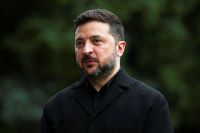
Again with disarming frankness, the authors acknowledge that Ukraine will survive unconquered and even that Volodymyr Zelensky will remain its President. What to do with those citizens who are inclined to call such a peace deal a defeat? The working paper goes into deep forensic detail, carefully categorizing potential malcontents. The most dangerous group are dubbed the “couch patriots” who have not themselves participated in the war yet remain vocally focused on the capture of Kyiv. To neutralize this constituency, the Kremlin has planned to engineer an “emotional reversal” among the most prominent Z-bloggers, along with the promotion of more moderate voices in social media. Those who resist the change in Party line will be “struck off the list of patriots” and threatened with prosecution for discrediting the army.
Somewhat less threatening, in the Kremlin’s view, are returning veterans. Their potential anger at what many might see as a betrayal is to be bought off with handouts to veterans to start new businesses in the “reconstruction of the new territories” in Ukraine. Their energy is to be “redirected into peaceful channels” such as staging commemorative events, joining political parties, or for the hard core who wish to continue fighting, signing new mercenary contracts with Russia’s African Corps. Russia’s media are to be instructed to suppress stories of violent crime by returning veterans in favour of stories of their peaceful reintegration.
The final category of potential dissidents are military-industrial workers likely to lose their jobs. The Kremlin spin doctors’ blunt remedy for this constituency is “Control. Support. Demonstrate new opportunities.” In short, the overarching formula for the Kremlin’s “Image of Victory” is to ram home the message that “the heroes of the Special Operation died fighting for peaceful skies above our heads,” and that “by restoring peace, we ensure their sacrifice was not in vain.”
What the document does not cover are the nuts and bolts of a peace deal on the ground, broadly assuming that Luhansk and Donetsk will be annexed in full and Zaporizhiya and Kherson divided under the line of control. The authors also assume that EU sanctions on Russia will remain while US sanctions are lifted. And, significantly, they also anticipate that the mechanism for a peace deal will be agreements between the US and Russia, then between the US and Ukraine.
What’s missing, crucially, is what Putin thinks about the post-war arrangements that his underlings are working on. Officially the Kremlin’s current position is that talks with the US are frozen, and while they are ready to talk to Europe, Russia will not make the first move. But what this leaked document shows is that behind the scenes, wheels are turning and that serious political constituencies at the very top of the Kremlin are not just hoping for peace but actively planing for it. Indeed, the fact that this document has been made public may be a sign that people in Kiriyenko’s camp are doing their best to nudge public and elite opinion in the direction of peace.
In short, the leaked Kremlin plans are an unusual glimpse into the usually closed black box of real-time Kremlin policymaking. Interestingly, unlike the mealy mouthed Soviet-jargon filled statements of mastodons like Foreign Minister Lavrov or Kremlin negotiator Yury Ushakov, the logic, language and tone of this document is snappy, clear-headed and largely honest about the war’s dismal outcome. The question is whether the czar will heed his minions’ sensible advice.

Comments