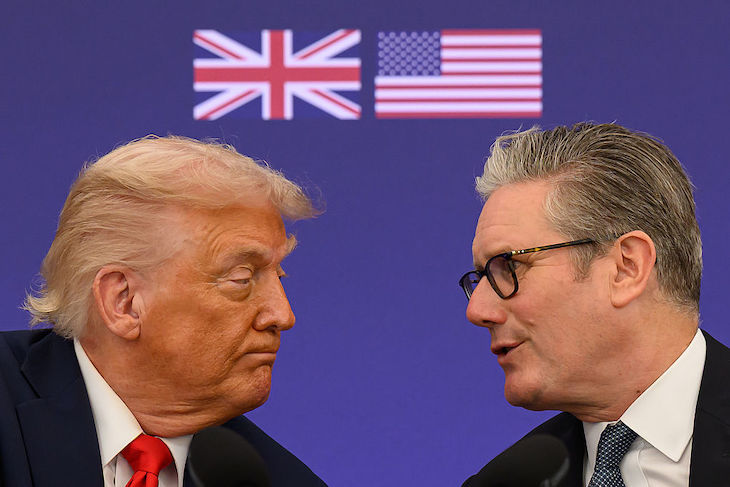
Britain’s relationship with the United States is special. Our ties run deeper than governments, are stronger than personalities and are resilient against ideological fashion. But under Keir Starmer’s leadership, this once unshakeable bilateral partnership is in danger of being profoundly damaged.
The truth is that Starmer governs in defiance of Britain’s core interests. From here in America, an alarming realisation is taking hold: that Starmer is the first Prime Minister in memory to treat Atlantic alignment as discretionary, rather than structural.
Starmer has chosen to introduce hesitation where instinct once prevailed
When Donald Trump moved to restore credible deterrence against Iran’s accelerating nuclear capability, he did so openly and deliberately. The message was unmistakable: the United States is prepared to act if diplomacy fails and nuclear breakout looks imminent. At that critical moment, Starmer made a choice: the British government refused to give permission for the US to use UK military bases to support potential strikes on Iran. Access to long-standing joint facilities was treated as conditional rather than automatic. Legal review was placed above operational readiness. Restraint trumped deterrence. Washington has noticed.
RAF Fairford, which has hosted US Air Force personnel since the Second World War, and Diego Garcia, the joint UK–US military base in the Chagos Islands, were constructed and maintained for moments exactly like this. They are operational instruments designed to sustain credible deterrence during crisis escalation. Previous British governments, whether Labour or Conservative, understood that their value lay in predictability under pressure. But Starmer has chosen to introduce hesitation where instinct once prevailed.
The restructuring of sovereignty arrangements around the Chagos Islands has been particularly difficult to fathom. No adversary compelled Britain to blur authority over one of the Indo-Pacific’s most critical installations. No emergency forced legal ambiguity into what had long been strategic clarity. At a time when China’s maritime expansion intensifies, London has elected to inject uncertainty into a key joint asset. Why?
Taken together, these choices represent a departure from a pattern that endured through decades of shifting governments. Harold Wilson disagreed with Washington over Vietnam yet preserved the Atlantic frame. Margaret Thatcher aligned with American resolve while asserting British sovereignty. Tony Blair partnered the United States in Iraq (and Afghanistan) at immense domestic cost. Even leaders sceptical of particular American operations maintained the underlying assumption that Britain was structurally Atlantic. They argued within the alliance. They did not insulate themselves from it. Starmer has crossed that line.
The divergence extends beyond immediate defence posture. In 2024, Labour activists travelled to American swing states to campaign against Donald Trump. Starmer insisted that these volunteers were ‘doing it in their spare time’ and that Labour hadn’t funded or organised the trip. But the damage was done. Formal complaints of foreign political interference were lodged. Trump is not a man who forgets such things.
He will also, no doubt, have noticed that his state visit last year was scheduled during parliamentary recess, precluding any address to the House of Commons. That platform has been extended to leaders of far lesser strategic weight. Whatever critics think of Trump personally, he is the elected US president and, as a result, the principal guarantor of the maritime order on which Britain’s trade and security depend. Denying that forum while maintaining ceremonial language of partnership is not neutral choreography. It is deliberate signalling.
The appointment of Peter Mandelson as ambassador to Washington was another disastrous move that has damaged the special relationship. Perhaps it goes more to judgement than intent, but the post carries exceptional importance in transatlantic relations. Maybe Starmer thought he was being smart in sending the Prince of Darkness to try to handle Trump, but the risks were glaringly evident and the outcome fully avoidable.
The Online Safety Act – passed under the Conservatives – reflects an additional philosophical break. Starmer’s administration has embraced its sweeping authority over digital speech. Application of this regulatory model is fundamentally at odds, not only with America’s First Amendment tradition, but previously assumed British freedoms. This is not an abstract divergence; it affects American technology firms; it signals comfort with a continental model of speech supervision rather than the Anglo-American presumption of robust expression.
Even the tone of Britain’s public institutions has contributed to this climate. When the BBC edits or frames presidential remarks in ways widely perceived in the US as selectively hostile toward Trump, it confirms the impression that institutional neutrality has eroded (and not just towards the American presidency). Cumulatively, such signals shape perception.
Joe Biden’s reflexive positioning against Britain on matters touching Ireland, coupled with his frequent public emphasis on Irish identity, despite limited personal connection to the country, made him no friend of Britain. His hostility to Britain damaged American interests and also strained our mutual alliance. So perhaps we had it coming.
Yet what distinguishes the breakdown in relations under Starmer from earlier tensions is agency. Starmer is not merely the passive product of institutional drift. The PM is the active executor of a recalibration. He has chosen to prioritise international legal framing over allied strategic reflex. He has chosen to dilute clarity in the Indo-Pacific. He has chosen symbolism that cools rather than reinforces Atlantic confidence. He has chosen a regulatory posture that distances Britain philosophically from American speech traditions. These are decisions Starmer has made. And Britain must reap the consequences.
President Trump does love Britain, champions its Brexit spirit and reveres its monarchy. However, American strategy will not be built on nostalgia. If Starmer continues to define Britain’s posture in this manner, any weakening of the alliance will not be imposed by adversaries. It will be his clear choice.
The so-called Special Relationship has survived wars, recessions and changes of government on both sides of the Atlantic. It’s unfathomable that today it should be threatened by choice.






Comments