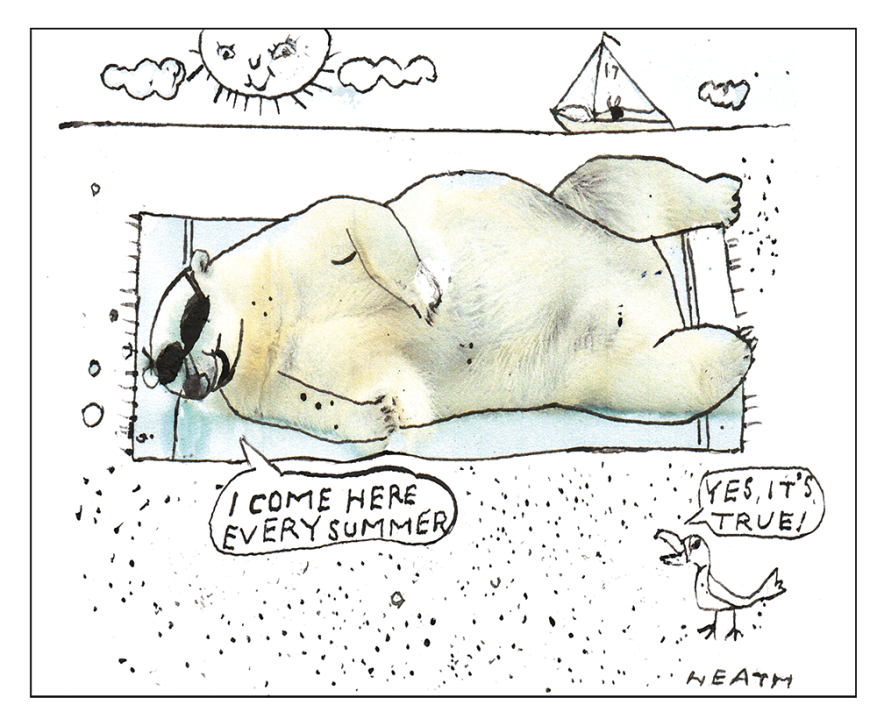

The BBC reported terrible news recently about polar bears: they are thriving. This is very annoying of them as it goes against the interests of environmental activists, polar bears being the very emblem, mascot and clickbait of climate change cataclysm. But the bears’ stubborn refusal to get the memo and starve has become too obvious to ignore.
The latest evidence comes from the Barents Sea, and the Norwegian-administered archipelago of Svalbard in particular, where bear numbers have been steadily increasing. Surprisingly, they are also getting fatter, according to measurements taken when bears are caught and weighed. This is despite a decline in sea-ice cover in the area, especially in fall. Even more unexpectedly, the bears are fattest in or after years when the sea ice retreats farthest.
In Svalbard, bear numbers have been steadily increasing. Surprisingly, the bears are also getting fatter
The scientists admit this took them by surprise. “We predicted that body condition in adults would decline over time and that bears would be leaner in years with less available sea ice or in the spring following such years,” write Jon Aars and colleagues, adding that from 2000 “both males, and females… increased in body condition for the following two decades.”
This follows a similar report the year before from the Chukchi Sea, north of the Bering Strait, where the bears are also thriving in both number and health as the sea ice retreats. Some other populations, in Hudson Bay and the Beaufort Sea, are doing less well, but overall polar bear numbers have probably more than doubled since the 1960s and are still growing.
By now the polar bear was supposed to be in decline. The US Geological Survey predicted in 2007 that their numbers would fall by two-thirds by 2050, starting much sooner. It had better get a move on. Grist ran an article two years ago on “why the climate movement doesn’t talk about polar bears any more.” The beast is off message.
How come? When I first visited Svalbard in 1978, there was more sea ice and bay ice for much of the year than today, providing plenty of habitat for bears. On our first morning, my friend and I had a narrow escape when pack ice blew on to the beach where we had camped, bringing an inquisitive bear that – tracks showed – circled our tent as we slept. We were woken by somebody hooting a car horn to warn us. We looked out just in time to see the animal lollop off on to the ice.

The point is that this was the first bear seen near the town of Longyearbyen in summer for many years. We became briefly famous as “the Englishmen who saw the ice bear.” (It was later shot after hanging around the school and is one of 17 stuffed bears in the town.) To see bears on the west coast of Spitsbergen in those days was all but unknown, let alone in town. Now bears turn up near Longyearbyen regularly, and all along the west coast they break into huts, devastate colonies of eider ducks and barnacle geese, chase and kill reindeer and make camping risky, even with trip wires and weapons.
The increasing numbers are caused by the fact that bears were hunted for their skins until 1973, after which they were a protected species. But this cannot explain the increase in their girth. The authors of the new study suggest that the bears that stick to Svalbard’s coasts are gorging on whale and walrus carcasses, walrus numbers having rocketed from around 100 in the 1970s to about 4,000 today.
But the “pelagic” bears that migrate to the islands from the east across the sea ice are doing even better, because ringed seals, the animals’ main prey in spring and early summer (when bears can eat enough to survive for months), are thriving. Ringed seals prefer thin seasonal ice to thick permanent ice through which they cannot make breathing holes – so fall melting and winter freezing suits them.
An inconvenient truth is that we now know Arctic seas are more productive when the ice melts more. Sunlight fuels blooms of plankton, which feed fish, which feed seals, which feed bears. One study found that in 22 years to 2025, the productivity of phytoplankton shot up by 80 percent in the Eurasian Arctic, 34 percent in the Barents Sea, thanks to less ice and therefore more sunlight.
Lots of evidence now suggests that the Arctic Ocean was nearly or completely ice-free in late summer and early autumn in the early millennia of the current interglacial period, around 9,000-6,000 years ago. It was probably very rich in marine life as a result, with lots of seals on the ice for polar bears to eat in spring, even if the bears had to take refuge on land and fast during the ice-free autumn months – just as they do today in Hudson Bay and much of Svalbard.
Most polar bear scientists have continued to insist the species is in imminent danger of extinction, because that way lies funding. They ostracized those who dissented, such as Mitchell Taylor and Susan Crockford, Canadian zoologists who argued that polar bears would probably survive even in a warming Arctic. “For the sake of polar bear conservation, views that run counter to human-induced climate change are extremely unhelpful,” said Andrew Derocher, as he expelled Taylor from the Polar Bear Specialist Group in 2009.
When a Netflix documentary in 2017, narrated by Sir David Attenborough, filmed walrus which had fallen off a cliff in Siberia, Crockford argued that they had probably been stampeded by polar bears. The film’s producers dismissed the suggestion, but it later turned out she was right. Despite being hounded out of the University of Victoria in British Columbia in 2019 for her views on polar bears, Crockford has continued to argue that more seasonal melting of sea ice means more and fatter bears. Turns out she was right about that too.


Comments