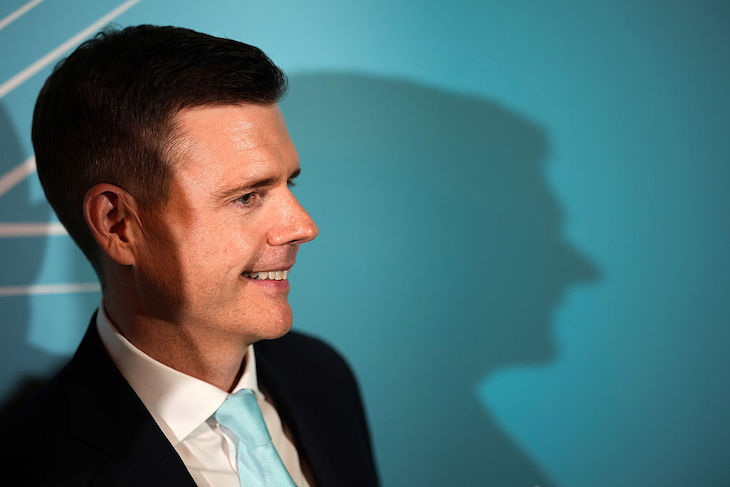
Sometimes, a nickname comes along so excellently unkind that you know it’s going to stick. One such is “MattGPT” – which will, I suspect, follow former academic and failed Reform candidate in the Gorton and Denton by-election Matt Goodwin to his grave.
“MattGPT” is a nickname that will follow former academic and failed Reform candidate Matt Goodwin to his grave
The taunt gained traction after the writer Andy Twelves noticed a series of factual errors in Goodwin’s self-published new book Suicide of a Nation: Immigration, Islam, Identity. (He seems to have been strongly inspired in theme as well as in choice of title – intellectual homage, or Salieri eyeballing Mozart? – by the success of our own Douglas Murray’s The Strange Death of Europe: Immigration, Identity, Islam.)
Were these, Twelves wondered, the result of AI “hallucinations”? He noticed, after all, that Goodwin left ChatGPT URLs in some of the footnotes. When challenged, Goodwin said crossly he used AI only “to obtain datasets”, claiming that this was standard practice. But Goodwin also included quotations from Cicero, Livy, Roger Scruton, Friedrich Hayek and several others that appeared to have been misattributed or made up out of whole cloth, and for which he has still been unable to supply any satisfactory source. “Made-up quotes,” as Mrs Thatcher put it, “are the giveaway sign of someone using ChatGPT for research.”

The affair has certainly put a dent in Goodwin’s reputation. Chairing a lively debate between Goodwin and Twelves on GB News, Miriam Cates, whom Goodwin might ordinarily think of as an ideological ally, treated him with admirable rigour and dispassion. Tim Montgomerie, hardly a scion of the wokerati, likened the affair to Rachel Reeves’s “dodgy footnotes” and called for an inquiry. If even Reform thinks your presence in the party is a threat to their reputation, given the rogues’ gallery of disgraced former Tories that now adorn its front bench, you might take that a bit personally.
I do not claim to know how much Goodwin leaned on AI in the composition of his new book. The certain answer to that question is known only to Matt Goodwin, his search history and his conscience. Mr Twelves’s claim that “it’s not just factual errors in this book, but basic spelling and grammar ones”, I should say in fairness, tends to support Goodwin’s claim that he wrote it all himself.
But there’s a bigger point at issue, here, than Matt Goodwin’s slightly bonkers career trajectory from respected academic studying radical populism to radical populist to national laughing stock. It’s to do with his decision to write a book in the first place. Why, when most of his considerable income now comes from his rabble-rousing tweets on X, his Substack and his journalism and TV appearances, should he have bothered?
After all we are, it’s contended, heading for a post-literate world: one in which, soon, libraries will be shuttered for good and the transmission of human knowledge delegated to podcasts, bite-sized social media posts and, yes, AI.
Ever fewer students, we’re told, read books, and ever more outsource the research and writing of their essays to ChatGPT. Their teachers, likewise, let ChatGPT design their courses and mark their essays. It doesn’t get any better when these golden boys and girls graduate and go into their influential jobs in the big world. The Daily Telegraph last week published a survey on the country’s new class set-up containing the dismaying finding that today’s elites are the least likely of all the demographics surveyed to read books at all.
Yet even as we’re in wholesale retreat from books themselves, we’re still in thrall as a society to the idea of books. You could call it “bookiness”. Those made-up quotes, that pilfered subtitle, those questionable footnotes, and the fact of Goodwin’s argument being in a codex at all: these are clumsy tributes to the kudos that still attaches to real scholarship. The quotes are, at least ostensibly, from famous authors. The existence of footnotes and references imply a library. Intellectual pride, even when you’ve made the transition to full-time Twitter warrior, asks you to be the author of a proper book.
And isn’t bookiness exactly what ChatGPT and its LLM (large language model) cousins are selling? They’re selling – to the student, the self-published author and perhaps the sometime academic – the illusion that you’ve read the books they quote and allude to on your behalf. It’s selling the idea that you have the store of knowledge and understanding, or the facility with prose, that people get from reading books. It’s just saving you the bother of doing the work. Meanwhile the LLMs that are killing off our interest in books (and, judging by this, our trust in them) can only exist in the first place because of the books that they have stolen.
What I worry about is that this might be just a transitional moment; what stockbrokers call a “dead-cat bounce” in the value of the book. If we ask AI first to read books for us and then to write them, it’s hard to imagine that the importance we place on books themselves, or even on bookiness, will long survive. We’ll forget why we even valued these things. Why should the Matt Goodwins of the future – more efficient, less clownish Matt Goodwins – bother trying to produce something between hard covers? Even if they go to the trouble of writing one themselves, who’s going to believe they did so?
I imagine some future reader wandering into a ruined library like Charlton Heston stumbling on the Statue of Liberty at the end of Planet of the Apes: “You maniacs! You blew it up! Ah, damn you. God damn you all to hell!”



Comments