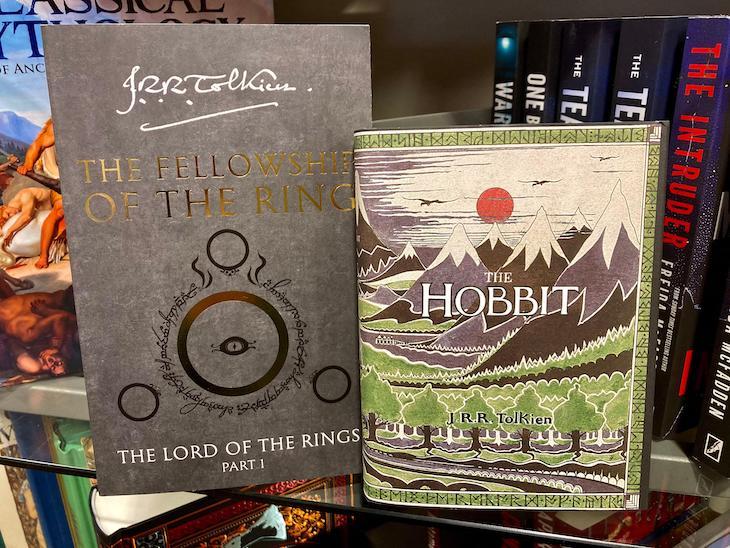
It was 1937, an age away, when JRR Tolkien’s book The Hobbit was first released. There are people alive who remember that year, but not many. The Hobbit was published by George Allen & Unwin after Stanley Unwin commissioned a review of the typescript (standard fee, one shilling) from his ten-year-old son, Rayner.
When he reviewed The Hobbit, CS Lewis said it was a children’s book “only in the sense that the first of many readings can be undertaken in the nursery.”
“Bilbo Baggins was a hobbit,” it read, complete with a ten-year-old’s errors, “who lived in his hobbit-hole and never went for adventures, at last Gandalf the wizard and his dwarves perswaded him to go. He had a very exiting time fighting goblins… This book, with the help of maps, does not need any illustrations it is good and should appeal to all children between the ages of five and nine.”
I was that age when I first encountered it, and it was the book that taught me to read. I had no difficulty with letters or with words, but it was the novel that first propelled me into a life of reading that shows no sign of ceasing, and whose pleasures first dazzled me during a wet family holiday one Easter on the Isles of Scilly.
There were days of sub-tropical sunshine on Tresco, but mostly we stayed on St. Mary’s and the rain whipped down. I remember the charmed scent of freshly baked Chelsea buns at a bakery in Hugh Town, but more than that I remember the mingled perfume of the flowering narcissi and the wild garlic as my brother and I were taken on what felt like forced marches across the countryside.
In the evening, after I’d got into bed, my stepfather read The Hobbit to me. The glint of gold, Gandalf and his dwarves, Bilbo’s first steps on adventure: they are as real in my memory as the child’s frightened excitement at the trip by train and sea from our home in north London to a friend’s borrowed cottage.
My stepfather would get to a particularly exciting point and declare that it was time for sleep. He would put the book down, opened out, cover upwards, at the point we had reached. And the next night he would pretend not to notice that the pages had somehow advanced.
What a disappointment, to read it to my son. The enchantment seemed to hold at the start, but soon I felt myself being marched not into a world that had come as naturally as the leaves to a tree, but one constructed by an Oxford professor with a love of etymology and Beowulf. The Misty Mountains seemed to rise less from the margins of the world than from Tolkien’s deliberate machinery. Too often, his mock-archaic solemnity was portentous, almost pompous. I found myself sympathizing with Hugo Dyson, the Inkling who, as Tolkien read The Lord of the Rings, was reputed to have groaned, “Oh God! Not another fucking elf!”
When he reviewed The Hobbit, C.S. Lewis said it was a children’s book “only in the sense that the first of many readings can be undertaken in the nursery.” Twenty-five years later W.H. Auden said, of Alice in Wonderland, that “there are good books which are only for adults, because their comprehension presupposes adult experiences, but there are no good books which are only for children.” Alan Bennett’s Uncommon Reader plays on that theme by having its heroine – our late Queen – return to a book by Ivy Compton-Burnett that once left her cold, and find pleasure there: reading, she notes, is a muscle, and one she has developed.
Bennett relies on willful corgis to introduce Her Majesty to a traveling library, but in my deliberate campaign to get my kids into the habit of reading, I longed to bring Harry Potter to bear. They refused, having taken against it on a point of prejudice, much as they expressed revulsion for foods they’d never tried.
One wet half-term holiday in Devon – how much of the British love of reading is indebted to the weather? – I lost my temper, and grabbed a copy of Harry Potter and the Philosopher’s Stone that was on the shelf in our Airbnb. Our kids retreated to their bedroom, and hid under the bedclothes to shut out my voice. I read anyway.
Before I got to the end of the first paragraph, two little heads popped out from beneath the duvet. In the evenings of the months that followed, the four of us sat and read through all seven volumes. They were even better than I remembered. So was Gerald Durrell’s My Family and Other Animals, which came next.
By then I had been given the joy of spotting my son curled up on the sofa, a hundred pages in, with no idea of the hour. He has died, but his books are in my library. His younger sister reads still – young adult fiction whose pleasures escape me, but so obviously enchant her into journeys to distant worlds.
The Hobbit is not a great book, but for me, as for many others, it was one of those that made books great.




Comments