‘Moscow is hard to love,’ Simon Morrison writes at the beginning of this engaging book, ‘but I love it.’ He deliberately sets out unconstrained by academic pieties, despite holding the post of Professor of Music and Slavic Languages and Literatures at Princeton University. He says he wrote A Kingdom and a Village ‘out of nostalgia for pre-oligarch decrepitude, when the world looked at Moscow with pity’.
The Orthodox Church and the security services have been conjoined from the 16th century to the present
The book is tripartite. The first part begins in 1147, when a prince named Yuri built a fort on a hill above a river. (When the authorities unveiled a monument to Yuri in 1954, Morrison reveals, a Muscovite yelled: ‘Doesn’t look like him.’) The story proceeds with Mongol hordes, fire, plague, Ivan III (the first to use the title ‘Tsar’) and Ivan IV, the Terrible. Moscow emerges as ‘the third Rome’, and the section closes as the last Yurik ruler dies.
Many aspects of this early history are contested (how the Cyrillic alphabet took root, for example). When the sources differ, Morrison tells us; he is never hasty to impose a coherent narrative on a bundle of conflicting facts or on gaps in the evidence.
In Part Two, ‘Second City’, which ushers in the Romanovs, the sources begin to cohere (the book includes 77 pages of notes). The 6ft 7in Peter the Great, grandson of the first Romanov ruler and ‘the most notable of all 18’, relocated the capital to St Petersburg in 1712. Morrison highlights the European foundations of the new city – ‘its architecture belonged to Italy or Spain or France’ – while Moscow ‘clung to Slavophile traditions… inured to suffering and proud of the violence it had committed against Kyiv and other, closer cities’. Kyiv, ‘the Slavic fountainhead’ 550 miles to the south, is a constant presence throughout the book.
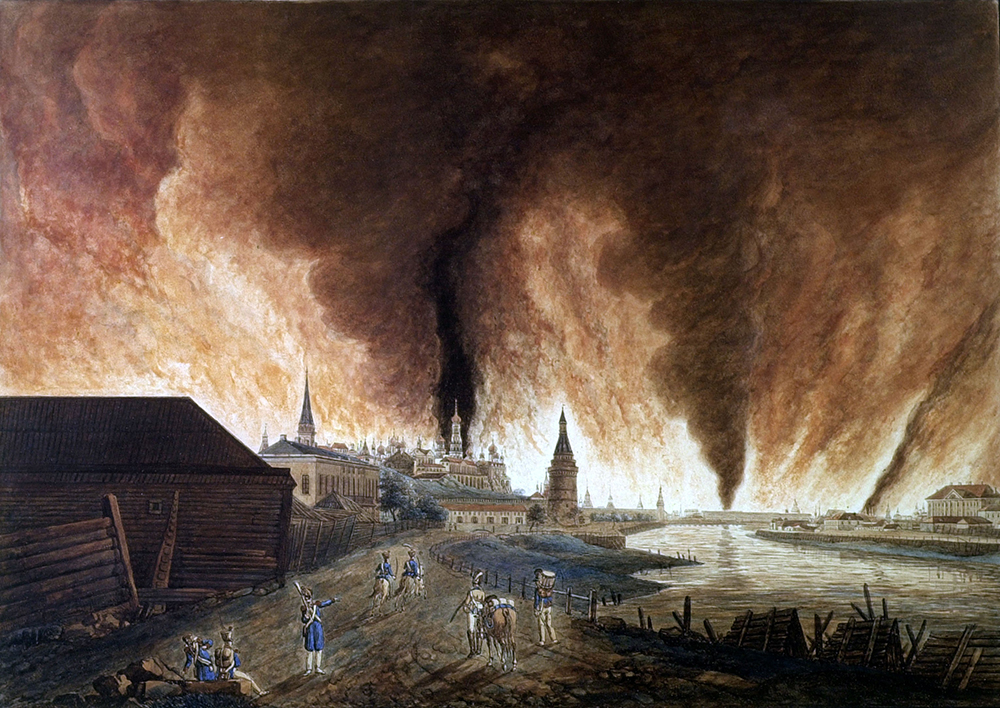
By the time Napoleon’s Grande Armée marched into an evacuated Moscow in 1812 the population had fallen from 270,000 to 10,000. Only a quarter of the housing stock survived the ensuing fire, and ‘from the ashes, a new Moscow would arise’. Morrison tells the story well, though it has been told many times before. He sits on the fence regarding the historical controversy surrounding General Mikhail Kutuzov, the ageing commander-in-chief under Alexander I – whether Tolstoy inflated his reputation and so on.
Sometimes the structure is thematic: a ‘Grand Theatre’ chapter, for example, showcases the storied history of the Bolshoi, while another, ‘Zaryadye’, traces the evolution of the neighbourhood of that name. These chapters look back and forward in the chronology, introducing new tempos and rhythms.
Part Three, ‘Soviet Capital’, opens in 1905 with Russia’s defeat in the Russo-Japanese War. It was Lenin who relocated the capital back to Moscow in 1918, ‘fulfilling’, according to his accomplice Grigory Zinoviev, the chairman of the Communist International, ‘the Slavophiles’ “timeless dream”’. Uncle Joe then ‘transformed Moscow… into a map of his obsessions’. After the horrors of the murderous 1930s, Muscovites had to endure the second world war. One night in July 1941, the Luftwaffe dropped bombs from 200 planes in 30-minute waves for five hours.
The book effectively ends with Stalin. There is very little on Gorbachev, let alone Putin, ‘the sloe-eyed security service minion with the bad combover’. But Morrison is keen to trace the effects of the past on the present: ‘The events of 1598 to 1613 lie beneath Russia’s response to the Napoleonic invasion, the second world war, the end of communism and even Nato’s incursions into eastern Europe in Ukraine some four centuries later.’ What pertained in the 18th century lives on: unlike St Petersburg, according to the first chapter of Part Two, ‘Moscow resisted Europe – still does’. Ivan the Terrible’s thuggish oprichniki emerge as direct ancestors of Lenin’s Cheka, Stalin’s NKVD, Brezhnev’s KGB and Putin’s FSB. After the oprichniki expanded in the 16th century, Morrison writes: ‘The Orthodox Church and the security services were conjoined from that moment forward to the present day.’ I would have liked more on the Church and its baleful role.
With a nod to the present, Morrison acknowledges ‘less merriment these days, sunk as Moscow is in a combination of Putin stagnation, the Ukraine war and the techno feudalism that is making serfs of us all’. He has been studying the City on the Seven Hills for decades, he says, having first visited in 1990. A fluent Russian speaker, he draws on personal experience, and is surely right when he asserts: ‘No Muscovite would be so gullible as to assume the government was ever on their side.’
Sources cited include a love note from a woman to a man etched on birchbark with a bone or iron stylus more than 1,000 years ago: ‘What is it you hold against me that you did not come to see me on Sunday?’ But ordinary people, on the whole, are silent in these pages. Morrison states at the outset: ‘I have assembled this book with a focus on rulers first and the ruled second.’ So there is none of the granular detail of diary entries and letters that have taken centre stage in popular histories in recent years.
That said, the author works hard and successfully to lift scenes off the page, and his interpolations are endearing. ‘A greater commitment to cleanliness would have helped,’ he observes when the flea-borne bacillus Yersinia pestis kills thousands. The prose is a model of clarity most of the time, though anachronistically colloquial language can jar (‘Shostakovich reached out to Stalin’), as can some of the weaker generalisations (‘The Symbolists chafed against reality’.)
Russian film, literature and music have naturally fostered national pride and gained traction in the public imagination, often by liberally reinterpreting history, and Morrison cites examples adroitly. As one might expect from a professor of music, the passages on composers are of particular interest. He writes astutely about Shostakovich’s late output in the period before his death in 1975. ‘Because by then he was able to express what he wanted in his music [as opposed to the repressed years under Stalin], he ended up expressing nothingat all.’
‘As I gaze into a distant mirror,’ Morrison writes of his ambitious undertaking in his introduction, ‘I hope to see the present reflected back.’ To a certain extent he succeeds in his aim. Commenting on Stalin’s unbuilt Palace of the Soviets on the site of the Cathedral of Christ the Saviour, he states, ‘the erasure was erased’, and this is the theme that emerges most clearly from these pages: regimes come and go, but ‘Moscow prevailed’ – sulky, surly, inward-looking but lovable, despite it all. (In St Petersburg, ‘people smiled for no reason’.) As Morrison concludes: ‘The melon-sweet snow falls on the Arbat each winter of each year of each decade of each century.’


Comments