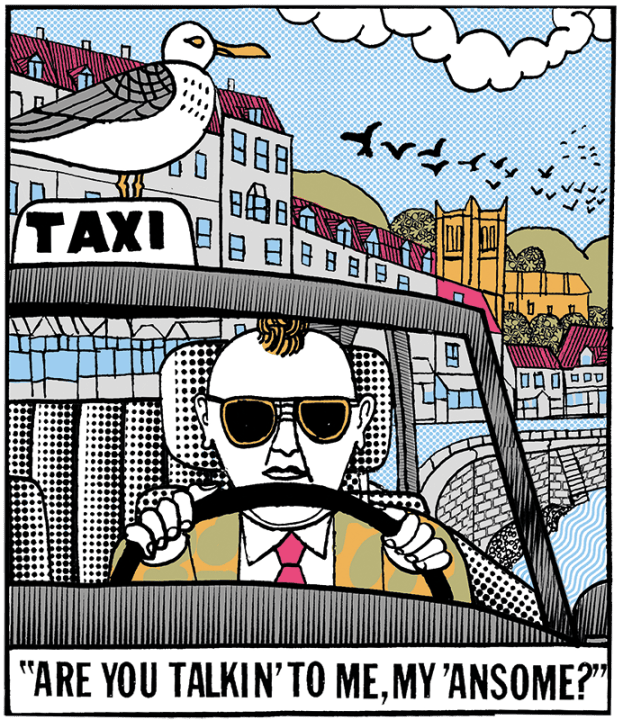
I’m afraid I lost my patience with my son when, after ferrying him to school, Scouts, sea cadets and football (rugby and association), he asked for a lift into town to meet his pals. ‘I’m not a taxi driver!’ He stared at me with the contempt only a 13-year-old boy can muster: ‘Yes, you are. That’s literally your job.’
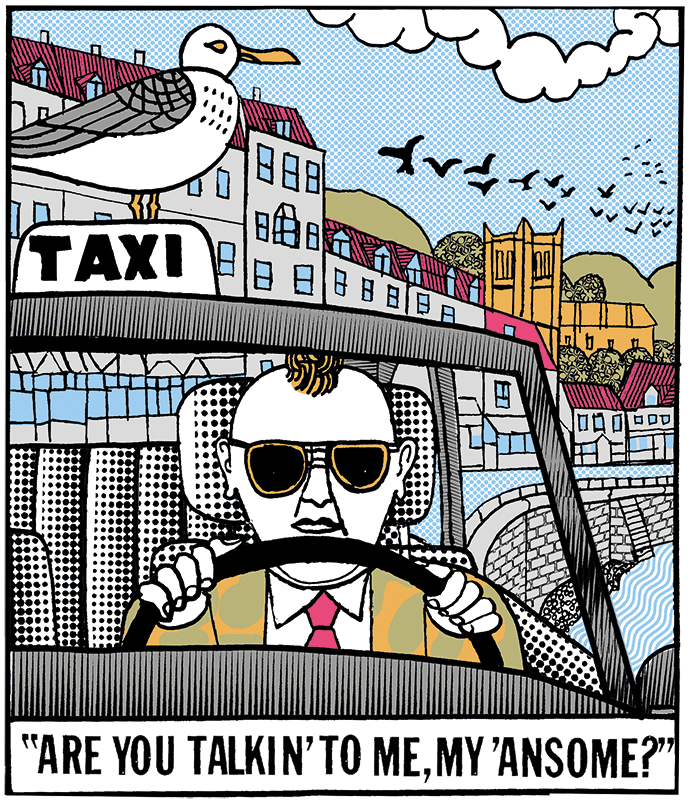
For the past 12 months, I have indeed been driving a cab. It was my ex-wife’s idea. She passed the taxi office, with its sign saying ‘Drivers needed’ in the window, every morning, and thought it was a better notion than pretending that doing stand-up was a job. ‘You like driving!’ she said, drawing an erroneous conclusion from the fact that I drive tens of thousands of miles a year for gigs; ignoring the fact that what makes these journeys tolerable – chain-smoking, listening to naval history podcasts, and the validation of strangers at one end – doesn’t apply when you’re driving a cab.
I’m not even a particularly good driver. I’ve always been very self-conscious, after a girl I was dating, soon after I passed my test, told me that you can tell what a man is like in bed by the way he drives. I immediately stalled the engine. (It happens to lots of men: it’s not a big deal.)
Nevertheless I applied for my cab driver’s licence from the local council. There was no driving test, nor did I have to take the Knowledge; but I did have to have a full medical and provide proof that I spoke English. Then I had to wait six weeks for the council bureaucracy to process my application, during which time I accrued another six points on my licence.

I got my badge. I immediately got access to a car and a two-way radio, and spent the first few days resisting the temptation to refer to myself as Broadsword calling Danny Boy.
I knew the area pretty well – I’d stood for Cornwall Council for the division where I was driving; if you can navigate VoteSource, you can navigate anything – and wasn’t confused by the Cornish habit of giving different names to either side of one street, or the fact that all rural addresses start ‘Tre-’. People down from London tried to give me postcodes, but I preferred to rely on other sources. A Cornishman giving me directions once began: ‘Carry on to where there used to be chickens…’
But I am well aware that the question you are asking is this: have I been busy? The answer is, not really. Most days I would struggle to earn the minimum wage after splitting the fare with the cab firm. The customers tended to be either very rich or very not – the middle classes drive themselves, unless it’s a very important birthday – and I preferred the latter. They tipped better.
I was driving during the day – the drivers who’d been working longer bagsied the night shifts, when all the garbage and trash are on the sidewalk and you can hustle some real money – and mostly took old ladies to hospital or the chiropodist. Occasionally I was called out to do the trip from Lidl to the harbour, which I always hated: largely because it takes ages while fishermen load and unload supplies for a week’s trawling. But also because they expected you to drive to their boat on the quay, which never felt safe. You have to turn round on a circle not much wider than the car, with a drop into the Atlantic and no barrier.
It picked up a bit in summer, when the tourists arrived, but not much – there were more fares, but the roads were so busy you could do fewer trips. It always took them a few days to get used to the idea that you should probably book in advance: my busiest day was when there was a wedding between a Cornish lad and a girl from London. His family, all knowing the score, booked cabs weeks beforehand; her family all opened Uber ten minutes before they needed to leave and saw the notification that the nearest car was in Bristol. I think I got them all there before the recessional.
The only thing that kept the taxi firm going, in the end, was the school contracts. These were highly prized, as you got paid even if the student in question never turned up. (Since many of these school contracts were for children going to pupil referral units, this was not uncommon; after ten minutes hanging around reception, someone would ring their mum, who would say: ‘Oh, Jayden’s not coming in today.’)
It always took the tourists a few days to get used to the idea that you should probably book in advance
I did wonder if it was the best use of money – there was one child whose taxi to school was paid for; his brother, who was at the same school, would follow in convoy in his mother’s car – and sent in a FOI request to see how much Cornwall Council spent on taxis. It’s about £19 million a year, although they reckon home-to-school transport could cost £44 million by 2028.
When my year was up, I went to renew my licence. The council noticed I had too many points on it and so I had to attend a meeting of the licensing subcommittee to determine whether I was a fit and proper person to drive a cab. I was pretty confident: a driver at another firm served time for attempted murder, so I didn’t feel the bar was particularly high; and, after all, the fewer drivers there are, the more their school contracts will cost. But after much deliberation, last Friday they decided not.
My argument that I drove more in a year than the average person does in six did not find favour with them either. They told me on Monday – well you can’t expect a council official to work late just because someone’s livelihood is at stake, can you?
My son was pleased though. Now I don’t have to drive a cab, I can take him to school every morning.





Comments