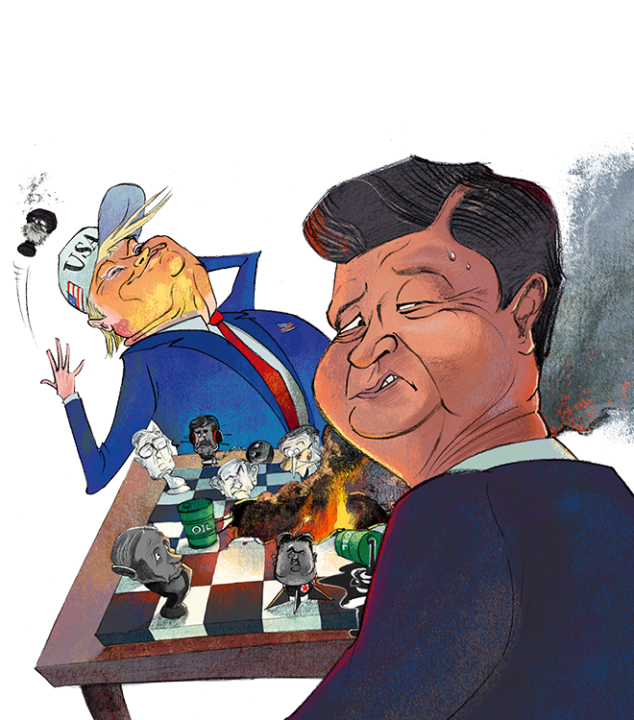
The United States and Israel killed Ayatollah Khamenei, and Xi Jinping’s decade-long project to build an alternative to the American-led order died with him.
For years, Beijing quietly assembled a network of dictatorships and client states designed to blunt American power. Iran supplied China with cheap oil and kept Washington bogged down in the Middle East. Russia waged war on Ukraine with Chinese materiel support, a gamble that was supposed to cement a powerful anti-western axis but has instead bled Moscow into dependence on Beijing. Regional proxies from Lebanon to Gaza added just enough chaos to stop Washington focusing on China. The Chinese Communist party (CCP) propped up Nicolas Maduro’s Venezuela, too, as it funneled narcotics and other ills into America.
The view in Beijing has been that the West is declining. Xi built his foreign policy on that premise
That network has now suffered damage so severe that no trade deal – no matter how many soybeans China agrees to buy from the US, or how many Boeing jets it orders – can disguise the devastation. And at the end of this month, Xi must sit across from Donald Trump, the man who greenlit the strike on the Ayatollah in Tehran and the seizure of Maduro in Caracas.
Trump flies to Beijing on March 31 for three days of talks. It will be the first visit by an American president since 2017. The summit was designed to extend the one-year trade truce both sides struck last October, with its lower tariffs, soybean purchases and standoff over rare earths and chip exports. Both sides had been preparing for weeks. Then Khamenei was killed and everything else became secondary.
China is the largest buyer of Iranian oil on Earth. It imports more than 70 percent of the crude it burns, and Iran has been one of its cheapest suppliers. Khamenei’s death throws the terms of that arrangement into doubt and the US is now threatening tariffs on any country that trades with Tehran. Beijing has yet to find a coherent response.
I spent the better part of the past decade watching this network take shape, reporting from North Korea, Xinjiang, Turkey, Russia and Ukraine as the architecture grew. I walked the streets of Kashgar documenting a surveillance state being built in real time, and sat with Uighur exiles in Istanbul who told me what it was like to live inside it.
Xi built a coalition, loose and transactional and deniable, that would give China strategic depth if it ever needed to withstand serious American pressure. The line I heard constantly when I was in China, and still read in CCP sources today, is that the West is declining. Xi built his foreign policy on that premise.
By most visible metrics, he was succeeding. Trade between China and Russia hit a record $245 billion in 2024, and Beijing was flooding Moscow with the microelectronics and drone components that kept Russia’s war machine running. Beijing overtook the combined West as the largest trading partner of the Gulf oil states, long an American sphere of influence. Everywhere Xi looked, the system was transforming in his favor.
But even as the trade figures climbed, the foundations beneath them were giving way. Russia’s invasion of Ukraine four years ago has now cost it more than a million military casualties by most credible estimates – losses on a scale unseen in European warfare since World War Two. Moscow has gone from being a partner capable of projecting power to a dependent surviving on Chinese goodwill. Iran’s regional proxies were wiped out, with Hassan Nasrallah, the secretary-general of Hezbollah, and Hamas’s Yahya Sinwar and Ismail Haniyeh killed in response to the horrors of 7 October. Syria’s dictator, Bashar al-Assad, was toppled. And now Khamenei, the linchpin of Tehran’s revolutionary state, is dead.
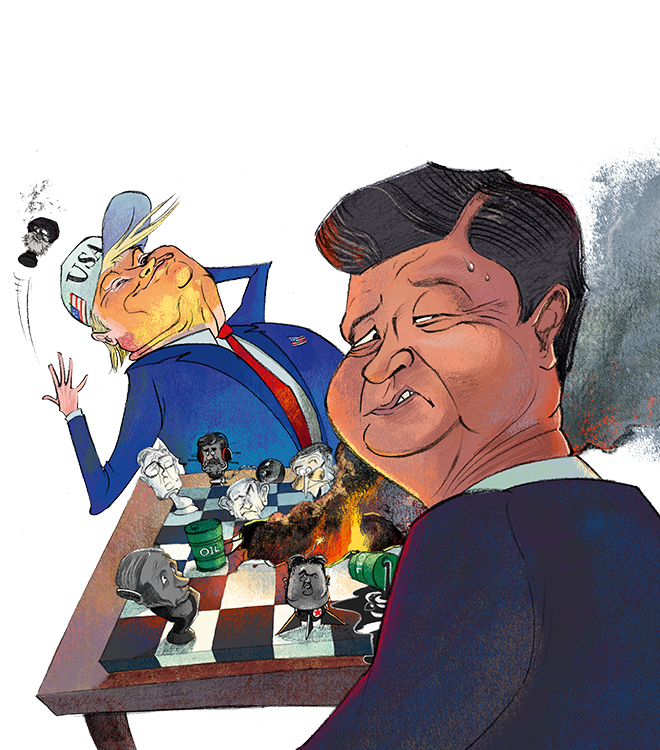
None of these figures was a Chinese asset in any direct sense. Each, however, was useful to Beijing, a piece on the board that kept the West distracted and off balance. One by one, they were being eliminated.
Start with the money, which reveals how little Beijing actually paid for the influence it is now losing. China’s 25-year partnership with Tehran, signed with fanfare in 2021, promised $400 billion in investment. Almost none of the money arrived, because it didn’t need to.
What China took from Iran was oil. An average of nearly 1.4 million barrels a day in 2024 and 2025, according to tanker-tracking data from the commodities firm Kpler, often bought at $8 to $10 per barrel below market price, through a shadow fleet operating outside western sanctions.
Now Xi faces a problem he cannot talk his way out of. Foreign Ministry spokesperson Mao Ning called the killing a “grave violation of Iran’s sovereignty and security.” But the Gulf states are watching what Beijing does, not what it says. And so far Beijing has offered Tehran no materiel support, no weapons, nothing that would cost China anything.
Beijing’s own spending reveals which side it has chosen. Last year, Iran received almost no investment from Belt and Road, Beijing’s flagship program for building infrastructure and buying influence abroad. Saudi Arabia received nearly $20 billion in contracts. Xi cannot say so out loud but the money has moved to Riyadh, and Tehran gets little of it.
The optimistic read is that Beijing is simply upgrading, swapping Iran for richer partners in the Gulf. There is something to this. China’s deepening relationships with Saudi Arabia, the UAE and the broader Gulf are real and accelerating.
What Xi has lost is harder to replace than a trading partner. Iran kept Washington tied down in the Middle East, unable to focus on China. That was extraordinarily useful, and it cost Beijing almost nothing.
Which brings us back to the room in Beijing where Xi and Trump will sit across from each other.
The conventional wisdom is that Trump arrives weakened. The Supreme Court struck down his emergency tariffs on 20 February, ruling that the President does not have the power to impose them. Chinese goods still face steep duties under other trade laws, but Trump’s ability to raise them at will is gone.
That take misses what the Iran strike has done to the room. Trump walks into Beijing as the president who signed off on the killing of the supreme leader of one of China’s most important partners.
Whatever leverage he lost at the Supreme Court, he recovered over the Iran strike. His threat of 25 percent tariffs on any country doing business with Iran puts Beijing’s oil imports squarely in the crosshairs. He walks into the summit with the stronger hand – and Xi knows it.
As Zineb Riboua, a research fellow at the Hudson Institute, which tracks Beijing’s military footprint across the Middle East and Africa, told me, Xi will try to “convey an image of a strong China, but their grand strategy is not functioning as they wish it to be.”
Xi arrives boxed in on every front. He cannot defend Iran without alienating the Gulf states. He cannot abandon Iran without appearing weak to the remaining members of the coalition he spent a decade assembling. He needs a trade deal to stabilize China’s economy, which is slowing far faster than Beijing admits. Official figures claim 5 percent growth, but Rhodium Group, a widely cited independent research firm, puts the real number at closer to 2.5 to 3 percent. He needs Trump in a generous mood.
The deepest damage, though, is something Xi cannot afford to acknowledge: what losing Iran means for Taiwan.
The deepest damage is something that cannot be acknowledged: what losing Iran means for Taiwan
Most analysts think about a Chinese invasion of Taiwan in military terms. Can Beijing’s forces actually land there and take the island? But invading Taiwan would also trigger western sanctions far worse than any-thing imposed on Russia. And after what happened to Khamenei, Beijing knows that escalation does not end with sanctions. To survive all that, China needs countries willing to sell it oil off the books, help it move money past western banks and provide political cover. Iran and Russia were supposed to be those countries.
China could still invade Taiwan, but not with any confidence that the CCP would survive the consequences. Some will argue that makes Xi more dangerous, that a leader who sees his options shrinking might act before they disappear. But everything he is doing points the other way. He is shoring up his economy, not preparing for war.
The summit will be conducted in the language of trade. Iran will hang over every session, but don’t expect that in the communiqué. Every government from Tokyo to Riyadh will read the subtext.
Xi will sit across from Trump and speak the language of a strong and ascendant China. The image is no longer the reality.


Comments