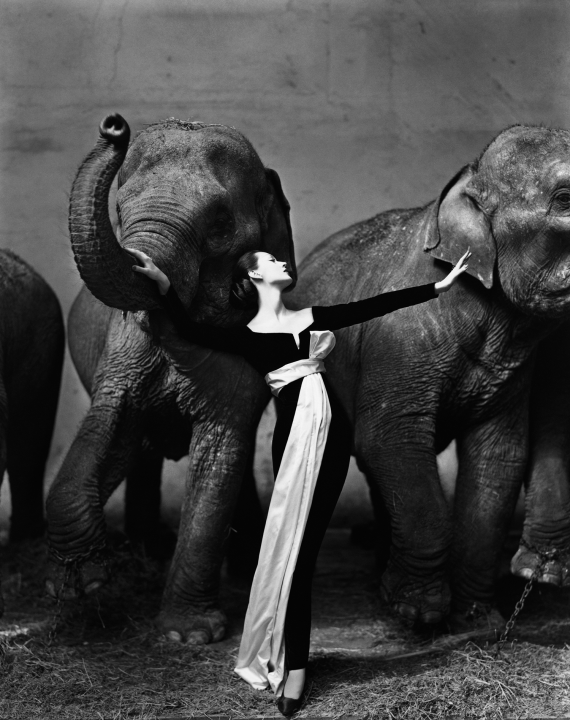
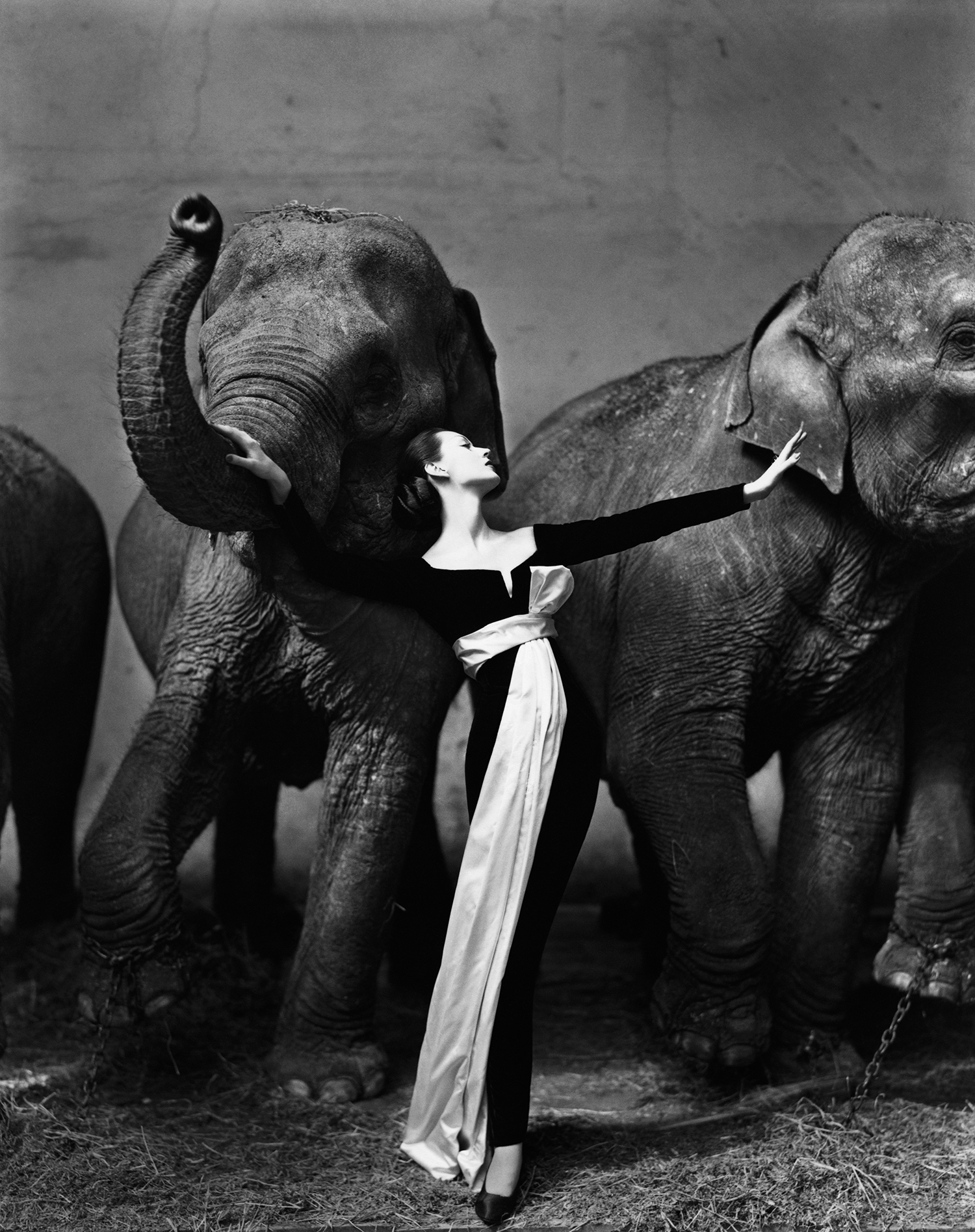
‘I have seldom had such a delicious hour,’ Isaiah Berlin wrote to me in January 1993. ‘I realise that Avedon and I are now friends for life, even if I never see him again.’ Berlin wasn’t alone in being bewitched. A few months earlier, Tina Brown had taken over as editor of the New Yorker and hired Avedon as staff photographer to open up its pages of solid, sacrosanct text. It was a blasphemous but brilliant move. With him came an incredible archive of images: Picasso, Stravinsky, Beckett, Hitchcock, Bogard, Garland, Auden, Chaplin, Streisand, Bacon, Capote, the Beatles… I could go on. As the TNY’s photographer – its only photographer – Avedon was under commission to produce new work, and as London editor, my role was to suggest new subjects to interest him.
Not surprisingly, given the pantheon of deities, none of those I approached refused. Seamus Heaney escaped having his ‘soul stolen by Avedon’ by being in Australia, although the notoriously reclusive Brian Friel, who happened to be in London, trekked out to the shabby Clapham studio. John Bayley brought his wife Iris Murdoch, then in a late stage of dementia, but most of our sitters were rising stars – Martin McDonagh, Patrick Marber, Jez Butterworth, Ian Bostridge and Thomas Adès, among the writers and musicians. Good-looking actors bored him. He adored Tilda Swinton, and he was drawn to Rufus Sewell only because of the ‘magnetism and sexual implication in his face’. Theatre was Dick’s passion, and almost every sitting was a performance of sorts. He told Derek Jacobi to ‘come as Francis Bacon’; instructed Nigel Hawthorne to re-enact the madness of King George III; captured the electricity of Ralph Fiennes’s Hamlet; wanted Ian Holm to replay his Lear, soiled, naked and clutching his Fool. The single time I saw Dick nervous was while waiting for nonagenarian John Gielgud, but such deference produced one of his least memorable portraits. ‘I could do better,’ he told me. ‘If he is willing.’
Hypnotised by those black eyes, a sitter would do almost anything to please him
To be an Avedon subject was a risk. Exposure on his existential white cyclorama meant being confronted by what he called the ‘topography of a face’, a stark black and white record of every hair and cross-hatching of lines. Bob Dylan, who had posed for Avedon in his youth, refused a second request, according to Rolling Stone editor, Jann Wenner. ‘Dylan had become a very vain guy and didn’t want to be photographed in Wrinklevision, which had kind of become Dick’s speciality.’ I found out that Salman Rushdie had been enraged by the satanic close-up that a manipulation of studio lighting had produced. ‘I didn’t know whether to blame the photographer or my face.’
During what Avedon called ‘the foreplay’ – a 15-minute sit-down over a hot drink and biscuits – he would relax and charm his subjects. The rapport continued when they had stepped out on to the cyclorama as the Deardorff camera, controlled by the shutter on a cable, enabled Dick to stand to one side, maintaining eye contact as they spoke. This was never the usual machine-gunning of frames, but fewer than a dozen stills as he usually knew in advance the picture he wanted. He left lighting and technical expertise to his assistants so that he could focus on an interchange of energy with his sitter – ‘a little theatre of two-ness’. The greatest collaboration I witnessed was when Judi Dench, recreating her role as a veteran actress in Amy’s View, willed tears into her eyes as she cold-creamed her face. The lens was her dressing-room mirror.
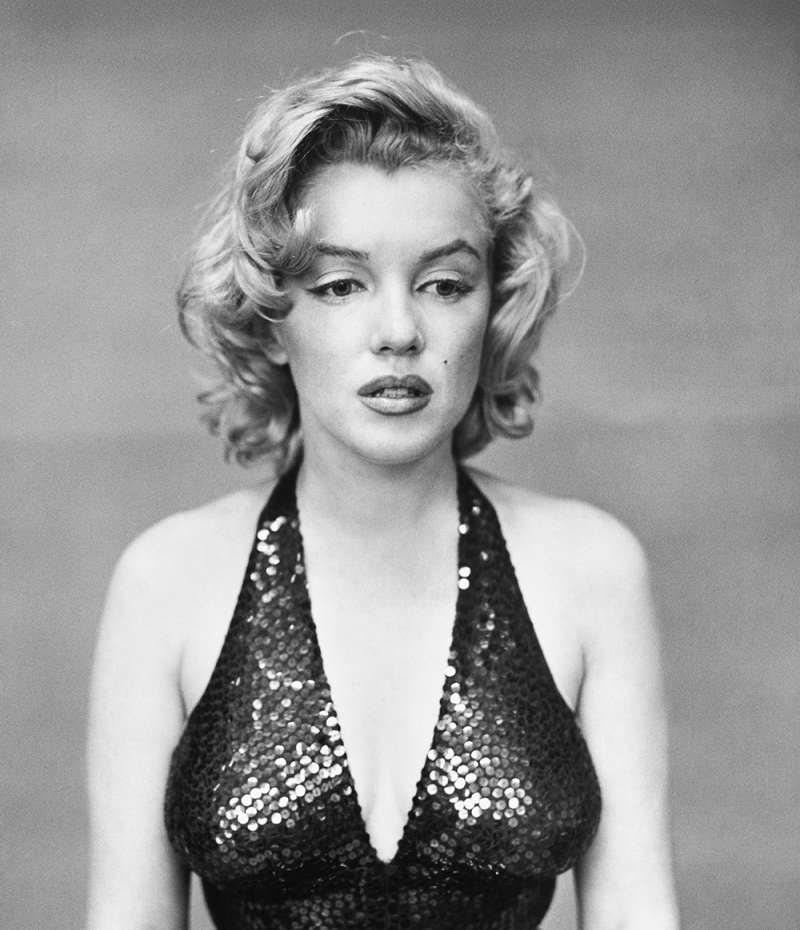
Avedon would refuse to give up until he had caught his moment of truth, famously exhausting Marilyn Monroe until she sank into her Norma Jean self (see below). In l957, in their room in New York’s Waldorf Astoria, he got the Duke and Duchess of Windsor, cuddling their pug, to drop their smiley masks by fibbing that on the way to the studio his cab had run over a dog.
A session was mostly a combination of manipulation and submission. Hypnotised by those black eyes, a sitter would do almost anything to please him. Rudolf Nureyev, days after his l961 defection, not only stripped off his practice clothes, but astounded Avedon by facing the camera and co-ordinating an erection with a slow port de bras en haut. ‘It was as if he was dancing with every part of himself,’ Dick told me. ‘I thought this was the most beyond-words moment – too beautiful to be believed.’ Twenty years later, in what is now an Avedon classic, Nastassja Kinski lay naked on a cement floor while a snake, placed between her legs by its charmer, writhed up her body and flicked its forked tongue into her ear like a kiss. Avedon got the split-second shot.
Just as arresting, but far more controversial, was what became known as the ‘pussy picture’. It happened after the model, Stephanie Seymour, had tugged up her sheer black body stocking. ‘Do it more,’ Avedon urged. ‘Emphasise it… Higher!’ His assistant remembered the shoot as ‘a spontaneous thing’, but it can’t have been: the hairdresser knew in advance that he had to topiary the ‘fur coat down there’ into a V-shape (its angularity matches the photograph’s vertical impact and the lighting perfectly balances the glow on her neck and face). The fashion world was appalled by what it regarded as art porn and no magazine would publish it. ‘The pose isn’t sexy,’ a heterosexual friend remarked. ‘Her expression is the opposite of “come hither” – at least to me.’ This ambiguity in Seymour’s eyes – part defiance, part pleading – is what makes the image so extraordinary. The Whitney hung it life-size in the l994 retrospective.
Last week, for 104 minutes in a Soho screening room, hearing that gravel voice, and watching the slim, antic figure raking his white mane and bouncing about in black cords and sneakers, I felt sucked back into the pulse-racing, incandescent Dick Avedon orbit. ‘Everything was zang!’ as my plus one, Penelope Tree, put it. Aged 16, she had been spotted by Dick at Capote’s Black & White ball in New York and become a 1960s muse, along with Twiggy and the gap-toothed Lauren Hutton (three of the model interviewees), whose beauty had appealed to Avedon by being ‘a little off’.
With access to fabulous archive and home-movie footage, director Ron Howard provides a sweeping retrospective, beginning with the child who always felt he was a ‘flunker’ but knew he could ‘see like a son of a bitch’. Avedon’s first photographs were the ID mugshots of fellow merchant marines, each face against a white background, prefiguring his future portraits. Fashion recognition came with coverage of Dior’s swirling New Look contrasted with crumbling postwar Paris; and his fame was consolidated in 1957 by his idol Fred Astaire’s impersonation of him as Dick Avery in Funny Face. Along with the glamour there would always be political commitment – to black American civil rights, anti-Vietnam war activism, and an apocalyptic vision of his country’s failings in 2004. This huge 2004 portfolio was Dick’s final New Yorker assignment and it killed him on the road.
Avedon had spent half a century capturing the momentum of the times, and with projects like In the American West recorded human diversity with a twist of his own. Portraits were what he valued most: ‘Faces that hold the wall’. ‘Like Rembrandt, Avedon caught the shorthand signature of an entire life’ (Simon Schama); ‘New Yorker profiles in miniature’ (Adam Gopnik); ‘The equivalent of an in-depth biography’ (Mikhail Baryshnikov).
A session was mostly a combination of manipulation and submission
Authorised by his Foundation, Avedon is far from in-depth. Through the narration of his son John, we learn of Avedon’s failure as a father – ‘He was always gone’ – and of his two failed marriages. His obsession with mental institutions was rooted in family connection: the tragic demise of his sister and second wife. But there is no mention of Avedon’s women. Or his men. A 2017 biography, co-authored by Norma Stevens, Dick’s studio manager and confidante of 30 years, outed him as gay, naming the director Mike Nichols among his ‘forbidden affinities’. The strong women he was close to – Renata Adler, the revered American journalist, being one – are said to have been covers. ‘I think it was useful to him for us to be an item,’ she is quoted as saying. Dick’s long relationship with Nicole Wisniak, the creative force behind the French cult magazine Égoïste, is portrayed as another pretence.
Their liaison had certainly convinced me. Nicole would always join Dick in London, going to the theatre every night and sharing his bed at the Connaught. Their affection was tangible, and I remember his jokey asides about Viagra. I thought Nicole was an amazing woman. Like Adler, she was, in the words of Stevens, ‘all aura, her intelligence blazing out’, her red, pre-Raphaelite hair the equivalent of her predecessor’s signature long thick plait. With Égoïste, she gave Dick completely free expression, taking him off piste with party reportage (the Volpi Ball), and with experimental photographic essays of Cirque du Soleil, whose artists’ extraordinary physicality pushed the boundaries of his performance pictures. Nicole did not hesitate to publish the infamous Stephanie Seymour shot. Dick had shown it to her as a photostat at the airport. ‘Look! I’ve done it again!’ he’d said. He meant: produced another masterpiece. She knew it would cause no scandal in France, the country of Courbet’s ‘L’Origine du monde’. ‘We don’t have this prudery about sex.’
How much more enlightening Nicole Wisniak’s recollections of two Avedon decades would have been than the appearances of well-heeled gallery owner Larry Gagosian, droning on about the lunch Dick produced of nothing but boiled eggs and champagne (a send-up, surely). But Ron Howard’s film steers clear of the intimate circle. The exception is the New Yorker’s Adam Gopnik, whose beautiful memoir is among the tributes in Norma Stevens’s ‘tell-all’ from which he vehemently distanced himself. Formally dressed, with a silk handkerchief in his jacket pocket, he speaks as eloquently as he writes and tears up at the end when describing ‘lovable’ Dick. You will have to read the book to find out why. A riveting, visual feast, Howard’s documentary is airbrushed Avedon, and as such would have had its subject’s blessing. ‘Marriages, love, sex – everything diminishes,’ we hear him say. ‘Work is the one thing that doesn’t turn on you.’
Avedon, 12A, is out now in selected cinemas and on Netflix.


Comments