
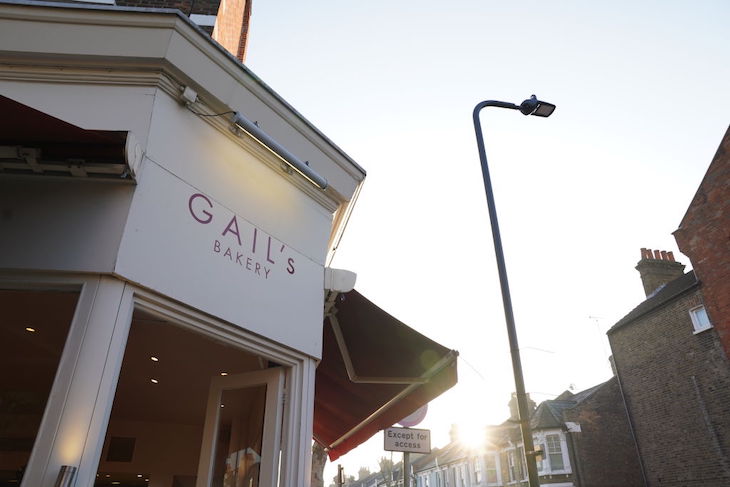
If anti-Israel agitators wish to avoid being described as terrorists, they might begin by ceasing to terrorise ordinary people. The smashing of the Gail’s branch in Archway, north London, red paint flung across its walls, slogans sprayed beside its door, is the latest instalment in a now familiar pattern: vandalism presented as virtue, intimidation dressed up as solidarity. The activists call it protest, but let’s call it by its real name: menace.
To vandalise Gail’s in the name of Gaza is a deliberate effort to intimidate and must be treated as such
The branch’s windows were broken twice within a single week. Slogans reading “Reject corporate Zionism” and “Boycott” were sprayed across the frontage, an anarchist symbol scrawled beside the entrance. Staff arrived at dawn to clear shattered glass from the pavement while police opened a hate crime investigation. That sequence of events is not persuasion in any recognisable democratic sense, but coercion, carried out by people who operate under cover of darkness and disappear before they can be held accountable. Thugs.
It is at least on brand: this sort of violence and intimidation sits uncomfortably close to the political culture these activists claim to romanticise. For much of the past eight decades, the most visible export of Palestinians has been violence: hijackings, bombings, suicide attacks, knife assaults, rockets. They perfected many of these techniques which we now all have to experience. People can argue endlessly about history, borders, mandates and missed opportunities. That argument has been running for decades and will continue to do so. What has been far more visible to the outside world is the method that has so often defined Palestinian militancy over the past seventy-eight years: hijackings, bombings, shootings, stabbings, rockets, the theatre of fear. For many observers, that has been the most recognisable export of Palestinianism to the wider world.

The word was intifada, uprising through force. What we are now witnessing in London is its imitation. The smashing of shop windows, the ritual daubing of red paint, the attempt to make ordinary commercial life feel unsafe, all mirror that politics of intimidation. In that sense the product has been successfully exported. The intifada has been globalised, exactly as its most ardent advocates once promised it would be.
In that sense the vandalism in Archway is not an aberration, but imitation.
Contrast that with what Israel has exported. One example will suffice. Teva Pharmaceuticals manufactures roughly one in five of the generic medicines used by the NHS. I have stood inside the facilities in Israel where they produce these life-saving treatments. I travelled there with Kemi Badenoch when she was Trade Secretary as she worked on a renewed UK–Israel trade deal – talks that were later frozen by the incoming Labour government in response to the war started when the Palestinians savagely attacked Israel on October 7th. That decision punished both Israel and Britain, as a result of Palestinian terrorism. It didn’t do much to help the Palestinians, either. Pro-Palestinian campaigners have even targeted Teva, calling for the shutdown of its UK operations,
The targeting of Gail’s belongs in a dark historical context. The smashing of Jewish shop windows did not begin in Archway. It did not begin in 2023. It did not begin with the Palestinian cause.
In medieval Europe, Jews barred from land ownership and many trades were funnelled into commerce and moneylending. When plague struck, when debts mounted, when religious hysteria flared, shops were looted, homes ransacked, communities expelled. In 1391 in Spain, riots tore through Jewish quarters. In the Rhineland during the Crusades, communities were massacred and property seized. These were eruptions of violence tied to theology and envy, local in execution, brutal in effect.
By the late nineteenth and early twentieth centuries, the pattern hardened into politics. Karl Lueger in Vienna promoted boycotts of Jewish businesses. In 1904, in Limerick, a boycott drove members of a small Jewish community from the city. Interwar Poland saw organised campaigns to exclude Jewish merchants from economic life.
Then came state power. On 1 April 1933, Nazi storm troopers stood outside Jewish shops across Germany, daubing Stars of David on windows and warning customers away. “Don’t buy from Jews.” It was presented as a day of action. It marked the beginning of systematic economic strangulation. Aryanisation followed, forced sales at a fraction of value. In November 1938, during Kristallnacht, some 7,500 Jewish businesses were wrecked, their glass smashed and scattered across streets, synagogues burned, owners arrested and sent to camps.
This pathetic attempt is no Kristallnacht, for sure. But the image of red paint across a Jewish-associated shopfront, glass shattered, slogans accusing it of collective guilt, carries an echo that should trouble anyone with a functioning memory.
Since October 2023, Jewish schools in Stamford Hill have been vandalised with red paint. In 2025, a Jewish-owned business in the area was attacked, with red paint thrown, windows smashed and ‘Drop Elbit’ sprayed on the frontage. A building housing Jewish businesses in north Manchester was also daubed with red paint and ‘Happy Nakba Day’ graffiti. In November 2023, the Wiener Holocaust Library’s sign was defaced with ‘Gaza’ in red paint. In each case, the perpetrators frame their actions through the language of Gaza and Israel, while the immediate targets are local premises that are identifiably Jewish or associated with Jewish communities.
This is intimidation. Its purpose is to make communities feel exposed, unwelcome, watched. That is why police classify such incidents as hate crimes. That is why they must treat them with severity.
The branch’s windows were smashed twice within a single week
When rioters smashed shop windows during the 2011 London riots, courts processed offenders swiftly and imposed custodial sentences. Society recognised that mass vandalism is not mischief. It is a rupture of the social contract. We live together in cities on the understanding that disputes are argued, not enacted with bricks and paint. Once that line is crossed, fear replaces trust. If the state fails to enforce that boundary consistently, it invites repetition, and reveals their tolerance of violence against some specific people.
As for Gail’s itself, the charge sheet collapses under scrutiny. The bakery was founded by Israelis decades ago. They no longer own it. I know them. I have met them. They are not caricatures of hard-line nationalism. They have, in fact, often been critical of their own government. That detail should not matter. Israel’s government is democratically elected and has led its country through an extraordinarily tough war triggered by the 7 October massacre.
Gail’s today is majority-owned by an American investment firm. It is a British business, employing British staff, paying British taxes, selling bread to British customers. To vandalise it in the name of Gaza is a deliberate effort to intimidate and must be treated as such.
If activists wish to persuade, they should try argument. If they choose intimidation instead, they should expect the law to answer in kind. But in today’s Britain, what are the chances it will?




Comments