
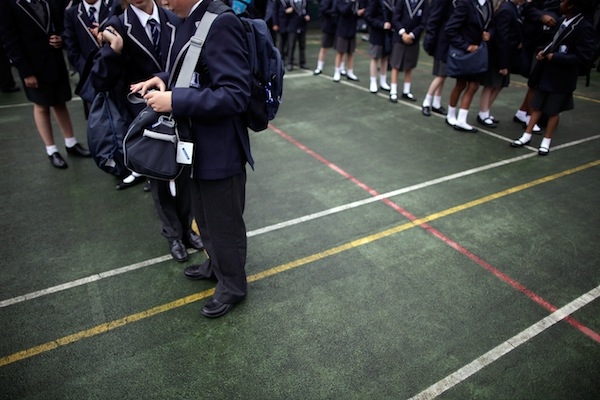
The Guardian has published a piece on school reform which perfectly expresses the attitude which has condemned children of lower-income parents to dismal education for years. The introduction of the story goes as follows:
There are around 10,600 empty school places in Suffolk. Or, to put it another way, if 10 average-sized secondary schools were closed down, there would still be a place for every child living in the county who needs one. Which made it somewhat surprising, therefore, when the Department for Education approved four free schools in the county, with a further two in the offing.
‘The Suffolk free school scandal’, as local campaigners are calling it…
Behold the bureaucratic mindset: why open a new school if there are places to fill in bad ones? Surely what matters is the convenience of the planners. Next, witness ‘local campaigners’ as a phrase used to describe the enemies of the new school. What about campaigners who usher in free schools, like the Breckland parents who brought in the profit-seeking International English School? They can’t be ‘local campaigners’ in the Guardian’s argot: such a phrase is used only for Good People who side with Big Government.
Next, where is the ‘scandal’? That there two free schools are opening in Suffolk, and they can only do so because there is parental demand. I wonder if the Guardian ever asks itself: why is there demand? If there are 10,600 vacancies in the Suffolk council schools, why do some parents want to go to the free school? Might it be that the existing schools are unpopular, and might that be for a reason? If there is a scandal, it is the failure of the council-run schools to satisfy demand.
It’s interesting to see who lines up with Big Government against parental choice. The Royal Society of Arts decided to add is tuppenceworth and the Guardian mentions its report which concludes:
‘There does not appear to be any rhyme or reason as to where free schools are being encouraged or permitted’ and described them as an ‘unguided missile rather than a targeted weapon in the school programme’.
Note, again, the bureaucratic’s shock. These new schools seem to set up depending on parental demand, which is unpredictable. We can’t have that! Whatever next? And again, if new schools are ‘unguided missiles’ then whom are they aimed at? This is about protecting unpopular schools, and allowing them to keep inflicting harm on the pupils whose life chances they stymie.
The Guardian continues:
Jeremy Rowe, head of Sir John Leman high school, in Beccles, where the most controversial free school to date is scheduled to open in two months’ time, put up a tough fight on the grounds that the school would undermine his own. His school’s most recent Ofsted report described it as ‘good with outstanding features’.
If a new school ‘undermines’ an existing one, might that be because the new one is perceived to be better by parents? This happens in Sweden all the time: existing schools appeal against new schools saying ‘we can’t take this pain, please don’t let them steal our pupils’ and the Swedish authorities invariably ignore them and green light the new school.
And why? Because in Sweden, the left are on the side of the pupils: the education debate there is about kids. In Britain, the left are on the side of the teachers’ unions: the education debate here is still all about the adults. What mystifies me is how anyone on the left can defend a system which delivers such an appalling service to kids in poor neighbourhoods but performing well for those rich enough to move to a better catchment area. To read The Guardian’s story, it’s as if parents and the pupils do not exist – or, if they do, they are presumably stupid and unfit to decide which school their parent wants to go. In Sweden, the left had to change and adapt as thousands of low-income schools pupils voted with their feet. That change will come to Britain, too. But not yet.



Comments