Canterbury

Save us from the Gospel according to Grok

The Rt. Revd. Martyn Snow, the handsome and up-to-date Bishop of Leicester, has decided that it’s OK, even admirable, for clergy to use AI to write their sermons. Bishop Snow was on the radio the other day, proud to share with listeners that in his diocese, they’ve even had an AI expert come to give pointers to the priests. No more painful head-scratching on a Saturday afternoon for the lucky clerics of Leicester. ChatGPT will sort it. Just plug in a Bible verse and a few well-crafted prompts, and you’re off to the cricket, or to Pride, whichever way you swing. It’s one of those many times I wish Michael Wharton was still alive and writing.


gospel

The depth of Edmund de Waal

“I’m very, very proud of making pots,” says Edmund de Waal. “I don’t call myself a conceptual artist.” He is putting the finishing touches to an exhibition of ceramic sculptures at Gagosian’s Beverly Hills gallery. Around the walls are sleek, tiered vitrines filled with porcelain vessels, along with a sequence of smaller gold-painted boxes – “reliquaries,” as de Waal calls them, inspired by the early Renaissance master Duccio. “I hate the word minimalism. I find it completely useless as a term.” In the last 20 years, de Waal has risen from the status of a humble ceramicist to become one of Britain and America’s leading contemporary artists, best known for his multipart installations of pots.

Which are the ‘Twelve Churches’ that made Christianity?

From our UK edition

40 min listen

What links the Church of the Nativity in Bethlehem and St Peter's in Rome with the 16th Street Baptist Church in Birmingham, Alabama, and Canaanland in Ota, Nigeria? These are just some of the churches that Anglican priest and writer the Revd Fergus Butler-Gallie highlights in his new book Twelve Churches: An Unlikely History of the Buildings that made Christianity. The Anglican priest and writer joins Damian Thompson on Holy Smoke to explain how each Church not only tells a story but also raises a surprising dilemma for modern believers. Fergus aims to tell the history of the Churches 'warts and all' and argues that, from Turkey to Britain, today’s Christians must be prepared to defend their religious spaces.

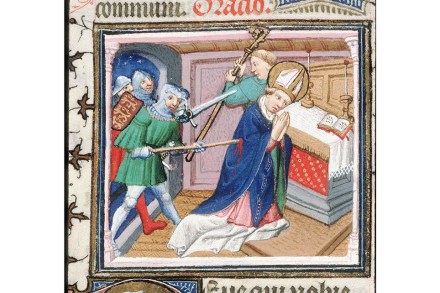
What became of Thomas Becket’s bones?

From our UK edition

The St Brice’s Day Massacre? I must admit I hadn’t heard of this ‘most just extermination’ of Danes in Oxford at the instigation of King Aethelred the Unready in 1002, perhaps because the teaching of history in this country tends to kick off in 1066. You certainly don’t think of Oxford as a place that pioneered techniques of ethnic cleansing. Crypt is a collection of seven essays that unearth details about how certain people lived and died in the past. If you didn’t already know Alice Roberts’s background as an anatomist and biological anthropologist, you’d have a good chance of deducing it from this book.

Pilgrimage is beginning to resemble any other kind of holiday

From our UK edition

Hidden away in the Old City of Jerusalem is a tattoo parlour which has been serving pilgrims for the past 700 years. The Razzouk family parlour near the Jaffa Gate claims to have been inking crosses into travellers’ skins since the 1300s. True or not, it’s a good example of how contemporary pilgrimage sites draw on an occasionally dubious history to offer something unique in a crowded travel market. The pilgrim parlour is one of many memorable details from Peter Stanford’s Pilgrimage, which looks at how this ancient tradition has been revived for the 21st century.