On 21 February 2022, 35-year-old Charlie Walker flew into Yakutsk in the Russian Far East, ready to ski hundreds of miles up the frozen River Lena, pulling his gear on a sledge. He was heading to the Laptev Sea, a large peripheral bay of the Arctic Ocean. A neighbour at home in London had wished him luck. ‘Frostbite I can handle,’ Walker replied. ‘Let’s just hope Russia doesn’t start a war while I’m there.’
But it did.
Walker writes: ‘That Special Military Operation changed everything: for me, for Ukraine and for the world.’ Obliged to change plans, he flew north-east to Batagay over the Verkhoyansk Mountains, and from there set out over the Yana and Omoloy rivers. Large plastic letters in the car-park of Batagay airport announce the ‘Pole of Cold’: an exiled dissident had logged a record low of -67.8°C.
The chained ghosts of Gulag workers stalk these pages. I fancy they are mocking the ‘adventurers’ among us
The author’s journey pierces the taiga, that five-million-square-mile boreal forest that lives in the Russian imagination as a primordial hinterland and refuge of mythic spirits. Walker artfully modulates the tension as he hauls his 85kg sled along the fabled zimniki, the seasonal roads cleared on river ice that are strong enough to carry lorries. He interleaves practicalities with lightly conveyed historical and scientific information, the latter including the vagaries of climate change. The route skirts the world’s largest ‘thermokarst’ sinkhole, where melting permafrost collapses in on itself. Meanwhile the author, by now frozen himself, finds wolf tracks round his tent.
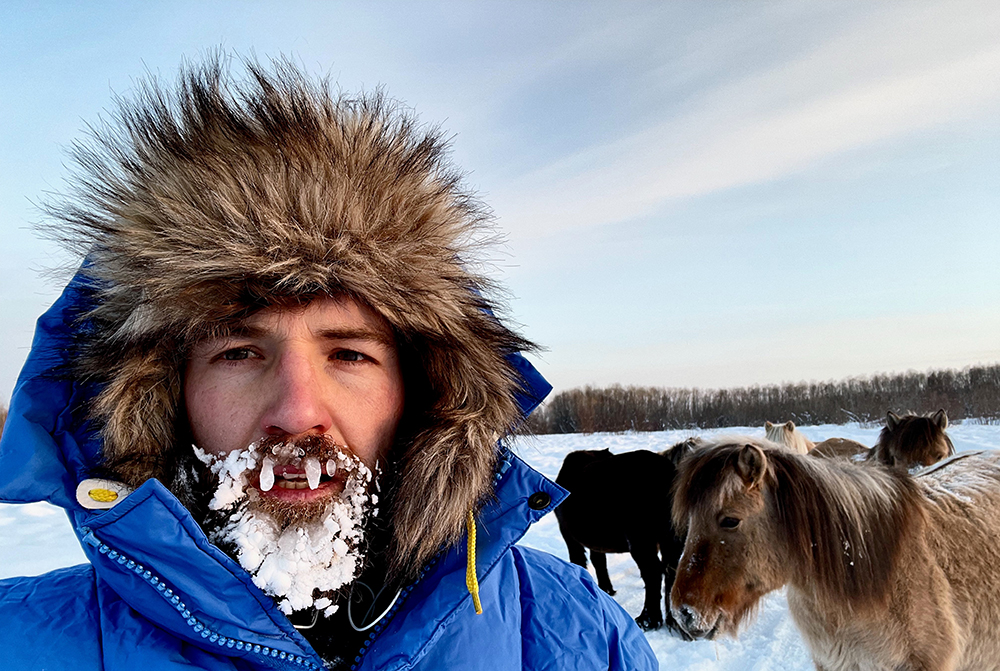
I had initial misgivings about this book. Walker, described as ‘an award-winning explorer, author and international keynote speaker’, appears in a photograph on page 50 with a frozen beard. He has form in the iced beard department – a previous book being Through Sand and Snow. Travel literature reached peak beard, surely, at the end of the last century. Are we to go backwards in this, as in so much else?
But Walker won me round. An immensely likeable companion, he crucially doesn’t take himself too seriously, and although he says that for periods ‘the quiet simplicity of the wilderness was bewitching’, the experience he conveys in these enjoyable pages is essentially a long scream of very cold anguish.
The emotional heart of On Thin Ice lies in people’s reaction to the unfolding catastrophe of war. They all ask Walker’s opinion of it, whether they are ethnic Russians or indigenous Siberians like the Sakha (which the Moscow administration used to refer to as Yakut) or reindeer-herding Eveni (not to be confused with the closely related Evenki, another reindeer people of the Russian north). ‘Putin is a good and strong leader for my country,’ a friendly teacher informs the author, continuing: ‘Really, Ukraine invaded Russia.’ By the end of Part One, Walker writes: ‘I marvelled at how effective Putin’s repression through fear was.’

He stays in Ust-Kuiga, a river port built for loading tin onto barges by Gulag convicts. Almost two-thirds of Stalin’s workforce across the Russian Arctic were prisoners. Their chained ghosts stalk these pages. I fancy they are mocking the ‘adventurers’ among us.
Encounters with the FSB, or secret police, understandably frighten our man almost from the start. Hospitality is withdrawn. Strangers begin to film him. Paranoia takes hold, and who can wonder? FSB goons extract witness statements from people Walker has met. Word gets out on the truckers’ Telegram channel that the foreign hiker has been in trouble with the police. An Instagram post from an account called Yakutia News reports that a case has been opened against Walker in Ust-Kuiga for anti-war propaganda. ‘How could the Siberia of my imagination,’ he wonders, ‘be at once so dazzlingly white and yet so full of darkness?’
Approaching journey’s end after 600 hard miles, ‘the accelerating tectonics of colliding sea-ice currents had formed a pressure ridge where great, jagged blocks were thrown up in their clash, some of the massy shards taller than me’. Then the goons arrest him. They insist he is working as a journalist, violating the terms of his tourist visa, and that he has photographed restricted military sites. Part Three takes place in prison, at first in Tiksi, a settlement so remote that residents refer to the rest of Russia as materik – the mainland. A new law enshrines a 15-year sentence for so-called journalists who purvey ‘fake news’. The British embassy sends a link to a directory of English-speaking lawyers: the closest is 2,846 miles away.
The book reads like a thriller. What a gripping film it would make.



Comments