The gulag

The clear and present danger of exploring the Gulag

From our UK edition

On 21 February 2022, 35-year-old Charlie Walker flew into Yakutsk in the Russian Far East, ready to ski hundreds of miles up the frozen River Lena, pulling his gear on a sledge. He was heading to the Laptev Sea, a large peripheral bay of the Arctic Ocean. A neighbour at home in London had wished him luck. ‘Frostbite I can handle,’ Walker replied. ‘Let’s just hope Russia doesn’t start a war while I’m there.’ But it did. Walker writes: ‘That Special Military Operation changed everything: for me, for Ukraine and for the world.’ Obliged to change plans, he flew north-east to Batagay over the Verkhoyansk Mountains, and from there set out over the Yana and Omoloy rivers.
The awful calamity of Stalin being a music lover

From our UK edition

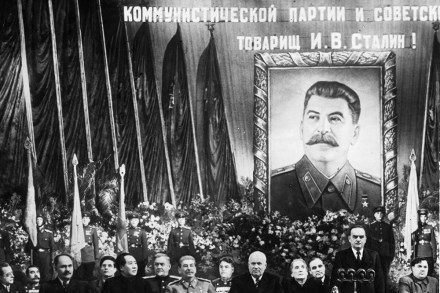
At around 9 p.m. on 5 March 1953 Sergei Prokofiev died of a brain haemorrhage on the sofa of his Moscow flat. He was 61, and had struggled for years with ill health. He had long complained of pain in his soul. Less than an hour later, the source of that pain, Joseph Stalin, died of a heart attack in his dacha on the outskirts of Moscow. Prokofiev’s death wasn’t so much forgotten as ignored. The leading music magazine Sovetskaya muzyka devoted the first 115 pages of its new issue to Stalin; only then did it mention Prokofiev. A million people thronged the streets to see Stalin lie in state; only 15 attended Prokofiev’s funeral. A string quartet played beside Stalin’s bier. Its violinist, Veronika Rostropovich, cried inconsolably. ‘Leave me in peace,’ she told her colleagues.

Imprisoned for years on Putin’s whim

From our UK edition

Imagine: it’s 16 December 2004 and you are a middle-ranking banker living in Moscow – prosperous but ordinary, a long way below oligarch level. You are looking forward to a New Year’s trip with your family to Prague – the hotel is booked; your young son is excited. Your phone rings while you are at lunch: an investigator whom you’ve never heard of asks you to come and answer a few questions. You ask if tomorrow will do. ‘No, you must come today,’ insists the caller. ‘It’ll take around 20 minutes.’ What do you do? If this were the beginning of a thriller, Vladimir Pereverzin would have instantly made his way to the secret lock-up with the false identity documents and gone on the run.

Vivek is right: America is devolving into tyranny

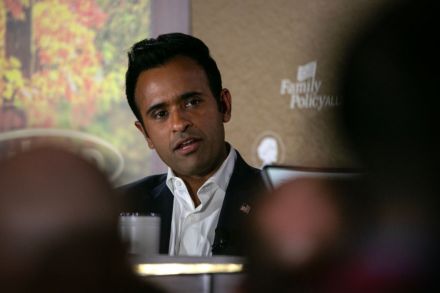
Many commentators (including yours truly) have pointed out that America is divided more now than it has been since the late 1850s and the run up to the Civil War. But as usual, I may have understated the case.  That, anyway, is what Vivek Ramaswamy would say. In a remarkable, just-published interview with Tom Klingenstein, Ramaswamy several time insists that we are not in a pre-war situation. It’s worse than that. “We are,” he insists, “absolutely in a war with the fate of the country at stake.” Hyperbolic? I don’t think so. The war, he acknowledges, could and likely will get worse. But we can already see the troops deployed and the battle lines drawn.

vivek ramaswamy

A last-minute escape from the Holocaust

From our UK edition

At the beginning of his profoundly moving memoir of his grandparents, parents, the Holocaust and the Gulag, Daniel Finkelstein writes: This the story of how my family took a journey which ended happily in Hendon, eating crusty bread rolls with butter in the café near the M1, but on the way took a detour through hell. Who would have guessed what those people, tucking into rolls at the newly-opened Brent Cross shopping centre in the mid-1970s, had been through?

Stalin the intellectual: the dictator cast in a new light

From our UK edition

The link between mass-murdering dictators and the gentle occupation of reading and writing books is a curious one, but it definitely exists. Mao was a much- praised practitioner of traditional Chinese poetry; Hitler was widely if haphazardly read, dictated Mein Kampf and was a fan of Karl May’s Wild West stories; and Stalin, as Geoffrey Roberts shows, took books at least as seriously as the purging of foes, real and imagined.