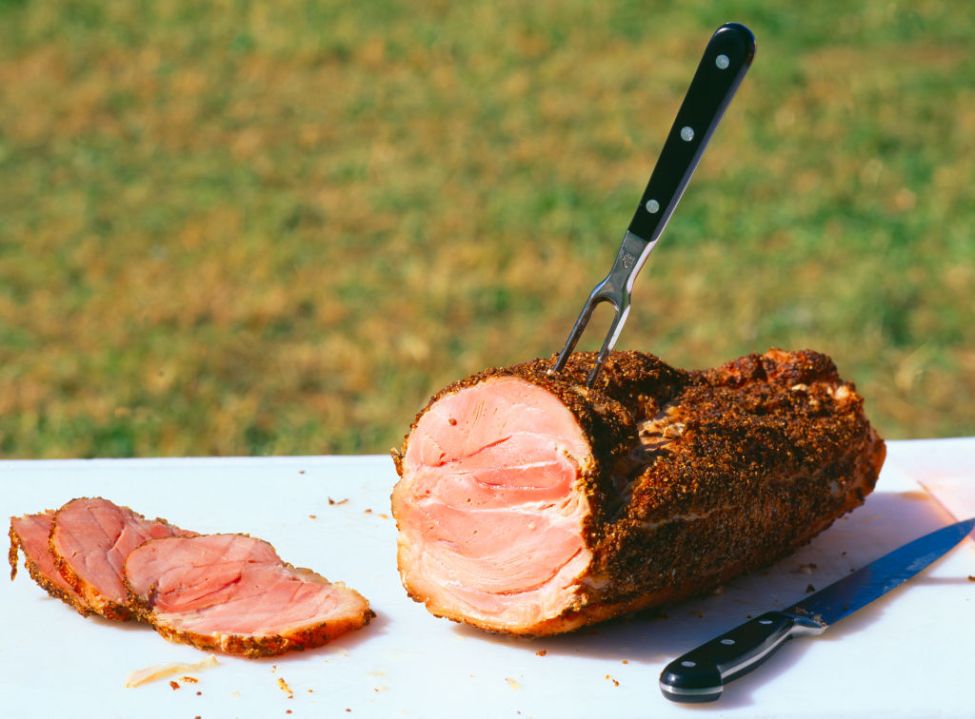

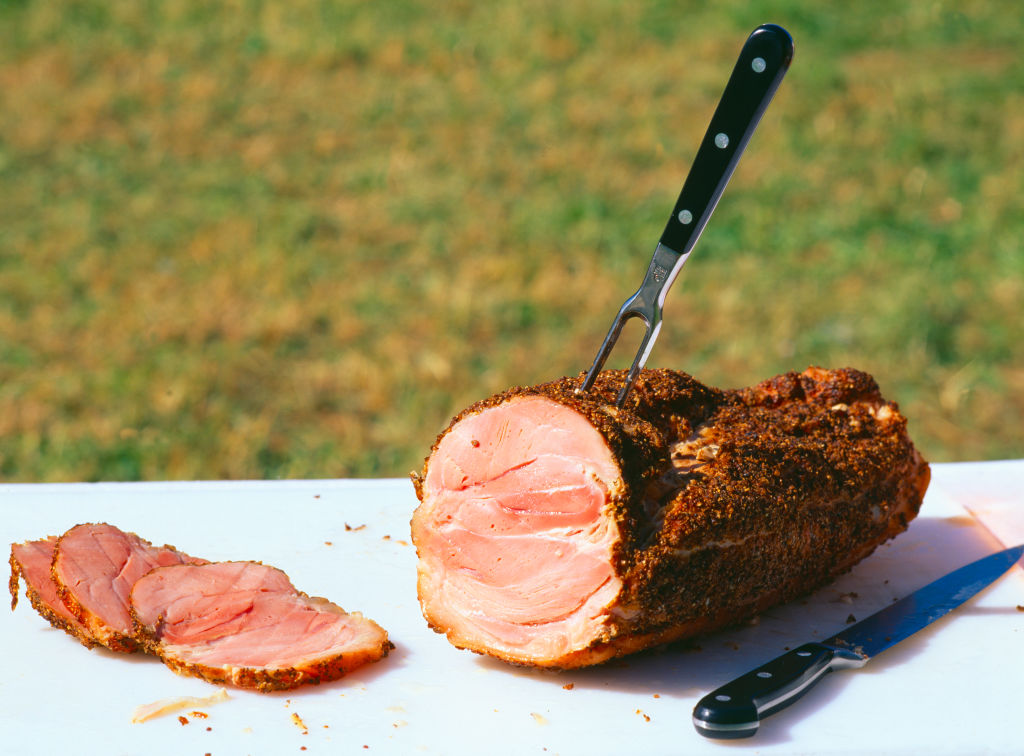
Easter is fast approaching, so of course I’m thinking about ham. This iconic centerpiece of the Easter dinner table isn’t usually associated with the barbecue pit – at least not anymore – but it’s time that changed.
Ham and barbecue have had a long and somewhat rocky relationship. Both have smoky roots in the early American colonies – especially Virginia – but they originated separately. Europeans had a long tradition of salting and air-curing hams, but that method proved insufficient for preserving pork in the hot, humid climate of the New World. The Virginia colonists started rubbing their hams with brown sugar and salt and hanging them for weeks in smokehouses instead of out in the open air.
These days we call that salt-cured, long-smoked meat “country ham,” but back then it was just “ham.” There was no need for the qualifier before the 19th century, when a new type of meat arrived on the scene. As major pork-packing centers such as Cincinnati and Chicago emerged, their large-scale producers adopted a “wet-curing” method. They packed hams and shoulders into tubs and poured over them a sweet and salty “pickle” made by boiling rock salt, saltpeter and sugar in water. The hams remained in the pickle for five to seven weeks before being removed, rinsed and hung for long enough in a smokehouse to impart a little wood-smoke flavor.
As more packing houses brought wet-cured “city ham” to the market, merchants began advertising the older style as “country ham.” Over time, packers concerned with efficiency dispensed with the extra step of smoking, some switching to using liquid smoke in the brine and others abandoning smoke flavor altogether. By the end of the 19th century, American ham had strayed far from its smokehouse roots.

In the 20th century, though, city hams returned to the smoke, thanks to cooks at barbecue restaurants. By the 1950s, ham could be found regularly on barbecue menus alongside smoked beef, ribs, pork and turkey. Often it was listed as “pit ham” to indicate that it was not a fresh cut of pork slow-cooked on the pit, but rather a fully-cooked city ham that was bathed in hardwood smoke for just a couple of hours, then sliced thin and served.
“Bar-B-Qued” ham, as it was also called, could be had alongside sliced beef and sausage at barbecue restaurants across Texas, and it was a regular companion to the famous ribs in Memphis. Perhaps no city is more ham-centric than Kansas City, where the item remains a barbecue menu staple to this day, at least at older restaurants.
My go-to order at Gates BBQ is the mixed plate, which delivers three “long end” ribs and piles of tender sliced beef and ham, all slathered in Gates’s signature orange-brown sauce. Ham is still on the menu at other classic Kansas City joints such as Arthur Bryant’s, LC’s, and Joe’s KC – at least for now.
Two decades ago, pulled pork – that is, pork shoulder cooked on the pit and pulled into shreds – was virtually unknown in Kansas City. But lately it has started creeping onto local menus, displacing pit-smoked ham in the process. You won’t find any ham at well-regarded newer restaurants such as Harp Barbecue, Q39 and Slap’s BBQ, which all offer pulled pork. In 2020, Plowboys BBQ stopped serving ham because, as the owner told Kansas City magazine, “something had to give to allow more room for other items growing in popularity.” Plowboys closed permanently two years later, though I can’t say for certain that it was due to the removal of ham.
Outside Kansas City, ham is less common as a barbecue meat, but you can still find it here and there. You can order “pit ham” on the weekends at Kreuz Market in Lockhart, Texas, while at Jack’s Bar-B-Q in Shreveport, Louisiana, it’s in the first position on the menu board. “Pit ham” is a staple alongside the iconic thin-sliced beef at Baltimore’s famous pit-beef stands, too.
As I see it, if you are planning to serve a sugar-cured ham this Easter, you should consider skipping the oven. Why not take a little inspiration from America’s old-school pitmasters and finish the holiday star on the smoker?
Be sure you have a fully cooked ham, not a fresh or uncured one. You’re really just getting the meat up to temperature while infusing it with rich smoke and activating the savory juices. Fire your pit or smoker with hardwood (hickory is a great choice) and keep it at a steady 275°F till the ham’s internal temperature has reached 140°F.
Some cooks glaze pit ham with a blend of honey, brown sugar and mustard, but I don’t find that necessary. (But if you do go down that route, brush on the glaze once the internal temperature hits 125°F.) I find pit-smoked ham is superb when accompanied by sweet and tangy Kansas City-style barbecue sauce – and even better with the bright yellow mustard-based sauce we love here in the Carolinas.
So, let’s ham it up this Easter. That holiday classic deserves to return to its historical roots and be finished with a big dose of barbecue smoke.


Comments