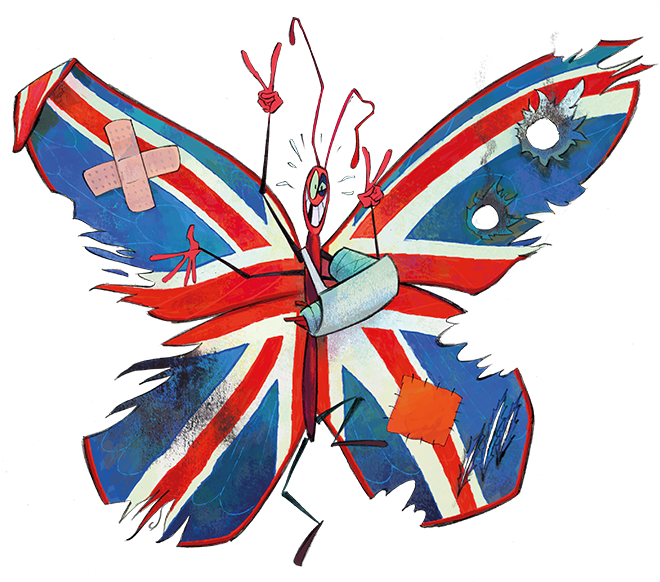


It may not feel or sound like it but Keir Starmer is a born-again Brexiteer. His achievements in office may be nugatory, his search for a legacy tragicomic, but there are countless actions this government boasts of which simply would not have been possible if we had stayed in the EU.
Earlier this year, Labour moved to protect our steel industry with a tariff package possible only because we have an independent trade policy. I was delighted this month when the minister in the Lords made it clear this was a Brexit benefit. Those same Brexit freedoms allowed the Chancellor last month to cut tariffs on more than 100 foodstuffs to ease the cost-of-living crisis. Both the Prime Minister and Chancellor have lauded trade deals with India and the US – arrangements with the world’s two largest democracies – more preferential than any the EU could secure.
And trade isn’t even the half of it. Relaxations of EU regulation in the City have brought new business. Operating outside the EU’s Digital Markets Act, our tech sector is outstripping continental neighbours. We have a decisive edge in AI and a globally respected AI Security Institute, which could not have been established in the EU. We are, albeit slowly, as Matt Ridley reports on page 18, developing gene-edited crops with higher yields and a less toxic environmental footprint. We have even imposed, as Bridget Phillipson delights in reminding us, VAT on private school fees. None of this would have been possible without Brexit.
I recognise that some of these steps may not be to your taste. But the key to all these policies is that we can, should we choose, amend, reverse or double down on them as we, the British people, wish. And that’s the biggest Brexit benefit of all: we are a full parliamentary democracy once more. We have taken back control.
We are a full parliamentary democracy once more. We have taken back control
Ten years on from that historic vote – when more of us voted for one single cause than have ever voted before or since – we have been told that Brexit is at best a tawdry and compromised achievement, a sentimental indulgence in nostalgia, haute gammonry at its worst and a self-inflicted wound that makes seppuku look like keyhole surgery.
Those who make that argument are the same people who told us that Brexit would usher in a cataclysmic recession, that it would make us Vladimir Putin’s poster child, that it would lead to the erasure of the City of London as a financial centre and a flight of talent that would leave Britain a yokel backwater. In short, the kind of experts from organisations with acronyms who have got things consistently wrong in the past.
The reality has been different: Britain is growing at least as fast as our major European partners (the countries growing fastest in recent years have been those which imposed the most savage austerity in the early 2010s). We took the lead among European nations in the fight against Russia when it invaded Ukraine. The City is flourishing: Britain remains the world’s largest net exporter of financial services, according to TheCityUK, an industry-led body representing UK-based financial and related professional services. Net exports were £84 billion last year, 12 per cent higher (in real terms) than in 2015. And however many masters there are in the universe, they still seem to be flocking to London. There were 162,000 people working in finance and insurance in the City of London in 2015, pre-Brexit, and 223,000 in 2024.
Could that growth have been more impressive? Of course. Is there still a long regulatory tail of EU legislation holding us back? Absolutely. But the choice to go further, faster is there – and can be exercised in a manner impossible while still in the EU.
It should also be noted, lest it be forgotten, that public services benefitted from our departure from the EU. The fastest vaccine roll-out in the world; much more than £350 million a week extra for the NHS; and a student exchange scheme (Turing) which is better value for money and more horizon-expanding than the Erasmus programme.
There are, of course, costs to being outside the EU. There are regulatory barriers to exports, which particularly affect agrifoods. But real as those costs are, they have been absorbed and adjustments have been made. The hit has been taken. And now the gains can be realised. We are coming out of the dip in the Nike swoosh.

Our food producers may have faced an additional, cruel and unnecessary risk premium with the government’s changes to inheritance tax on farms, but agriculture has a bright future. The reforms to the Common Agricultural Policy, again impossible in the EU, have stripped back bureaucracy, allowed greater flexibility in the wise use of aids to increase yield and shifted subsidy to support real environmental gains. All alongside the chance of a second green revolution in crop and livestock breeding. We now have a farming policy which is more pro healthy food production and more pro environment, setting a world-leading standard. The same applies to fisheries: we have been able to restore stocks to health and give the industry a future that would have been impossible without Brexit.
Brexit freedoms have not been exercised so wisely in every area. Taking back control of our borders was accompanied with the implementation of a points-based immigration system which enabled the inflow of many more workers, students and, crucially, dependents than the country ever envisaged or wanted. The higher-education, health and care sectors were already addicted to importing foreigners before Brexit – boosting vice-chancellors’ balance sheets and keeping labour costs low. This ‘human quantitative easing’ grew only worse in the years immediately after Covid.
But while migration policy was mismanaged, the tools are in our hands to correct, and reverse, that error. Net migration has fallen dramatically, following changes introduced at the end of Rishi Sunak’s premiership. Home Secretary Shabana Mahmood has pledged to accelerate that drive. And across every party, save the Greens, there is a commitment to tighten border controls yet further. We can exercise sovereignty over who can come to Britain, and who can stay in Britain, in a way we never could in the European Union. It is up to the current generation of politicians to put right the errors of implementation that occurred while I was in government.
Of course, there are other steps to take to ensure truly effective control of all migration, legal and illegal, chief among them reform of, or preferably withdrawal from, the European Convention on Human Rights and other, related, international obligations. But we could not even contemplate leaving the ECHR if we had not already left the EU. Not only would the taboo of departure from trans-national straitjackets still be there in our political culture, it would have been illegal. Every EU nation must abide by the strictures of the ECHR, even though the European Court of Justice itself accepts no superior jurisdiction.
It is still, perhaps, imperfectly understood how the ECJ constrains the freedom of any EU member state. Laws which are framed by the bureaucrats in the Commission – and which can be passed without any single state being able to veto them – are automatically translated into national law. Ten years ago, in this magazine, I explained how government ministers were asked every day if they assented to new laws being enacted in the UK and how, if they objected, which I did repeatedly, they were told there was nothing they could do about it. The process was too shabby and dishonest even to be called a farce. The people elected to govern in your name were, across huge areas of law–making, legislative eunuchs.
I believed then that it was fundamentally unhealthy, corrupting of our politics and debilitating to democracy, for ministers to run for election on the basis that they would bring change and then protest in office that they were prevented from doing so. I entered politics to bring change, not to be cucked by the EU constitution.
It is not, of course, the EU alone which constrained ministers. Over time parliament has ceded power to the courts, to quangos, to regulators and lobbyists, to the lanyard class and the legal establishment. There is an understandable anger at this failure and a growing impatience to sweep away the impediments to ministerial agency and government action. You see it across all parties, from the appeal Morgan McSweeney made to Labour to be an insurgent government, to Kemi Badenoch’s plans for the Public Sector Equality Duty, to Danny Kruger’s mooted Whitehall changes.
The hit has been taken. And now the gains can be realised. We are coming out of the Nike swoosh
Again, none of these arguments would have the urgency they possess, nor the possibility of success, without our departure from the EU. Asserting the fact once more that our elected parliament is sovereign, that it can set aside any other jurisdiction, competence or constraint, was the central, over-riding point of Brexit. Stay in the EU and you accept that, in the name of some greater good such as ‘influence’, you will acquiesce in the frustration of parliament’s, and the people’s, will.
And so the erosion of accountability continues. Which is why talk of re-joining is dangerous. Not so much because the promise of an instant ‘growth dividend’ is moonshine, though it is. Not just because the EU would demand Carthaginian terms for our re-entry – with increased contributions, a commitment to the euro and unrestricted free movement – although it would certainly make those demands, and more.
Not even because the ability to innovate in the growth industries of the future – tech, AI, life sciences, bioengineering and so on – would dissipate, although it would. But because re-joining would mean saying to the people of this country that they had neither the wit, nor the virtue, to make their own decisions. That, rather than politicians listening to the call for change and acting on it, ministers would prefer to willingly surrender the power to make a difference for good.
Brexit was a vote for a faster feedback loop between politicians and the people, the ability to yank the chain harder when ministers do not live up to their promises. That chain was yanked with great, cleansing, propulsive force in 2024 and I felt the spray. But that vote was not a repudiation of Brexit, it was its vindication. The failure I charted above to control migration, and indeed to go further, faster in re-building and re-balancing our economy, saw the Tories punished. Now it is proving Labour’s turn. The message from ten years ago – the demand that politicians change our society – has not diminished in force or fervour. That there is unfinished business is clear. But it is clearer still that Brexit alone makes that change possible.
Those who voted Leave knew it. They braved condescension and endured years of frustration to have it delivered. They must not be let down.



Comments