
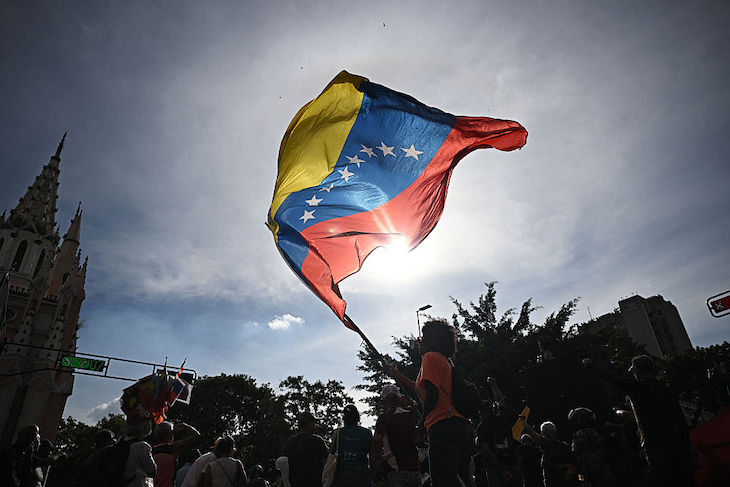
Will the Venezuela adventure end up like Afghanistan, or will it be another Iraq? In the eyes of most commentators, those seem to be the only options, both of which cost trillions of dollars and thousands of lives while achieving little, especially in the case of Afghanistan.
It is clear that if Venezuela is to be the success story that the White House would like to see, there can be no alternative to the Panama model
Some have also thrown in the example of the 2011 overthrow of Colonel Gaddafi in Libya, after which the rule of law collapsed, human trafficking thrived and instability spread across the region. One analyst even cited Operation Uphold Democracy of 1994, which deepened Haiti’s dependence on foreign aid and left it one of the most dangerous, unstable and impoverished states on Earth.
It would seem that prospects aren’t good for the Venezuelans. Having reported from that benighted country on the ground, I dug out the number of my local fixer. ‘Everyone was very anxious yesterday. The streets were empty,’ he told me over WhatsApp. ‘Today, we expect the same.’ It would be difficult to persuade anybody in the country to appear on my podcast, The Brink, he added, as the climate of fear was too intense.
They are right to be apprehensive. For some reason, however, most observers seem to have overlooked the most relevant historical example, which also happens to be the one that offers not just a blueprint for the rebuilding of Venezuela but a significant source of hope.
Let’s talk about Panama. On December 20, 1989, under the direction of George Bush senior, the United States invaded with overwhelming force and quickly toppled the authoritarian regime of General Manuel Noreiga, a convicted drugs trafficker, who had presided over a banana republic. So far, so similar.
Fast-forward to the present day and we find a thriving liberal democracy, one of the most stable countries in the region. Panama – which is separated from Venezuela only by Colombia – benefits from historically low inflation, high wages and the highest GDP per capita of any Latin American state.
Unemployment tends to be relatively negligible and despite ongoing challenges of corruption and political interference in the management of the state, the country is an outstanding success. How did this miracle unfold?
Answer: good planning. Immediately after Operation Just Cause, in which a force of 27,000 American troops overthrew Noriega in a matter of weeks, the postwar strategy was put into action under the codename Operation Promote Liberty.
Looking back at documents held by the Joint Chiefs of Staff that detail the campaign, three lessons for the Trump administration stand out.
Firstly, the nationbuilding phase began within days of the invasion, even before the fighting had ceased. The first men and women of the 96th Civil Affairs Battalion arrived in Panama on December 22 1989, just two days after hostilities had commenced; the last of the resistance would not be mopped up until the middle of January, by which time hundreds more American civilian experts were at work in the country. At that highly volatile moment, the way in which the United States gripped the levers of control early on was key to the smooth transition to stability.
With impressive speed, a humanitarian operation was rolled out. Over Christmas and New Year alone, less than a week after the invasion, government aid workers and special forces troops helped distribute 1,660 tons of food, mostly ‘meals ready to eat’, and 218 tons of medical supplies. A camp was quickly set up to house displaced persons, catering for 5,000 souls.
This would be a great help in Venezuela, which is already prone to collapse. While reporting from the country in the past, I have seen with my own eyes the huge queues outside poorly-supplied supermarkets, supervised by gangsters with automatic weapons; the children dying from cancer in hospitals that have run out of medication; and the families starving in the rural areas. Now that the regime has fallen, a plan for aid would seem urgent. Where is it?
In the Panamanian example, responsibility swiftly passed from General William W Hartzog, who had spearheaded the invasion, to the commander of the 96th Civil Affairs Battalion, with a detailed handover to his peacetime colleagues. This brings us to the second lesson: American meticulousness.
According to the documents, tasks given to civilian officials included: ‘Restore basic functions throughout Panama City, establish a police force, provide emergency food distribution, create a night watch using helicopters with spotlights, protect property, supervise Panamanian contractors in cleaning up the city, restore the production and distribution of newspapers, and develop a grassroots organisation to ‘sell’ the [new] government to the public.’
With a guerrilla insurgency still ongoing and looting becoming widespread, the task force commander worked with the newly appointed Colonel Roberto Armijo, of a fresh administration, to recruit volunteers for police duty.
Yet this was not carried out in a slapdash manner; candidates, most of whom were drawn from the ranks of regime policemen or soldiers, were carefully screened, and of the 400 men who put themselves forward, only 160 were accepted.
This thoroughgoing approach was reflected throughout the operation. Especial attention was paid, for instance, to what had become known since the Malayan Emergency as ‘winning hearts and minds’.
Psychological operations experts rolled out a strategy to persuade the public to back the new leadership, as well as convincing the guerillas of the futility of further resistance. According to the documents, the propaganda campaign was carefully designed according to a list of core messages:
‘US troops had deployed to protect the lives and property of US citizens; US troops would help [the new president] form a government responsive to the will and aspirations of the people; US differences were with Noriega, not with the Panamanian people; US forces would depart as soon as the new government could take over; the United States would reward those assisting in locating [old regime] leaders and weapons caches; and a reward of $l million would be paid for anyone apprehending Noriega and turning him over to US forces.’
As 1990 ticked on, unrest died down, confidence in the Americans grew and stability began to blossom. Moving at a rapid but sensible pace, the strategic focus moved to nation-building. At the time, there were nearly 17,000 US combat troops and 9,500 servicemen from Southern Command in the country. These were gradually redeployed, allowing technocrats to take the reins, supported by special forces.
The first stage of Promote Liberty had concentrated on public safety, health, and population control measures. Later, however, the Americans assumed responsibility for longer-term challenges facing the new Panamanian government, such as rebuilding commerce, winning public support for reforms, and restructuring the security forces into separate police, customs, and defence organisations.
That brings us to the third and final lesson for the Trump administration, which also happens to be the most important: commitment. Overall, the Americans remained engaged in Panama for about four-and-a-half years, requiring a huge investment of resources, both financial and in terms of personnel.
How did this miracle unfold in Panama?
With the benefit of hindsight, it was certainly worth it; the relative flourishing of Panama today is testament to that. At the time, however, rebuilding the shattered state was a significant drain on the federal budget.
It is clear that if Venezuela is to be the success story that the White House would like to see, there can be no alternative to the Panama model. It is true that there are significant differences between the two countries. Venezuela is 12 times larger than Panama, with six times the population, and the world is more multipolar and volatile than it was in the Nineties, not least thanks to the erratic style of the 47th president.
The three principles of speed, meticulous planning and long-term commitment, however, would be an indispensable part of any successful effort to usher that beleaguered, abused and beautiful land to an era of stability. Unless Trump is more interested in Greenland, of course.

Comments