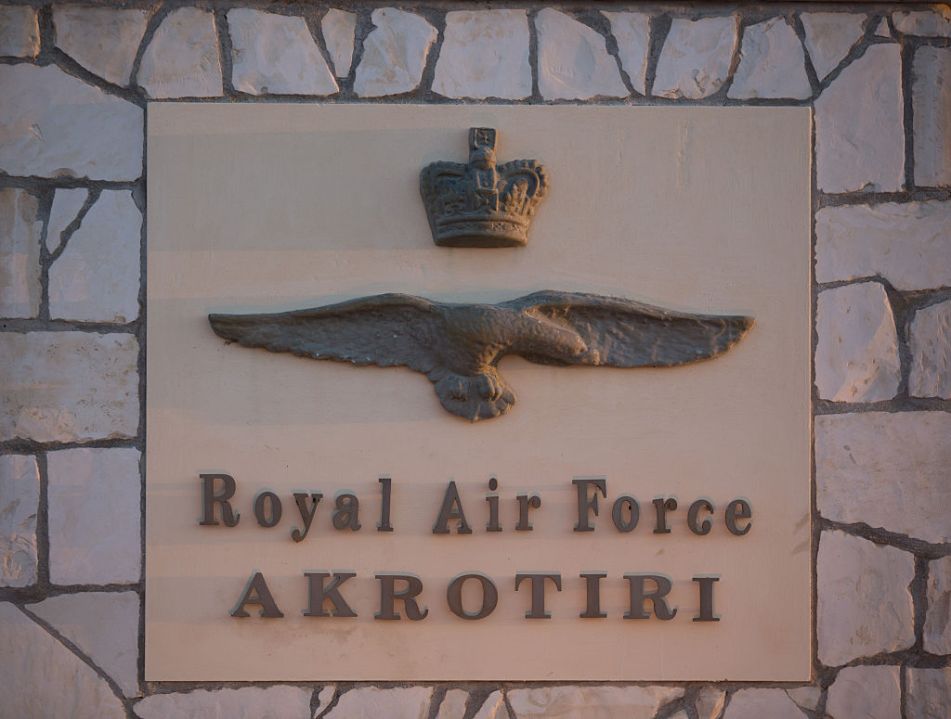
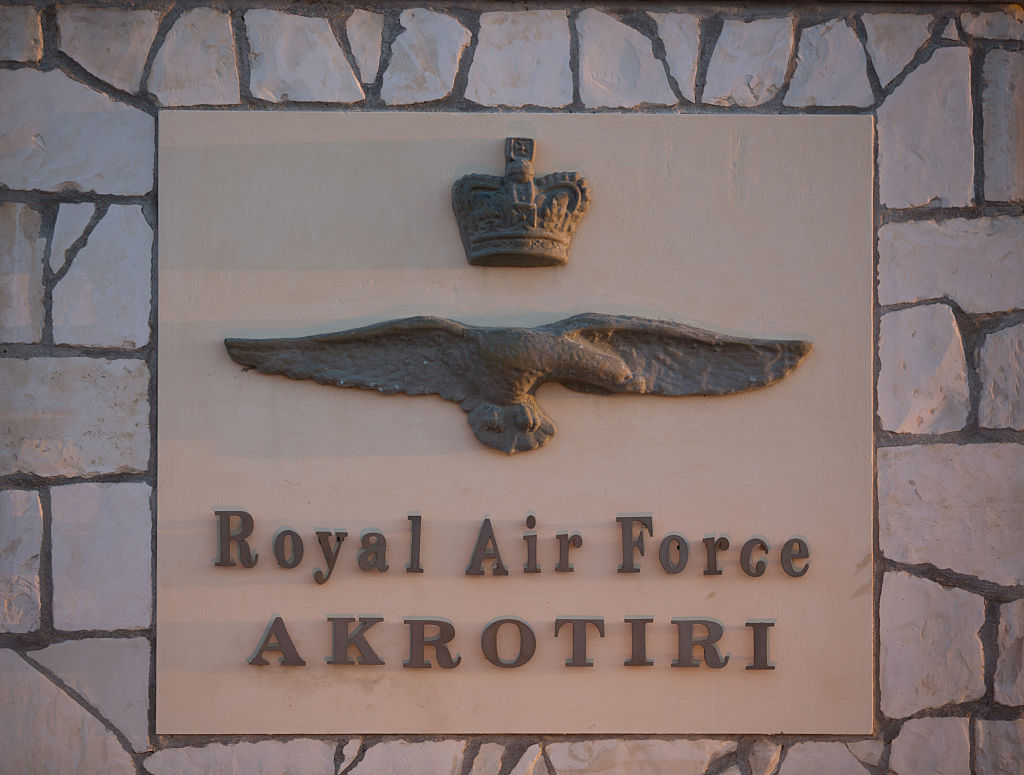
When RAF Akrotiri in Cyprus was targeted in an attempted drone attack on Monday, it didn’t just leave the British government open to accusations that it was slow to respond to events in the Middle East. It also led to criticism from those who would like to see the British overseas territory returned to the Republic of Cyprus.
The drone attack caused minor damage and no one was injured, but in the initial aftermath it was unclear whether it had been shot down by British forces on Cyprus, by Cypriot air defences or by an American warship in the area. The attack has led the UK government to send the warship HMS Dragon to Cyprus, although it will take at least a week to arrive there. As Tim Shipman revealed in this week’s magazine, questions will be asked about why military assets were withdrawn from the region ahead of the war.
Following the attack, the popular Cypriot daily Philenews argued that the British ‘presence endangers our country, our citizens’. Far from the British providing security, some see the drone attack as yet another example of the threat posed by having UK bases on the island. In 2024, Hezbollah threatened to attack Cyprus over the role of the bases in the Gaza conflict, and the Cypriot government suspects they are responsible for the drone attack this week.
This has emboldened Cypriots who have longstanding objections to the British presence on the island. Former Cypriot attorney general Costas Clerides renewed calls this week for talks about the British territories. He has argued that British operations ‘go beyond their operational framework’ and that Cyprus has every right to ‘request and demand renegotiation’ over the territories.
Clerides and his allies have been strengthened by the Chagos dispute. In 2019, the UN General Assembly adopted a resolution in favour of the International Court of Justice – which advised that Britain should hand over the Chagos archipelago to Mauritius. In response, the Republic of Cyprus’s representative to the UN, Polly Ioannou, welcomed the news. She argued that when it came to the decolonisation negotiations that led to the establishment of the bases, the ‘genuine will to part with some territory is a myth; coercion is always present’. Her remarks were just one of the many statements that alarmed those who feared the Chagos judgment could be used as a precedent beyond the British Indian Ocean Territory.
Akrotiri is one of two sovereign base areas – along with Dhekelia – which make up the British Overseas Territory located on the island of Cyprus. They are remnants of British rule over Cyprus – first leased from the Ottoman Empire and then later annexed following the Empire’s collapse after the first world war. The Republic of Cyprus agreed to the UK retaining the two territories during independence negotiations, finalised in 1960. Their independence document included security guarantees by three powers – the UK, Greece and Turkey – the latter of which ultimately used this as a pretext for invasion in 1974.
Beyond arguments against colonisation, the Turkish invasion in part explains some of the mixed feelings around the British territories. For Anglophiles on the island, the bases are the reason Turkish forces did not push further into the Republic to avoid a direct confrontation with a Nato ally. For opponents of the bases, Britain’s lack of help during the invasion demonstrated that the UK is only interested in using the territories to protect its own interests. These competing narratives continue to shape Cypriot politics today.
Perhaps this is one reason that Nicosia has not explicitly welcomed the move by the UK to send the warship HMS Dragon to the region, even though it has praised French and Greek moves to do the same. The delay in sending the warship hasn’t helped matters, with the Cypriot High Commissioner complaining on Sky News, that, ‘Greek forces are present… The French are coming. The least we expect is [that] the British are present.’ No wonder Defence Secretary John Healey flew to Cyprus this week in a bid to ease tensions.
The debate has been complicated by the fact that British overseas territories are technically covered by Nato’s umbrella, even though their status is legally complex and untested. It would remain at the discretion of the UK government to trigger Nato’s mutual defence clause should an attack on the territories occur. Similarly, it is unclear what the British reaction would be if Cypriot territory were hit but the British territories were the intended target. Perhaps this is why deputy Prime Minister David Lammy mistakenly referred to Cyprus as ‘part of Nato’ when appearing on BBC Breakfast this week.
What remains clear is that the attack on Akrotiri (and the debate over the use of Diego Garcia) has shown the strategic importance to Britain of its overseas territories. At the same time it has played into the hands of those who seek to use the Chagos deal as a blueprint for their own territorial disputes. This Labour government’s willingness to conclude the Chagos deal has already weakened our position. Now, these conflicts present a new paradox: the more operationally vital these territories become in the era of great power competition, the more politically contested they are likely to be.




Comments