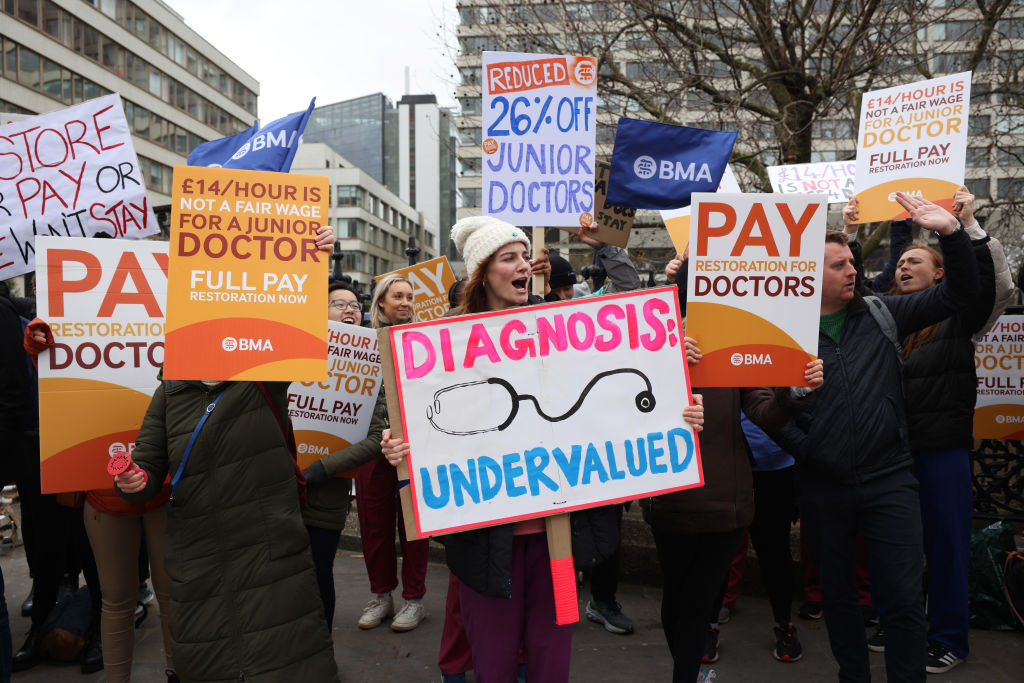
Immediately after the Easter weekend, junior doctors are planning a six-day strike. Unless they call it off, Starmer has said today, they’ll be punished. They have been offered a deal. On the table is an above-inflation pay rise, along with government funding for postgraduate exams that doctors have historically paid for themselves, and an offer of 4,500 additional specialty training places. ‘There are still 48 hours left to choose a better path,’ said Starmer. After that, the offer disappears.
The strikes are being driven by those who are most radical in support of state healthcare in its current model. Their struggle is likely to accelerate its collapse
The strangest part of this is not the pay offer but the training places, which ministers seem willing to conjure up or withdraw according to the needs of a labour dispute. On March 5 this year the Medical Training (Prioritisation) Act 2026 received Royal Assent, prioritising domestic graduates (and a few bizarre exceptions, like Liechtenstein and Ireland) for training jobs. The legislation was introduced to fix a disaster of the government’s own making, in which foreign applicants were displacing British graduates from the training posts required to turn newly qualified doctors into GPs and consultants. Our own doctors have been going unemployed as a result. Their misfortune might have been an acceptable human cost had anyone believed the system was meritocratic, that foreign doctors were better, and that their entry en masse was significantly improving the NHS.
Either the offer of an extra 4,500 training posts is absurd, or the threat to remove them is deranged. To create thousands of posts we did not need, simply to sweeten a pay dispute, would be extraordinary. To deny thousands of posts we do need, merely to punish the BMA, would be worse.
My fellow consultants view the strikes with weariness, and there seems no great support for the suffering of the junior doctors from the world at large. Nobody has drawn murals of superheroes taking the knee before young men and women in scrubs who aren’t as well off as their predecessors. Even those I work with don’t feel strongly about the strikes. All of them would like more money, and recognise that so would everyone else. Almost all of them continue to be excellent. Their daily company remains the highlight of my working life as a hospital consultant, and I worry whether standards stay high only from temporary inertia, and whether they might soon drop.
That first-rate candidates still apply to medicine is one of the strongest arguments that the state pays enough. Yet waiting for standards to fall would not be sensible. But even those juniors who feel strongly that they deserve more money, and take the drop in their pay relative to 2008 as a personal slight, generally tell me that they think this is not the right economic climate in which to be taking industrial action. The BMA is right to suspect that their support is wafer thin.
Starmer is right to push back. Junior doctor pay has declined in real terms, and some of their financial hardships have grown more acute than that drop explains. Junior doctors struggle to afford homes near their work, but so do many others; that is an argument for fixing housing, not for using NHS pay packets as a substitute for housing policy. Some difficulties are real, but not unique, and give no special right to public pity. Nor is the BMA’s widely reported new argument, apparently made in earnest, that a pay rise is urgent because of the war in Iran, likely to win them new friends.
The BMA’s negotiating committee has refused to put the government’s latest offer to its members. Turnout at the last strike ballot had fallen to 53 per cent, barely above the level required to make the walkouts legal. Back in February 2023, when the strikes started, it was more than three quarters. Starmer does not need to shift opinion by much to push support for the strikes below the level needed to keep them alive. From the point of view of keeping the dispute alive, the BMA is behaving rationally. From the point of view of internal democracy, honesty with its members, and the interests of patients, it isn’t.
There is a perverse symmetry in that the strikes are being driven by those who are most radical in support of state healthcare in its current model. Their struggle is likely to accelerate its collapse, costing the NHS money, degrading its performance, and eroding its support. The result of that, depending on what replaces it, may well be a system in which doctors earn more.
My current Easter plans are to be covering for the junior doctors for each day of their strikes, from 9 a.m. to 10 p.m. I will be paid well above my normal rates. Despite that, I would very much prefer to stick to my previous plans, which centred on re-potting my tomatoes and working through Henry Harris’s fine new cookbook from his Bouchon Racine. Once I sat on the BMA’s Junior Doctors Committee and would have had a say. These days I yell at clouds, cover their strikes and think of my tomatoes.



Comments