
Justin Marozzi has narrated this article for you to listen to.
Among examples used to demonstrate the law of unintended consequences is the possibly apocryphal ‘cobra effect’. British colonial administrators in Delhi once offered a bounty for dead cobras to control the city’s snake population. Enterprising Indians immediately started breeding cobras. When the British cottoned on and cancelled the bounty, the breeders released the snakes, resulting in even more cobras.
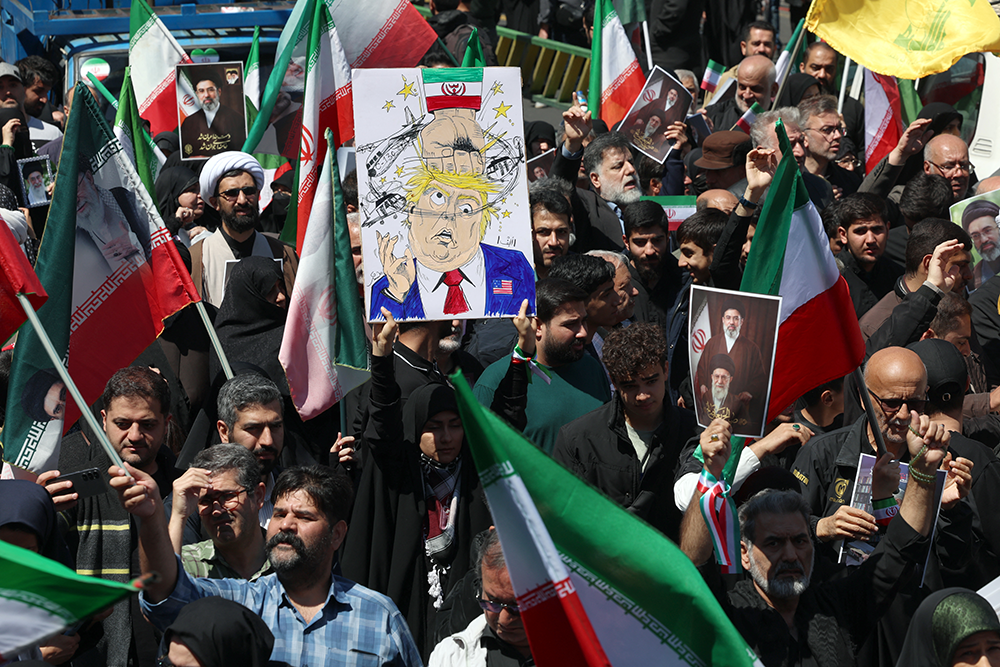
Donald Trump and Israeli Prime Minister Benjamin Netanyahu’s war with Iran may be having a similarly unwanted effect, only with a more dangerous cobra. Rather than removing a cornered regime, they have helped to strengthen it, elevating the influence of the powerful Islamic Revolutionary Guard Corps (IRGC) at the expense of both the Supreme Leader and his top mullahs.
‘The distinction between the IRGC and the state has become increasingly blurred,’ says Ali Alfoneh, a senior fellow at the Arab Gulf States Institute. ‘The Guards are no longer merely an institution benefiting from the state; in many respects, they have become an integral part of it.’ Ray Takeyh, senior fellow at the Council on Foreign Relations, considers the Guards ‘a state unto themselves’. While they still require some clerical cover and sanction for their brutality, the power balance has tilted in their favour.
It has a mafia-like control over the economy and increasingly determines parameters for US negotiations
If one institution in Iran has profited from the wars of 2025 and today, it is the IRGC. After two decades of taking control of Iran’s overstaffed, mismanaged and corrupt state-owned enterprises, it now has a mafia-like control over the economy, as well as being primus inter pares on security and, increasingly, determining the parameters for US negotiations. The assassination of Supreme Leader Ali Khamenei in February has only strengthened the Guards’ vice-like grip.
Kayhan Valadbaygi, fellow at the International Institute of Social History in Amsterdam, highlights two key signs of the IRGC’s enhanced position. First, the rise of parliamentary speaker Mohammad Bagher Ghalibaf, a former IRGC commander and father of Iran’s missile programme, within the negotiating track. Second, the appointment of General Mohammad Bagher Zolghadr, another IRGC veteran, as secretary of the Supreme National Security Council. IRGC figures are now front and centre of the bodies that determine Iran’s posture towards Washington.
Years of sanctions and smuggling have made the IRGC and its leaders enormously rich. Experts reckon it has a direct stake in upwards of 40 per cent of the economy, its indirect role extending to well over one half.
The seeds were planted in 1979, when Ayatollah Khomeini established a series of revolutionary-religious foundations, known as bonyads, to manage assets his government had expropriated. Exhibit A: Bonyad-e Mostazafan, the Foundation of the Oppressed, controlled by the Supreme Leader and affiliated with the IRGC. Today it is second in size only to the state-owned National Iranian Oil Company with upwards of 500 subsidiaries and interests in travel, transportation and tourism (skiing in the Zagros Mountains, anyone?), oil and gas, agriculture, food, power plants, property, industrial manufacturing and media.
One of the many tragedies for Iranians is that merely by going about their daily business they are enriching the people who have been oppressing them for half a century and recently machine-gunned them in the streets. Use a phone in Iran and you’re funding the Telecommunication Company of Iran and its mobile subsidiary, both controlled by the Etemad Mobin Consortium, an investment vehicle closely affiliated with the IRGC.
Bozorgmehr Sharafedin and Yeganeh Torbati’s superb book Stolen Revolution, published last week, is a study of how not to run an economy. It showcases the ghastly story of Said Rahmani, a global tech entrepreneur whose valiant efforts to bring start-ups to Tehran in the 2010s were ruthlessly thwarted by IRGC vultures who extorted and stole his companies in broad daylight.
Readers who deplore the dead hand of His Majesty’s Government on the British economy might spare a thought for those Iranians who must endure the depredations of a kleptocratic, blood-soaked IRGC. Where the UK has companies such as Serco hoovering up government contracts, Iran has ‘enterprises’ such as Khatam al-Anbiya Construction Headquarters, the IRGC’s engineering arm, which employs 135,000 and enjoys no-bid state contracts in oil, gas, rail, roads, tunnels, dams and pipelines worth tens of billions of dollars annually. Who do you think will win the contracts to rebuild Iran’s war-shattered infrastructure?
While presidents have come and gone, some reformist, others reactionary, the IRGC has risen from strength to strength regardless. Some, such as Mohammad Khatami (1997-2005) and Hassan Rouhani (2013-21), tried to clip the IRGC’s wings. Khatami’s effort to privatise more than 1,000 companies owned by bonyads failed spectacularly, as did his attempt to subject Setad-e Ejrayi, another gargantuan Khomeini foundation, to parliamentary oversight. As venal as it is opaque, Setad is one of Iran’s most powerful financial entities with assets estimated at $95-$200 billion. Other presidents, like IRGC veteran Mahmoud Ahmadinejad (2005-13) and Akbar Hashemi Rafsanjani (1989-97) entrenched and expanded IRGC’s economic clout, wittingly and unwittingly respectively.
The great question now is how will an IRGC-led Iran pursue negotiations with the US? Those predicting pragmatism may be disappointed. An ideologically indoctrinated IRGC, which considers the confrontation with the US a key stage in the final battle before achieving a new world order, will maintain a maximalist position, argues Ali Ansari, a professor of Middle East history at St Andrews University. ‘Anything short of a decisive victory will be regarded as a significant setback for the IRGC and its ideology. It therefore has an interest in prolonging the struggle.’
The Guards see talks less as a path to full normalisation than a way to ‘buy time, secure sanctions relief and protect the regime’s key military and regional interests’, says Saeid Golkar, professor of political science at the University of Tennessee at Chattanooga. Think a limited interim deal providing economic relief without requiring major concessions on Iran’s nuclear programme, missiles or regional role. The kind of deal, then, which is completely unacceptable to Washington.
None of this will make pleasant bedside reading in the US. Trump prides himself on his dealmaking abilities and repeatedly says the Iranians are begging for a deal. With energy costs spiralling, missiles once again flying between Israel and Iran, and the global economy heading into the buffers, perhaps now would be the time to clinch it.



Comments