It’s 4 a.m. on 25 June 1932. The sun hasn’t risen and the Maharaja of Porbandar is standing in his nightshirt in his suite at the Royal Palace Hotel in Kensington addressing a querulous gaggle of his compatriots. He’s the captain of the official Indian cricket team, which, in a few hours’ time, is due to start its first ever Test match in England at Lord’s, the game’s headquarters. But he hasn’t been well, or in any sort of cricketing form, so has recused himself from the on-field captaincy and given the job to his best cricketer, the prolific all-rounder C.K. Nayudu.
However, Nayudu is a Hindu commoner and his elevation to the captaincy has upset the delicate team balance between Hindus, Muslims, Parsees and Sikhs. Such differences are usually overlooked when the squad is led by a prince. But this time the players are unhappy at the maharaja’s delegation of responsibilities. Their concerns cannot easily be ignored, for this is arguably the most important day in the history of Indian cricket – the culmination of years of delicate negotiations which have brought an Indian Test team to Lord’s. If the mutiny succeeds, this aspiring cricketing nation will become a laughing stock. All the rumours about the pervasiveness of its ethnic divisions will be proved right.
This won’t just be bad for its cricket, but also for its political development. For while India is advancing on the cricket pitch, its constitutional future is being discussed in a series of commissions and round-table conferences where a leading issue has been how to represent the political demands of differing religions and ethnicities.
The British approach has been to develop a federal system which balances these various interests while maintaining the semi-autonomous position of more than 500 princely states, rich and poor, covering 40 per cent of India’s land area. But any deliberations have been overshadowed by developments outside the committee room – in particular, the popular success of the non-violent protest movement led by Mahatma Gandhi.
Britain’s hand in any negotiations has been restricted by the weight it has traditionally given to the princely states, which it has regarded as allies in the transmission of a measured approach to India’s future. And this cultural bias has taken hold of India’s nascent cricketing infrastructure and led it to the impasse at the Kensington hotel.
Ollie Randall deftly balances the cricketing and political elements of his story as he charts the sport’s development on the sub-continent. The game was initially taken up by the Parsee community in Bombay, which mounted the first Indian tours of England in the late Victorian era. With an assured command of his sources, Randall shows how, through imperialist vice-consuls with cricketing pedigrees such as Lord Harris, a former England captain, the Raj contrived to marshal growing enthusiasm for the sport to its ends. It hoped the spirit of fair play would ease the country’s progress to self-determination.
Among the good guys were the British businessman Raymond Grant Govan and his Goan secretary Anthony de Mello, whose Roshanara Club provided a physical centre for the game in Delhi. They promoted cricket by hosting visiting English teams and helping establish a Board of Cricket Control. This smoothed India’s progress onto the international stage and grew into the mega-rich BCCI which now dominates the game at home and abroad.
Several Indians read the room and began jockeying for position. One was ‘Ranji’, otherwise known as K.S. Ranjitsinhji, the Ram Nawab of Nawanagar in Gujarat, who had enjoyed a spectacular cricketing career at Cambridge University and Sussex. But he blotted his copybook with personal and financial scandals.
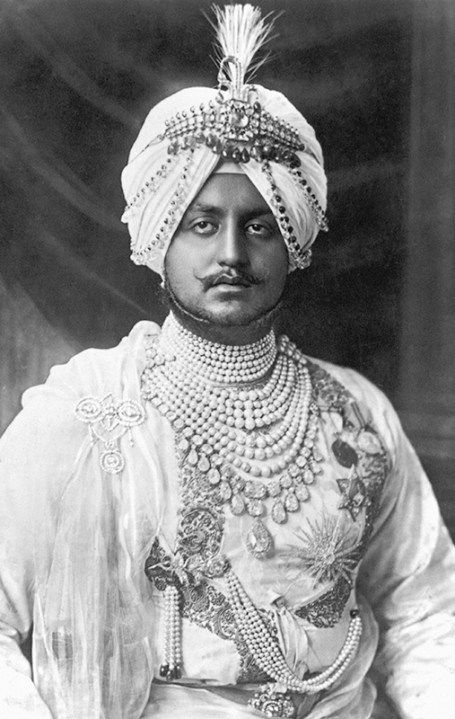
Bhupinder Singh, the Maharaja of Patiala in the southern Punjab, seemed fit to assume the mantle. He had fine cricketing credentials, having taken an unofficial Indian team to England in 1911, and was in line to lead the 1932 tour. But he splashed his money and his semen around; along with his 44 Rolls-Royces, he married ten times, and had a harem of 350 concubines, who bore him 88 children. Having overextended himself financially, he too made powerful enemies. They published a pamphlet, The Indictment of Patiala, accusing him, among other things, of rape and murder. Although the charges were unproven they diminished his reputation and ruled him out of any role in the Indian touring team.
So the Maharaja of Porbandar found himself in the job. If his cricketing skills were minimal (he made just two runs on the tour), he could manage people. Having averted his team’s pre-dawn mutiny, he was able to join 12,000 spectators at Lord’s and watch India’s opening bowlers reduce England’s best batsmen, including Herbert Sutcliffe and Frank Woolley, to 19 runs for three wickets. Although India’s success did not last, and they lost the match, they performed creditably throughout a lengthy tour, and Indian cricket, if not its politics, came of age.






Comments